
Offshore paysafecard casinos aimed at Australian players: what the deposit method does, and what it does not do, in 2026
A paysafecard voucher pays for a lot of things online. It was not designed to put online casino games within reach of Australians, and accepting it does not make an offshore site any less prohibited under the Interactive Gambling Act. The two halves of that statement sit at the centre of this guide: how the payment method actually works at the checkout, and what the Australian regulator has done about the offshore brands that advertise it to local players.

Data current as of 29 October 2026 and cross-checked against the Australian Communications and Media Authority’s published register of blocking requests and formal warnings.
Table of Contents
- What paysafecard is, and how it ends up at an offshore casino checkout
- Where the law sits, and where it bites
- Where responsible play sits, and what it does not cover at an offshore site
- How the shortlist is built, and which criteria actually separate one option from another
- RocketPlay
- Level Up Casino
- Woo Casino
- Spirit Casino
- National Casino
- Bizzo Casino
- Ignition Casino
- Instant Casino
- Jackbit
- Casino Intense
- Sky Crown
- How fast a paysafecard deposit actually clears
- What a paysafecard purchase does and does not protect
- How fast the regulator has moved, in numbers
- The 2026 reform bill, in one paragraph
- Tax, briefly
- Where a player should land
- Frequently asked questions
What paysafecard is, and how it ends up at an offshore casino checkout
paysafecard is a prepaid e-money product. A buyer walks into a sales outlet or pays online, hands over cash or a card, and walks out with a 16-digit code. That code is entered at an online checkout in place of a bank account or a card number. There is no card swipe, no card imprint, no name on the file. The product was founded in Vienna in 2000, was bought by Skrill in 2013, and now sits inside the Paysafe Group — the same company that runs Skrill and Neteller. Paysafe Prepaid Services Limited, the issuer, is regulated by the Central Bank of Ireland.

Vouchers are sold in denominations from 10 to 100 euro (or the local-currency equivalent) at more than 600,000 outlets worldwide, including Australian newsagents, petrol stations and supermarkets. The 16-digit code functions as prepaid e-money; from the second month after purchase, an unused balance starts to attract a monthly maintenance fee, so a code that sits unused slowly bleeds value.
The product is genuinely useful for the things it was built for: small online purchases where a buyer does not want to share bank details, or where a buyer cannot get a card. It is also one of the deposit methods that offshore casino sites marketed to Australians most often list on their cashier pages.
Why an offshore site lists it at all
An offshore brand lists paysafecard because it widens the deposit funnel. A player without a debit card, without a bank transfer capability that the bank has not blocked, and without an e-wallet the casino still accepts, can still walk into a newsagent and buy a voucher. The casino gets the money instantly; the player gets a deposit receipt.
What the casino does not get is a player identity that survives an Australian know-your-customer check, because the voucher does not carry one. That gap is part of the pitch — anonymity is a feature for the buyer — and it is the reason offshore brands add paysafecard to the cashier rather than treating it as an afterthought. It is also the reason the same brands appear again and again on the ACMA’s published action list.
Where the law sits, and where it bites
The Interactive Gambling Act 2001, strengthened by the 2017 amendments, makes it an offence for an operator to provide online casino games, online pokies or in-play betting to a person who is physically in Australia. No state or territory issues a licence for those products. What is licensable is wagering on races and sport placed before the event, lotteries and keno — in practice licensed by the Northern Territory Racing and Wagering Commission.
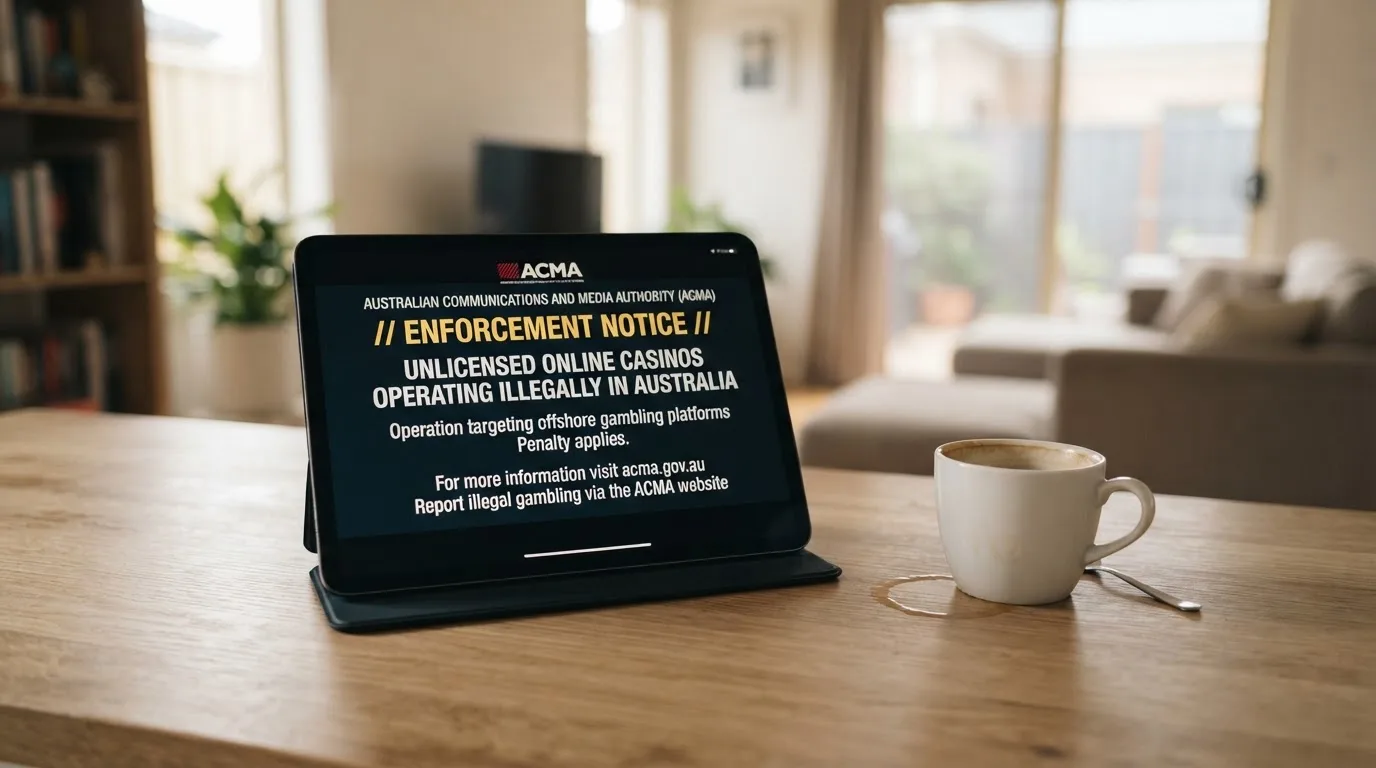
The ACMA investigates, issues formal warnings to operators and asks Australian internet service providers to block websites. According to the ACMA as reported in June 2026, a total of 1,751 illegal gambling and affiliate marketing websites had been blocked since the first blocking request in November 2019, and more than 230 unlicensed gambling services had left the Australian market since enforcement was strengthened in 2017. In a round reported the same day, 12 more sites were added to the blocking list: 7Signs, ChromaBet, Donbet, Duospin, Freshbet, Slots Gem, Jacks Club, Lucky Start, Pointsbetz, Spinrise, Vinyl Casino and Wildsino.
H2 Gambling Capital’s 2025 report puts annual losses to illegal sites at around A$3.9 billion, and records that the share of gambling going through legal channels fell from 74% in 2021 to 64%. The individual player is not prosecuted — the IGA targets the provider — but an offshore site gives no Australian consumer protection, no complaints body and no recourse if a withdrawal is refused. A site can be blocked with a balance still on the account.
What an Australian-licensed wagering site looks like instead
The licensed wagering channel is the comparison that makes the offshore pitch legible. Sportsbet, Bet365 and Ladbrokes are licensed in the Northern Territory; 52 online bookmakers sit with the NTRWC. Credit cards, credit-related products and digital currency are banned as payment for licensed online wagering since 11 June 2024, with penalties up to A$247,500 for operators. The legal deposit routes are debit card, bank transfer, PayID/Osko and BPAY. The licensed environment has a deposit method set and a regulator; the offshore environment has neither.
Where responsible play sits, and what it does not cover at an offshore site
BetStop, the National Self-Exclusion Register, has been live since August 2023. A player who registers is excluded from Australian-licensed online and phone wagering services. An offshore casino is not connected to BetStop, so the same self-exclusion does not bind it. A player who registers with BetStop and then deposits at an offshore site has used the register as it was designed — and the offshore site will still take the deposit.
The National Gambling Helpline on 1800 858 858 is free, runs 24/7 and offers chat through Gambling Help Online. Those services are useful wherever the problem sits, including at an offshore site. They do not freeze a balance, do not adjudicate a complaint and do not get a withdrawal unstuck.
The bank side is worth understanding because it shapes what a player can and cannot do at the cashier. Westpac’s gambling block works at card level: it refuses authorisation of transactions registered under the merchant category code “Betting/Casino Gambling” on eligible personal credit and debit cards. ANZ offers a comparable block in its app, with a 48-hour cool-down before the block can be removed and an honest warning that not every gambling transaction will be blocked and some non-gambling transactions might be blocked in error. ANZ’s block also catches Gambling Transactions made through a digital wallet such as Apple Pay on an eligible card, not just the physical card.
paysafecard sits outside both systems. The merchant code is whatever the casino’s payment processor assigns, not the bank’s “Betting/Casino Gambling” code, and the voucher carries no card to attach a block to. That is the feature and the limitation, and a player who relies on a bank gambling block to control spending has already lost the tool the moment a paysafecard voucher is bought at a newsagent.
Spending limits and the prepaid ceiling
The natural ceiling is the voucher denomination itself: 10 to 100 euro, or the Australian-dollar equivalent. A player can buy several vouchers a day, and a player who wants to lose more will. The product has no cumulative limit, no daily maximum, no cool-down between purchases. It is a wallet, not a budget.
Paysafe charges a monthly maintenance fee on an unused balance from the second month after purchase. A voucher bought on impulse and forgotten does not stay full; it bleeds value slowly until it is empty. That is a cost a player pays for not spending, which is the wrong way around for a budget tool.
How the shortlist is built, and which criteria actually separate one option from another
Any shortlist of offshore casino sites that accept paysafecard from Australian players is, by definition, a shortlist of prohibited services. A list that ignores that fact is dishonest, and a list that treats it as a tiebreaker misses the point. The first cut is therefore the regulator’s record: a brand the ACMA has acted against is on the list for that reason, and a brand that has not been acted against is on the list because the absence of action does not equal legality. No site on the list below is licensed in Australia for online casino games.
The second cut is what the cashier actually does at the Australian end. A brand that lists paysafecard as a deposit method but routes the actual transaction through a Skrill or Neteller wallet that is then refused at the Australian bank is not accepting paysafecard in any meaningful sense; it is accepting a click that ends in a declined payment. The published cashier page is the starting point, not the answer.
The third cut is the protection gap. An offshore brand does not connect to BetStop, does not sit with the NTRWC, and does not answer to the ACMA in the same way an Australian-licensed wagering provider does. A player who understands that gap is making an informed choice; a player who reads past it is not.
The criteria that matter at the checkout
- Whether the published cashier lists paysafecard as a deposit method and not just a click-to-Skrill redirect.
- Whether the casino’s payment processor exposes the transaction as gambling to the buyer’s bank or wallet, which determines whether a bank’s gambling block fires.
- The minimum and maximum deposit per voucher transaction.
- The withdrawal route — a deposit by paysafecard does not always unlock a withdrawal by paysafecard, and a forced withdrawal into a bank account or a card is its own refusal risk.
- The dispute route. A paysafecard chargeback exists, but it runs through Paysafe’s own terms, not through the ACMA, and not through an Australian external dispute resolution scheme.
The criterion the operator write-ups below emphasise
The write-ups below cover each brand the ACMA itself has published a formal warning for. The licence line for every one of them reads the same: no online casino licence exists in Australia for the products they sell. The useful comparison is therefore not “who is licensed” — none of them are — but “which ones have already been the subject of regulator action, what was the operator named, and which deposit method the listings report”. That is the comparison the table at the head of this section makes.
Landscape of operator and regulator action
| Brand | ACMA action and date | Operator named by the ACMA | Paysafecard support as listings report it |
|---|---|---|---|
| RocketPlay | Formal warning, March 2026; earlier Dama N.V. action in May 2022 | Pulsup Ltd (Rocketplay) | No listings evidence |
| Level Up Casino | Formal warning, May 2022 | Dama N.V. | Westpac listings reference |
| Woo Casino | Formal warning, March 2025 | Dama N.V. | No listings evidence |
| Spirit Casino | Formal warning, May 2025 | Dama N.V. | No listings evidence |
| National Casino | Formal warning, July 2025 | Consolutetish S.R.L. | AUSTRAC and reference listings |
| Bizzo Casino | Formal warning, July 2025; earlier TechSolutions action in 2022 | Consolutetish S.R.L. | No listings evidence |
| Ignition Casino | Formal warning, July 2025 | Bamboo Media | No listings evidence |
| Instant Casino | Formal warning, February 2025 | EOD Code SRL | Ecopayz and PayID listings |
| Jackbit | Formal warning, April 2026 | Ryker B.V. | No listings evidence |
| Casino Intense | Formal warning, April 2025 | Sterplay Holding Ltd | AUSTRAC, ITnews and NAB listings |
| Sky Crown | Formal warning (ACMA, September 2022) | Hollycorn N.V. | No listings evidence |
Comparison of deposit channels
| Channel | Legal Status | Payment Methods | Regulator |
|---|---|---|---|
| Licensed Wagering | Legal | Debit, Bank Transfer, PayID/Osko, BPAY | NTRWC |
| Offshore Casino | Prohibited | Variable (often includes Paysafecard) | None |
The “Paysafecard support” column reports what Australian-facing listings say about the brand’s cashier. Where the column shows “No listings evidence”, the omission is the data: the research consulted Westpac’s gambling block page, AUSTRAC, the NAB gambling block page, PayID, ecopayz and ITnews, and none of them carried paysafecard specifically as a listed deposit method for that brand. Where the column shows “listings”, it names the sources the listings came from and nothing more; it does not confirm that a paysafecard deposit will actually settle.
RocketPlay
The ACMA issued a formal warning to Pulsup Ltd over Rocketplay in March 2026; an earlier Dama N.V. action over Rocketplay sat inside a six-brand warning from May 2022. The same operator name appears twice in the regulator’s record, separated by four years, which is itself a piece of information about the brand’s posture. There is no Australian licence for online casino games, and the site is not connected to BetStop. The listings the research consulted did not carry paysafecard as a deposit method for this brand, so the “paysafecard casino” framing sits in the marketing, not in the data. A player drawn to RocketPlay by the deposit-method label should know that the label is what the page promises and what the regulator has acted against is the page’s actual product.
Level Up Casino
Level Up was inside Dama N.V.’s May 2022 warning. The same Dama N.V. vehicle has been the subject of ACMA action repeatedly since — Woo Casino in March 2025, Spirit Casino in May 2025 — which makes Level Up one entry in a pattern rather than a one-off. Westpac’s gambling block listings carry a reference for this brand; that reference exists because the bank’s block treats the merchant code the casino’s processor assigns as a gambling transaction, not because the bank endorses the site. The cashier’s published list of deposit methods does not survive a Westpac block at the card, and a paysafecard purchase that walks around the card has already done what the block was meant to prevent.
Woo Casino
Woo Casino was the subject of an ACMA formal warning to Dama N.V. in March 2025. It joined a long list of Dama N.V. brands the regulator has had to name. The research did not turn up paysafecard as a published deposit method in the Australian-facing listings for this brand, which means the deposit-method label on the cashier page is either conditional on country, conditional on KYC status, or simply not present in what the listings captured. A player who needs paysafecard specifically should not assume a brand on a comparison list is one of them.
Spirit Casino
Spirit Casino sits with the May 2025 ACMA warning to Dama N.V. — the same operator vehicle that has been the subject of three formal warnings in 18 months. Our research did not identify any evidence of paysafecard support for this site. The repeated operator name is the comparison that matters: a player who weighs Spirit Casino against a brand under a different operator vehicle is comparing how many times the regulator has had to write to the same parent, and that is a different calculation from comparing bonus headlines.
National Casino
National Casino was the subject of a July 2025 formal warning to Consolutetish S.R.L. AUSTRAC and reference listings carry an entry for the brand. The same operator vehicle was named in the same July 2025 round over Bizzo Casino, which means Consolutetish S.R.L. has joined Dama N.V. on the regulator’s repeat-offender list. A player comparing two offshore brands on the same parent operator is not comparing two brands; they are comparing two front doors to one operation.
Bizzo Casino
Bizzo Casino carries two regulator entries: the July 2025 warning to Consolutetish S.R.L., and an earlier 2022 warning to TechSolutions (CY) Group Limited and TechSolutions Group N.V. The same brand, two different operator vehicles, two warnings four years apart. The research did not find paysafecard in the consulted listings for this brand. The arithmetic is not subtle: a brand the regulator has had to write to twice is a brand the regulator has had to write to twice, and a third letter is a credible next step rather than a surprise.
Ignition Casino
Ignition was the subject of a July 2025 ACMA warning to Bamboo Media. We found no data indicating this brand currently supports paysafecard. A brand aimed at Australian players that does not appear in the Australian-facing listings the consulted sources capture is either a brand that has stopped pursuing the Australian market, a brand that has been quietly de-listed, or a brand that the listings do not cover. None of those readings improves the picture.
Instant Casino
Instant Casino was the subject of a February 2025 ACMA warning to EOD Code SRL. Ecopayz and PayID listings carry a reference for this brand. The PayID reference is itself a warning sign: paying to a PayID shows the account holder’s name before the transfer is sent, and AP+ warns that being asked to transfer money to a PayID on an illegal gambling site almost certainly means a scam site. A PayID reference attached to a brand the ACMA has acted against is the regulator’s picture and the payment system’s warning sitting on the same page.
Jackbit
Jackbit was the subject of an April 2026 ACMA warning to Ryker B.V., which also covered CasinOK. The warning is the most recent on this list by several months. Our research did not verify the presence of paysafecard on this casino’s payment menu. A brand that the regulator has had to write to within the last few months and that the consulted listings do not show a paysafecard deposit route for is the brand least likely to be the one a player was looking for, and most likely to be one the marketing redirected them toward.
Casino Intense
Casino Intense was the subject of an April 2025 ACMA warning to Sterplay Holding Ltd. AUSTRAC, ITnews and NAB listings carry a reference for this brand. NAB’s gambling block, like Westpac’s, refuses authorisation of transactions registered under the “Betting/Casino Gambling” merchant code; the listing reference exists because the bank’s block has been tested against the brand, not because the bank endorses it. A player whose bank is NAB and who tries to deposit by card has already hit the wall; a paysafecard purchase walks around it.
Sky Crown
Sky Crown was the subject of a formal warning to Hollycorn N.V. (with Blue Leo), published by the ACMA in September 2022. There is no publicly verified data indicating that this brand currently supports paysafecard. The 2022 date is worth keeping in mind: this is one of the older entries on the list, and the regulator’s record since has not softened.
How fast a paysafecard deposit actually clears
Paysafecard’s value at the cashier is that it clears instantly. The buyer hands over cash at the outlet, walks out with a 16-digit code, enters it at checkout, and the balance is on the casino account before the page reloads. The transaction is not a card authorisation and not a bank transfer; it is a prepaid code lookup against Paysafe’s balance database.
That speed is the reason offshore sites list the method. It is also the reason it is not a slow-paced payment that gives a player time to reconsider between the moment of decision and the moment of deposit. A bank transfer via Osko can take under a minute at a participating Australian bank, 24/7, including weekends, and arrives addressed to a BSB and account number or to a PayID — but it is still a transfer the player has to authorise in the banking app, with the account holder’s name visible at the PayID step. A paysafecard voucher is a code on a slip of paper. The friction is different, and so is the moment of friction.
The withdrawal side is where the speed picture reverses. A deposit by paysafecard does not always unlock a withdrawal by paysafecard. Many offshore casinos force the first withdrawal back to a bank account or a card, which means the player who deposited anonymously is asked to identify themselves at the moment they want their money out. A refusal at that step is the practical end of the protection story.
What a paysafecard purchase does and does not protect
The product’s pitch is the absence of a card or a bank account in the transaction. That absence is real, and it is useful for a buyer who wants to keep a card number away from a merchant. It does not protect the buyer against a merchant that takes the money and does not pay out.
Paysafe’s own terms govern disputes, and they run through Paysafe, not through the ACMA and not through an Australian external dispute resolution scheme. A chargeback route exists inside the Paysafe framework; it is not the same as an AFCA complaint, an ACMA referral, or a BetStop exclusion. The buyer has paid cash for a code, the code has been redeemed at the merchant, and the buyer is now in a customer-service dispute rather than a regulatory complaint.
That is the cost the marketing does not name. “Anonymous deposit” is a true statement about the card and the bank; it is not a statement about who answers if the withdrawal is refused.
The supplementary protections the buyer does not get
- No AFCA complaint route for an offshore operator that is not a member of an Australian EDR scheme.
- No BetStop coverage for an offshore site, because BetStop binds Australian-licensed wagering services.
- No ACMA complaint adjudication; the ACMA acts against the operator, not in favour of the player.
- No AUSTRAC recourse at the player level, even where AUSTRAC listings carry an entry for the brand.
- No PayID protection at the deposit step, because paysafecard is not a PayID transfer and the PayID warning does not apply.
The supplementary protections the buyer does still have
- A bank’s gambling block at the card, for any deposit that the casino’s payment processor routes through a card.
- A bank’s gambling block at the digital wallet, where the block is configured to catch Apple Pay or Google Pay on an eligible card.
- The Paysafe dispute route, which exists, is in writing, and gives the buyer a documented complaint rather than none.
- The National Gambling Helpline on 1800 858 858, free, 24/7, with chat through Gambling Help Online.
- The right to register with BetStop for the licensed wagering channel, which does not cover offshore but does cover everything the licensed channel does.
How fast the regulator has moved, in numbers
The arithmetic below uses the ACMA’s own published figures. The first blocking request was issued in November 2019; the running total of blocked sites reported in June 2026 was 1,751. Spread across the months between November 2019 and June 2026, that is roughly 22 sites added to the blocking list per month on average across the period. The figure is an average: some months carry a 12-site round, some months carry nothing, and the long-run rate is what the cumulative count gives.
The June 2026 round alone added 12 more names to the list. At that single-round pace, the regulator’s blocking output has been comparable to its long-run average in one announcement. The rate at which sites move from the open internet to the blocked list is therefore not a slow drift; it is the regulator’s working pace.
What the rate means in practice for an offshore site
A site that is not on today’s blocking list can be on tomorrow’s. The list is a moving target, and a balance held at an offshore site is a balance held at an address that may stop resolving within the same week. The blocking rate is the answer to the question “how long does an offshore site remain reachable from an Australian internet connection”. The 22-per-month average is the working number.
The H2 estimate and what it implies
H2 Gambling Capital’s 2025 estimate of A$3.9 billion lost annually to illegal gambling sites in Australia is a market-size figure, not a player count. The decline in legal-channel share from 74% to 64% between 2021 and 2025 is the comparable trend: illegal channels have taken ten points of share in four years. The blocking rate is the regulator’s response; the share movement is the problem the response is sized against.
The 2026 reform bill, in one paragraph
The Interactive Gambling Amendment (Gambling Reform) Bill 2026 passed Parliament on 19 August 2026. Its advertising and inducement measures commence on 1 January 2027, which means the law is on the books but not yet in force on a 2026 page. The bill addresses advertising and inducements rather than the offshore prohibition itself, so the underlying illegality of the product does not change on this page; what changes is the way licensed Australian operators can market what is already legal.
Tax, briefly
Gambling winnings of a recreational player are not assessable income under section 6-5 of the ITAA 1997, and losses are not deductible. A person who carries on a business of gambling is on a different model, and the ATO is the right reference for that case. The tax side is the simplest part of this picture and the part that does not change between onshore and offshore.
Where a player should land
The cleanest summary is this: an offshore casino site that lists paysafecard at the cashier is selling a product that cannot be licensed in Australia, and the deposit method does not change that. A player who understands the gap is choosing with eyes open; a player who reads past the gap is not.
For the player who has decided to play anyway, the comparisons that matter are the ones the table above makes legible — which brands the regulator has acted against, which operator vehicles have been warned repeatedly, and where the consulted listings do and do not show paysafecard as a working deposit route. None of those comparisons turn a prohibited product into a permitted one. They do tell the player what they are buying.
For the player who wants the protections the offshore channel does not offer, the licensed wagering channel is the answer. Sportsbet, Bet365, Ladbrokes and the rest of the 52 NTRWC-licensed bookmakers sit inside the regime the ACMA, BetStop and the bank’s gambling block were built around. paysafecard is not the deposit method that channel uses; debit card, bank transfer, PayID/Osko and BPAY are. The trade is real, and the player’s choice is which side of it they want to be on.
Frequently asked questions
Is it legal for an offshore casino site to accept paysafecard from an Australian visitor?
No. The Interactive Gambling Act 2001 prohibits providing online casino games, online pokies or in-play betting to a person in Australia, and no state or territory issues a licence for those products. Accepting paysafecard does not change that, because the prohibition sits with the provider, not the payment method. The ACMA has issued formal warnings to operators on this basis and has asked ISPs to block sites.
How quickly does a paysafecard transaction typically settle?
A paysafecard deposit clears at the cashier as soon as the 16-digit code is entered and validated against Paysafe’s balance database — the deposit is credited to the casino account before the page reloads. The withdrawal side is slower: a deposit by paysafecard does not always unlock a withdrawal by paysafecard, and a forced withdrawal into a bank account or a card is a separate, slower process.
Does using paysafecard offer any buyer protection if an offshore site refuses to pay out?
Paysafecard’s protection is the absence of a card or bank account in the transaction; it is not protection against a merchant that takes the money and does not pay out. Disputes run through Paysafe’s own terms, not through the ACMA and not through an Australian external dispute resolution scheme. An offshore site gives no AFCA complaint route and no BetStop coverage, so the practical protection is a Paysafe customer-service dispute rather than a regulatory complaint.
Can paysafecard be used to fund a licensed, land-based venue in Australia the same way it’s used online?
paysafecard’s product is an online 16-digit code spent at online checkouts; it is not a mechanism for funding a land-based venue. A licensed Australian wagering service — a sports bookmaker or a lottery — accepts paysafecard at its online checkout where the operator’s cashier lists it. The deposit methods the licensed channel is built around are debit card, bank transfer, PayID/Osko and BPAY, with credit cards, credit-related products and digital currency banned since 11 June 2024.
What deposit limits are commonly attached to paysafecard at offshore casino sites?
The natural ceiling is the voucher denomination itself — 10 to 100 euro, or the Australian-dollar equivalent — because the product is a prepaid code and not a wallet. There is no cumulative daily limit, no purchase cool-down and no KYC ceiling at the point of sale, so a player who wants to deposit more simply buys more vouchers. The monthly maintenance fee from the second month after purchase is the only automatic cost the buyer incurs, and it applies to balances left untouched rather than to balances spent.
Why might a bank block a paysafecard transaction flagged as gambling-related?
A bank’s gambling block sits at the card level and refuses authorisation of transactions registered under the “Betting/Casino Gambling” merchant category code. A paysafecard purchase is not a card transaction and is not a merchant-coded transaction in the same sense; the voucher is redeemed against a Paysafe balance, and the casino’s merchant code is whatever the payment processor assigns. A bank block therefore does not fire at the voucher step, which is the feature of the method and the limitation of the bank’s tool, and a player who relies on the bank block to control spending has already lost that tool the moment a voucher is bought at a newsagent.