
Pokies in New South Wales: Licensed Venues, Regulatory Pressure, and the Offshore Sites the ACMA Keeps Warning
Updated as of 29 October 2026 and verified against the ACMA’s register of formal warnings and blocking actions.
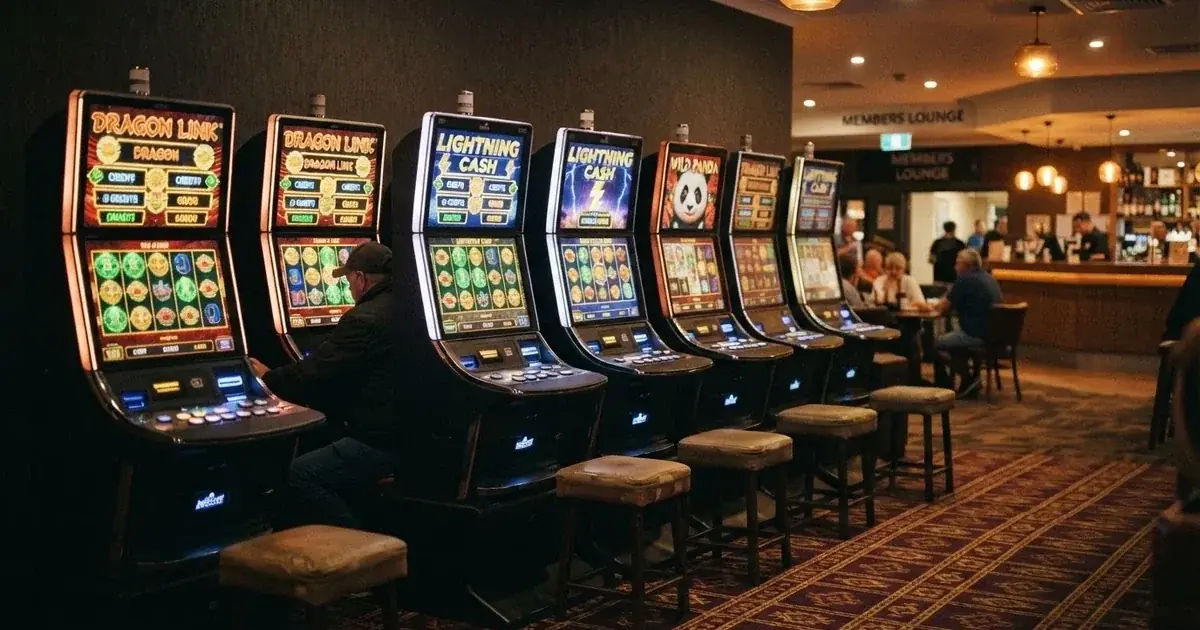
The question “where can I play pokies in NSW” sounds simple. The answer splits down the middle. On one side sits the largest pool of licensed gaming machines outside casinos in any Australian state, spread across thousands of pubs and clubs across New South Wales, plus the two casino floors at Sydney and Barangaroo. On the other sits a parallel industry of offshore websites marketing themselves as “pokies” to Australian players, none of which hold an Australian licence because none can. The Australian Communications and Media Authority has been warning, fining, and blocking them since 2017, and the cumulative count now runs into the thousands. Anyone searching for “best pokies in NSW” in 2026 needs both halves of that picture, because they describe very different things to the punter standing at a machine and the account sitting open in another browser tab.
Table of Contents
- What “Pokies” in NSW Actually Means
- The Legal Frame: What Is Licensable and What Is Not
- Responsible Gambling Supports That Apply in NSW
- How Payouts and Settlements Actually Work at NSW Pokies
- The Mechanics: Paytables, Sessions, and What the Numbers Mean
- How to Read a Pokies Shortlist for NSW
- The Offshore Brands the ACMA Has Formally Warned
- The Blocking Pace: What 2026’s Numbers Actually Show
- Why Casino Oversight Has Tightened in NSW
- Comparing the State Landscape: NSW Against Its Neighbours
- The Calculation: What Offshore “Pokies” Offers Actually Cost
- What an NSW Punter Should Take From This
- Frequently Asked Questions
What “Pokies” in NSW Actually Means
The word itself is Australian shorthand for poker-style gaming machines, the electronic slots that line the walls of clubs, hotels and casinos from Penrith to Lismore. In NSW, they are governed under state legislation and administered by Liquor & Gaming NSW, with separate casino oversight from the NSW Independent Casino Commission. Every machine in a pub or club carries a state authorisation, a published return-to-player rate, and a venue that is licensed to host it.
NSW had 87,298 gaming machines outside casinos across 2,195 venues as of June 2023, more than any other Australian state by a comfortable margin. Players lost A$8.18 billion through those machines in the 2022–23 financial year, roughly A$986 per adult, against turnover of A$85.72 billion in 2020–21, or about A$13,559 per adult. The numbers are blunt, and the state earns them a position at the centre of every national conversation about machine gambling.
The casino side is smaller in machine count but sits under a different regulator. The Star Sydney has been the long-established Sydney casino. Crown Sydney at Barangaroo opened in December 2020 and now operates as the city’s second casino floor. Both fall under the NSW Independent Casino Commission, which has issued escalating fines to both venues over compliance failures in recent years.
What “pokies” does not mean in Australia is an online casino product. The Interactive Gambling Act 2001, as tightened in 2017, makes it unlawful to provide online casino games, including online pokies, to a person physically in Australia. No state or territory issues licences for the product. The offshore sites that brand themselves “pokies” are running an offering the law does not recognise, and that distinction shapes everything that follows.
The Legal Frame: What Is Licensable and What Is Not
Australian gambling law splits into two regimes that do not overlap. The first covers wagering on racing and sport, lotteries, and keno, which can be licensed and which the Northern Territory Racing and Wagering Commission effectively administers for most of the corporate bookmakers, including Sportsbet, Bet365 and Ladbrokes. The commission has no full-time staff and meets once a month in Darwin, a structural curiosity that has drawn parliamentary attention.
The second covers online casino games, which cannot be licensed anywhere in Australia. The IGA targets the provider, not the player. The minimum age for any form of legal gambling is 18.
Enforcement runs through the ACMA, which investigates complaints, issues formal warnings, and can direct Australian internet service providers to block offshore sites at the network level. As of June 2026, the ACMA reported that 1,751 illegal gambling and affiliate marketing websites had been blocked since the first blocking request in November 2019, and that more than 230 unlicensed services had withdrawn from the Australian market since enforcement was strengthened in 2017. A single round in June 2026 added twelve more sites to the blocked list: 7Signs, ChromaBet, Donbet, Duospin, Freshbet, Slots Gem, Jacks Club, Lucky Start, Pointsbetz, Spinrise, Vinyl Casino and Wildsino.
The credit-card ban that took effect on 11 June 2024 closes off another route. Credit cards, credit-related products, and digital currency cannot be used to fund licensed online wagering. Legal deposit channels for Australian-licensed wagering are debit card, bank transfer, PayID/Osko and BPAY. A site asking an Australian customer for a credit card or a crypto deposit is operating outside the Australian framework, regardless of any overseas licence it may display.
The 2026 reform landscape adds one more layer. The Interactive Gambling Amendment (Gambling Reform) Bill 2026 passed Parliament on 19 August 2026, but its advertising and inducement measures commence on 1 January 2027. On a 2026 page that is law with a future start date, not a rule currently in force.
Responsible Gambling Supports That Apply in NSW
Player-protection machinery exists, but only for licensed services and only for the channels that connect to them. The two supports a NSW punter can actually use are:
- Gambling Help Online and the National Gambling Helpline at 1800 858 858, free and available 24/7, with web chat.
- BetStop, the National Self-Exclusion Register, which has been live since August 2023 and binds every Australian-licensed online and phone wagering service. A person registered with BetStop cannot open new wagering accounts with any Australian-licensed bookmaker, and existing accounts are closed.
Neither support catches an offshore casino. BetStop is connected only to Australian-licensed services, and the offshore sites have no obligation to honour an exclusion registered in Australia. The 1800 helpline will still help, but the practical effect of self-excluding from a site that is already operating unlawfully is uncertain. A punter who wants exclusion that actually bites needs to register with BetStop and stay on Australian-licensed wagering sites only.
For machine gambling specifically, NSW runs its own self-exclusion arrangements through venues, which is a different mechanism. A venue-level bar in a Sydney pub or a Newcastle club is enforced at the door, and the affected venue network can coordinate through Liquor & Gaming NSW.
How Payouts and Settlements Actually Work at NSW Pokies
Land-based pokies in NSW do not have “withdrawals” in the online sense. A player cashes out tickets at the machine or takes them to the cashier. That process is immediate, which is one of the structural reasons onshore venues remain the dominant product even when offshore sites advertise faster payout times for online wins.
The relevant numbers for machine players are return-to-player rates and the pace of turnover. NSW machines outside casinos have a regulated minimum RTP that the state publishes; casino floors operate under different rules negotiated in their licence conditions. Players comparing NSW to other states sometimes cite “payout percentage” comparisons, but those comparisons work only across comparable venue types, because a casino floor and a suburban club are running on different RTP floors.
The “best paying pokies in NSW” framing carries a built-in distortion. Every machine in a given venue category runs within a narrow RTP band set by regulation. The spread within the band is small. A punter chasing a higher RTP by choosing one venue over another is chasing differences that are typically under a percentage point, while the variance between machines and sessions is far larger than that gap. The promotional language about “best paying” tends to inflate a structural feature into a competitive advantage that does not really exist at the venue level.
The Mechanics: Paytables, Sessions, and What the Numbers Mean
A “paytable” is the rule sheet a machine displays, listing what each symbol combination pays and which features trigger bonuses. On a NSW pub or club machine, the paytable reflects the game’s design and the venue’s RTP floor. A player looking at one paytable against another is looking at design differences (volatility, feature frequency, max exposure), not at regulatory differences, since regulation sets the band both machines sit inside.
Session length for a NSW machine player is bounded by the venue’s opening hours and by personal limits. Most NSW pubs and clubs close their gaming floors in the early hours of the morning; very few venues run 24-hour gaming. A player asking “24-hour pokies NSW” is asking about the exception rather than the rule. Casino floors in Sydney run longer, but neither operates around the clock without interruption for cleaning, regulatory breaks, and the like.
The “NSW cashless pokies” question points at a long-running state programme to migrate from cash to card-based play on machines. Cashless gaming technology has been rolling out in stages and is intended to give players pre-commitment tools that cash play does not. The rollout has been uneven across venues, and a punter cannot assume a given venue has it; the practical answer is to ask at the venue.
For someone looking at offshore sites marketing “NSW pokies” as an online product, the same vocabulary means something different. There is no regulatory paytable floor, no state-supervised RTP, and no complaints body to approach if the account is closed or a withdrawal is delayed. The product carries the same name and a different regime.
How to Read a Pokies Shortlist for NSW
A shortlist of NSW pokies venues is not a shortlist of games. It is a shortlist of licensed physical locations where gaming machines operate under state authorisation, divided into three categories that do not compete with each other on the same axes:
- Registered clubs, which are member-based venues (RSLs, leagues clubs, Workers clubs) with gaming machines as one revenue line among several. Club entry usually requires membership, sometimes temporary. Clubs carry most of the machine count in NSW outside the casinos.
- Pubs and hotels with gaming-machine authorisations. Entry is generally open to the public, subject to the venue’s responsible-service-of-gambling obligations.
- Casinos, of which there are two in NSW: The Star Sydney and Crown Sydney at Barangaroo. Casino floors operate under the NSW Independent Casino Commission and run longer hours, higher bet ceilings, and a broader range of table games alongside machines.
A meaningful comparison among these categories has to start by acknowledging that they sit in different regulatory boxes. Comparing a suburban club to The Star on “best payout” is comparing two products that are licensed and configured differently; the comparison is technically possible but the answer depends entirely on what the punter values (machine variety, venue amenity, hours of access, regulatory oversight). The shortlist on this page works with that hierarchy rather than collapsing it.
The Offshore Brands the ACMA Has Formally Warned
The brands listed below are not a recommendation. They appear here because the ACMA itself has issued a formal warning over each of them for offering prohibited interactive gambling services to Australians. The product they advertise — “online pokies” to Australian players — is unlawful under the Interactive Gambling Act 2001, and the ACMA’s enforcement record is the public evidence of that fact.
| Brand | ACMA action and date | Operator named by the ACMA | Subject support |
|---|---|---|---|
| RocketPlay | Formal warning, March 2026 (Pulsup Ltd); earlier Dama N.V. warning, May 2022 | Pulsup Ltd | — |
| Level Up Casino | Formal warning, May 2022 | Dama N.V. | listings only |
| Woo Casino | Formal warning, March 2025 | Dama N.V. | listings only |
| Spirit Casino | Formal warning, May 2025 | Dama N.V. | — |
| National Casino | Formal warning, July 2025 | Consolutetish S.R.L. | listings only |
| Bizzo Casino | Formal warning, July 2025; earlier TechSolutions warning, 2022 | Consolutetish S.R.L. | — |
| Ignition Casino | Formal warning, July 2025 | Bamboo Media | — |
| Instant Casino | Formal warning, February 2025 | EOD Code SRL | — |
| Jackbit | Formal warning, April 2026 | Ryker B.V. | — |
| Casino Intense | Formal warning, April 2025 | Sterplay Holding Ltd | listings only |
| Sky Crown | Formal warning, September 2022 | Hollycorn N.V. | listings only |
A formal warning is a public regulator action, not a customer review. The ACMA names the operator entity behind the brand, the date the warning was issued, and the legal basis (the IGA’s prohibition on providing interactive gambling services to Australians). Many of these warnings target the same corporate group under different brand names: Dama N.V. alone has attracted warnings across RocketPlay, Level Up, Woo Casino and Spirit Casino, and Consolutetish S.R.L. across National Casino and Bizzo Casino. The same operator running a new brand does not reset the warning history.
For a punter weighing whether to engage with any of these brands, the structural facts are these: an offshore site is not connected to BetStop, does not honour Australian self-exclusion, has no Australian complaints body, and can be blocked by an ISP with a balance still sitting in the account. The site’s own terms may say otherwise; the legal environment in Australia does not.
The Blocking Pace: What 2026’s Numbers Actually Show
Between November 2019 and June 2026, the ACMA directed ISPs to block 1,751 illegal gambling and affiliate marketing websites. The first blocking request went out in November 2019. The current count in June 2026, against the seven-and-a-bit years that have elapsed since that first request, gives a pace of roughly 200 to 270 sites blocked per year, with the rate varying by enforcement round and by how many affiliate sites the ACMA targets alongside the operator brands. The band sits in that range because the ACMA reports cumulative totals rather than annual rates, and individual rounds can move the count by anywhere from a handful to more than fifty.
The pace matters because it tells a punter how actively the regulator is operating. A blocking round in June 2026 alone added twelve sites to the list, including several that had been advertising to Australian players under “pokies” branding. The blocking does not require a user to take any action; the ISP-level block takes the site offline for Australian connections regardless of whether the user has visited it before.
Why Casino Oversight Has Tightened in NSW
The NSW Independent Casino Commission has been the more active of the two casino regulators in recent reporting cycles. The Star Sydney received $10 million in fines and an enforceable undertaking announced on 2 June 2026, the result of an extended review into anti-money-laundering and governance failures. On 19 August 2026, the Commission fined Crown Sydney $1.75 million and The Star Sydney $500,000 in a coordinated action for allowing a minor to enter each venue. The pattern is enforcement, not negotiation, and it changes how a careful punter reads casino-floor compliance.
For a punter, the regulatory tightening matters because it shows the venues are under active scrutiny. A casino licence in good standing in NSW is not a static artefact; the conditions are being enforced, and the venues are paying for their failures. A punter weighing The Star Sydney against Crown Sydney against a major club venue is weighing operators with different regulatory exposure, and the exposure shifts over time.
Comparing the State Landscape: NSW Against Its Neighbours
A punter comparing NSW pokies to other Australian states works from data published by state regulators and collected by national statistical bodies. The headline numbers as of mid-2023:
| Jurisdiction | Gaming Machines (outside casinos) | Venues |
|---|---|---|
| New South Wales | 87,298 | 2,195 |
| Queensland | 21,122 | 351 |
| South Australia | 11,672 | 471 |
The NSW figure dominates. The per-adult loss figure is also higher: NSW players lost A$986 per adult on machines outside casinos in 2022–23, compared with roughly A$497 per adult in South Australia over the same period. The comparison is not flattering to NSW, and it is the kind of figure that lands a regulator’s desk, not a venue’s marketing page.
South Australia also sets a higher minimum RTP floor for machines (87.5%) and caps bets outside the casino at A$5.00, while Adelaide Casino itself has no maximum bet limit. NSW’s structure is different, with its own RTP floor and betting limits set in machine-by-machine and venue-by-venue configurations. The comparison tells a punter that “best paying pokies in NSW” is a question with a state-specific answer, not a transferable one from a more regulated jurisdiction.
The Calculation: What Offshore “Pokies” Offers Actually Cost
The formula for what a typical offshore “deposit bonus” costs a player is straightforward. Take the bonus amount, multiply by the wagering requirement the site sets, divide by the stake per spin to get the number of spins required, then multiply by the game’s house edge to get the expected loss over that clearing volume. The exact figures vary by site, but the shape of the calculation does not.
As an example, a A$500 bonus with a 40x wagering requirement means A$20,000 in required turnover. At A$1 per spin, that is 20,000 spins. At a 4% house edge (which is in the band for most online slots), the expected loss over those spins is A$800. The bonus clears; the player has lost A$800 on a A$500 bonus before any winnings are withdrawable, and the time required to play 20,000 spins at six seconds each is roughly 33 hours of continuous play.
That ratio is what makes offshore deposit bonuses worth examining rather than celebrating. The headline number is the bonus amount; the real number is the expected loss attached to clearing it. The two diverge by a factor that most promotional copy does not name. An Australian punter comparing an offshore “pokies” promotion to a session at a NSW club is not comparing like with like on cost, because the club session has no wagering requirement and no clearing volume — every spin costs what it costs, and there is no bonus-shaped loss layered on top.
What an NSW Punter Should Take From This
The clearest framing is this. NSW has the largest pool of licensed gaming machines in the country, regulated under state law with active enforcement by Liquor & Gaming NSW and the NSW Independent Casino Commission at the casino end. The venues are pubs, clubs, and two casino floors. The product is real, supervised, and subject to consumer-protection machinery (including venue-level self-exclusion and the National Gambling Helpline).
The offshore “pokies” market that advertises to Australians is a separate product running under separate rules. It is unlawful to provide in Australia, the ACMA has been actively warning and blocking operators since 2017, and the cumulative block count has passed 1,750 sites. The brands listed above are the publicly documented examples. A punter who stays within the licensed NSW framework keeps the protections that framework provides. A punter who steps outside it loses them, regardless of how the offshore site describes its offering.
The “best” in a search query like this one is not about picking a winner from a list of comparable products. It is about recognising that the two halves of the market are not comparable products at all, and that the licensed half is the only one an Australian punter can engage with under Australian law.
Frequently Asked Questions
Are online “pokies” sites legal for Australian players?
No. The Interactive Gambling Act 2001 prohibits providing online casino games, including online pokies, to anyone in Australia. No state or territory issues a licence for the product. The ACMA enforces the prohibition through formal warnings and ISP-level blocking.
How many pokies machines are there in NSW outside casinos?
NSW had 87,298 gaming machines outside casinos across 2,195 venues as of June 2023, more than any other Australian state. The figure is published in state gambling statistics and is the most-cited measure of the size of the NSW machine market.
What is the ACMA’s blocking record?
The ACMA reported in June 2026 that 1,751 illegal gambling and affiliate marketing websites had been blocked since the first blocking request in November 2019. A single June 2026 round added twelve sites to the blocked list. More than 230 unlicensed services have left the Australian market since 2017.
Can an offshore site honour a BetStop exclusion?
No. BetStop, the National Self-Exclusion Register, binds Australian-licensed online and phone wagering services. Offshore casino sites are not connected to it and have no obligation to recognise an Australian-registered exclusion. Self-exclusion works only on the licensed side.
What is the difference between a club, a pub, and a casino machine in NSW?
Clubs (RSLs, leagues clubs, Workers clubs) carry the largest share of machines and typically require membership. Pubs and hotels with gaming authorisations are generally open to the public. Casino machines at The Star Sydney and Crown Sydney run under a different regulator (the NSW Independent Casino Commission) and operate with higher bet ceilings and a broader range of table games. The regulatory regime differs across all three.
What payment methods can be used for licensed Australian wagering?
Licensed Australian wagering services accept debit card, bank transfer, PayID/Osko and BPAY. Credit cards, credit-related products and digital currency are banned for licensed online wagering since 11 June 2024. An Australian-licensed service asking for a credit card or crypto is operating outside the rules.
How much did NSW players lose on machines outside casinos in 2022–23?
NSW gaming-machine players lost A$8.18 billion outside casinos in 2022–23, roughly A$986 per adult. The figure is published in state and national gambling statistics and is the standard reference for the size of the NSW machine market’s economic footprint.
Are NSW pokies venues open 24 hours?
Most NSW pubs and clubs close their gaming floors in the early hours of the morning. Casino floors at The Star Sydney and Crown Sydney operate longer hours but not without interruption. A 24-hour venue is the exception rather than the rule.
What does a formal warning from the ACMA mean?
A formal warning is a public regulator action naming an operator entity, the date of issue, and the legal basis. It is published on the ACMA website and signals that the named operator has been found to be providing prohibited interactive gambling services to Australians. The warning does not, by itself, block the site; blocking requires a separate ACMA direction to ISPs.
Where can a punter get help with a gambling problem in NSW?
The National Gambling Helpline at 1800 858 858 is free and available 24/7. Gambling Help Online provides web chat. BetStop, the National Self-Exclusion Register, is available for Australian-licensed wagering services. Venue-level self-exclusion can be arranged through individual NSW venues and coordinated through Liquor & Gaming NSW.