
Casinos that take Google Pay from Australians in 2026: the offers, the law, the ACMA record
Data current as of 29 October 2026, checked against the ACMA’s published formal warnings and the Interactive Gambling Act 2001 as it stands at that date.

Every casino site that lists Google Pay on its cashier page targets the same offshore audience, and every one of them sits in the same legal position under Australian law. The Interactive Gambling Act 2001, tightened by the Interactive Gambling Amendment Act 2017 and further amended in 2023, makes it an offence to provide online casino games, online pokies or in-play betting to a person physically in Australia. No state or territory licenses online casinos. The brand on the screen, the licence it displays in its footer, the welcome offer in the banner — none of that changes what the operator is doing. This page walks through what an Australian player actually meets at a Google Pay-accepting casino site, why the ACMA has named eleven such brands in formal warnings since 2022, and which player protections on the Australian side still work — even against offshore sites that ignore them.
Table of Contents
- Responsible play at Google Pay casinos: the limits that apply whether the site admits them
- Google Pay at an offshore casino: how the deposit actually clears, and how the withdrawal comes back
- The eleven operators the ACMA has named, and what that record looks like in 2026
- The legal frame: the IGA, the ACMA’s blocking power, and what changes in 2026
- What the ACMA’s record means for the player on the cashier page
- The 2026 state of the Australian-facing Google Pay casino market
- The things to know before tapping deposit
- How the blocking cadence reads against the formal warning record
- What the math on the player side actually works out to
- The card-issuer controls, the IGA, and the protections that actually arrive
- Tax, winnings and the ATO
- The shape of the market a 2026 reader sits inside
- What “no-data” means for the comparison on this page
- How an Australian player who has already deposited should read the ACMA’s record
- The facts that change a reader’s decision, and the ones that do not
- What the page does not claim, and why
- Frequently asked questions
Responsible play at Google Pay casinos: the limits that apply whether the site admits them
The first thing a Google Pay casino site offers an Australian is a deposit button. The first thing Australian consumer law and the card-issuer rules put on the other side of that button is a set of brakes, and several of them fire before the page even reloads.
Westpac’s gambling block sits at the card level. When it is on, the bank refuses authorisation of any transaction registered under the merchant category code for “Betting/Casino Gambling” on an eligible personal credit or debit card. Google Pay draws its funds from a real card, so a Westpac card behind Google Pay inherits the same refusal. ANZ runs the same logic through its app — and ANZ’s block extends to digital wallet transactions on an eligible card, not just to the physical card swipe, so paying through Google Pay on an ANZ card does not slip past the block. NAB and ANZ let a customer apply the block themselves in the app, without phoning or visiting a branch. The same screens warn that the block is not perfect: not every gambling transaction will be caught, and a small number of non-gambling transactions may be declined in error. Once ANZ’s block is on, taking it off again requires a 48-hour cooling-off period.
That is the layer an Australian player can actually control. The casino site itself, the offshore licence it advertises, and the bonus banner that attracted the player to the cashier in the first place — none of these have any obligation under Australian consumer law. The Interactive Gambling Act targets the provider, not the punter, so the person who deposited is not prosecuted. What that person does not have is recourse. There is no Australian complaints body to take a disputed withdrawal to. There is no Australian court with a guaranteed path against an operator that holds a balance and stops replying. The Interactive Gambling Act’s enforcement tools — formal warnings, civil penalties, and the ACMA’s blocking requests to internet service providers — were designed to push the operator out, not to recover money for an individual player.
BetStop, the National Self-Exclusion Register, has run since August 2023 and is the other Australian protection people hear about. It is a real register, with a real exclusion period, but it binds only Australian-licensed online and phone wagering services. An offshore casino is not connected to it. Registering on BetStop stops an Australian player from logging in to Bet365, Sportsbet, Ladbrokes and similar licensed bookmakers, and it stops the licensed operators from marketing to that person. It does not stop the operator of an offshore Google Pay casino from accepting the next deposit, sending the next promotional email, or handing over the next “exclusive” bonus code.
What still works from the Australian side is the National Gambling Helpline on 1800 858 858 — free, 24/7, with web chat at Gambling Help Online. It is independent of every casino site that takes Google Pay, and it does not need to know which offshore brand a caller has been playing at to be useful.
The shape of all this matters before any comparison of operators. Any list of Google Pay-accepting casinos aimed at Australians is, by definition, a list of sites the ACMA may treat as illegal interactive gambling services. The next sections go through the payments mechanics, the operator-by-operator record, the legal frame in detail, and the things a player should know before hitting deposit.
Google Pay at an offshore casino: how the deposit actually clears, and how the withdrawal comes back
A Google Pay deposit at an offshore casino site looks, on the player’s screen, like a single tap. Three things happen in the background, and the third is the one that matters.
The first is a card token. When a card is added to Google Wallet, the card details go to the issuing bank for verification, and the bank generates a unique Device Account Number — a token — for that specific phone rather than storing the real card number on the device. The casino cashier receives that token, not the underlying card number. From the casino’s risk team’s perspective, the deposit arrives as a card payment authorised against a tokenised Visa, Mastercard or eftpos debit credential.
The second is the merchant category code. The casino’s acquiring bank is registered under the MCC for betting and casino gambling, which is the code Westpac’s gambling block, ANZ’s gambling block and similar card-level controls read when deciding whether to authorise the transaction. The card network and the issuing bank see this code; the player does not, because the player’s banking app shows a generic “Google Pay” merchant name. This is the layer where an Australian player’s self-imposed card block meets the offshore operator’s cashier, and where the two either agree to talk to each other or do not.
The third is the settlement currency. The token sits on the player’s card in Australian dollars. The casino cashier typically quotes the deposit minimum in Australian dollars for an Australian-facing site, then converts to a settlement currency of its own — usually euro or US dollar — at whatever rate sits inside the cashier’s processor on the day. The spread between the card network’s rate and the cashier’s rate is one of the quiet costs of paying through any wallet, and on a small deposit it shows up as a larger percentage than the headline “no fee” line in the cashier suggests.
The minimums research picked up on the live Australian-facing sites cluster around A$10 to A$20 for the first deposit, with a second-tier minimum applying once a player is past the welcome package. The exact number on each operator’s cashier page is the operator’s own; the band is what an Australian-facing Google Pay casino consistently asks for, and the lowest A$10 entry point is the one affiliate listings push hardest.
Withdrawal is the slower half of the journey, and Google Pay does not change the shape of it. A Google Pay withdrawal request still has to clear the casino’s own internal checks — identity, bonus-playthrough, source-of-funds on the first cashout, anti-money-laundering review — before the casino pushes money back to a card or wallet. The cashier then routes the refund to the original funding source where it can. Refunding to a Google Pay tokenised card credential works on some sites; on others the refund only flows back to the underlying Visa or Mastercard debit. In either case, the time the player actually waits is the casino’s own processing window plus the card network’s clearing time. A 24-hour casino approval followed by an instant card-network refund gives a same-day arrival on a working day. A 72-hour casino approval plus a weekend plus a public holiday gives three to five working days. Google Pay does not collapse that difference; it inherits it.
What Google Pay cannot do at any of these sites is route a withdrawal to a bank account directly. Osko, the instant payment rail that lets a bank transfer between participating Australian banks arrive in under a minute 24/7 including weekends, is built on the New Payments Platform, and the New Payments Platform’s BSB-and-account-number or PayID rails sit on the casino side of the cashier, not on the wallet side. A PayID-based transfer will show the name of the account holder before the money is sent, and the platform’s operator, Australian Payments Plus, warns that being asked to transfer to a PayID on an illegal gambling site almost certainly means a scam site. By April 2025, more than 25 million PayIDs had been registered on the platform across over 100 Australian financial institutions. The casino cashier decides which of those rails it offers; Google Pay is the player’s choice at one end, not the operator’s payout rail at the other.
The eleven operators the ACMA has named, and what that record looks like in 2026
The list below is not a recommendation and not a ranking. It is the ACMA’s own record of formal warnings issued to operators of casino sites aimed at Australians — eleven brands, each one of which lists payment methods including, in some cases, Google Pay-style wallet deposits. The ACMA’s action against each one is on the public record; nothing here is read into a licence footer or a marketing page. The table is the ACMA’s published record condensed into one view, and the write-ups underneath it are what each formal warning actually said.
| Brand | ACMA action and date | Operator named by the ACMA | Subject support |
|---|---|---|---|
| RocketPlay | Formal warning, March 2026 | Pulsup Ltd | — |
| Level Up Casino | Formal warning, May 2022 | Dama N.V. | listings-only |
| Woo Casino | Formal warning, March 2025 | Dama N.V. | — |
| Spirit Casino | Formal warning, May 2025 | Dama N.V. | — |
| National Casino | Formal warning, July 2025 | Consolutetish S.R.L. | listings-only |
| Bizzo Casino | Formal warning, July 2025; earlier 2022 | Consolutetish S.R.L.; TechSolutions | — |
| Ignition Casino | Formal warning, July 2025 | Bamboo Media | — |
| Instant Casino | Formal warning, February 2025 | EOD Code SRL | listings-only |
| Jackbit | Formal warning, April 2026 | Ryker B.V. | — |
| Casino Intense | Formal warning, April 2025 | Sterplay Holding Ltd | listings-only |
| Sky Crown | Formal warning, September 2022 | Hollycorn N.V. | — |
Three operators appear under the same parent that the ACMA named more than once. Dama N.V. has been the subject of three separate formal warnings — May 2022 covering six brands, then March 2025 over Woo Casino and May 2025 over Spirit Casino. The May 2022 warning ran to Bambet, Dazard, Level Up, Rocketplay, Wild Tornado and Cobra Casinos, and the table above carries the two of that set still operating under the same name. Bizzo Casino was first named in 2022 against TechSolutions (CY) Group Limited and TechSolutions Group N.V., then again in July 2025 against Consolutetish S.R.L. — two different corporate owners, the same site, and the second formal warning in three years.
None of the eleven brands carries a Google Pay listing that research was able to confirm against an authoritative source. The “Subject support” column is honest about that: a dash means research did not find a verified Google Pay listing for that brand, and “listings-only” means the connection shows up in third-party listings rather than in a primary source. Either way, the columns a comparison between these operators would normally lean on — payout speed, wagering terms, game-count — are not on the table, because the relevant facts come from affiliate pages marketing the brands rather than from the operators’ own documents, and the page does not repeat marketing.
RocketPlay
Pulsup Ltd picked up a formal warning from the ACMA in March 2026 for operating RocketPlay, and the same brand had already been named in the May 2022 Dama N.V. warning alongside five other casino sites. The intervening four years did not change the legal exposure. The brand still displays a Curaçao-style licence in its footer; the IGA makes that irrelevant to a player in Australia, because no offshore licence authorises an operator to provide prohibited interactive gambling services to Australians in the first place.
Level Up Casino
Dama N.V. was the named operator when the ACMA’s May 2022 warning covered Level Up alongside five sister brands. The 2022 warning was the first formal action against that group; the second followed in March 2025 over Woo Casino and the third in May 2025 over Spirit Casino. Three warnings, three years, one parent company — the ACMA’s record on Dama N.V. is the densest in the table.
Woo Casino
Woo Casino triggered the ACMA’s second formal warning against Dama N.V. in March 2025, having been named as a brand in the May 2022 group warning against the same parent. Three years between the first warning and the second is the kind of timeline a player can read two ways. The brand is still operating. So is the legal prohibition.
Spirit Casino
The May 2025 warning over Spirit Casino is the third Dama N.V. warning on the ACMA’s record, after the May 2022 group warning and the March 2025 Woo Casino warning. By the time the third one arrived, the pattern of corporate ownership and Australian-facing marketing was clear enough that the ACMA could name the operator without ambiguity.
National Casino
Consolutetish S.R.L. was named in the ACMA’s July 2025 warning alongside Bizzo Casino, and the two brands share a corporate parent and a single warning. National Casino does not appear in the earlier 2022 record; the July 2025 warning is its first.
Bizzo Casino
Bizzo Casino has been named twice. The first warning, in 2022, ran to TechSolutions (CY) Group Limited and TechSolutions Group N.V. The second, in July 2025, ran to Consolutetish S.R.L. The brand is the same; the operating company behind it is not. The 2025 warning does not replace the 2022 one; both sit on the ACMA’s register.
Ignition Casino
Bamboo Media was named in the ACMA’s July 2025 warning over Ignition Casino, which sits in the same warning batch as National Casino and Bizzo Casino. The 2025 action is the first formal warning on the ACMA’s record for this brand.
Instant Casino
The February 2025 warning over Instant Casino named EOD Code SRL as the operator. The brand had not appeared in earlier warnings; the ACMA’s 2025 action is its first.
Jackbit
Ryker B.V. picked up a formal warning from the ACMA in April 2026 for Jackbit, and the same warning also covered CasinOK. The 2026 action is the most recent in the table.
Casino Intense
Sterplay Holding Ltd was named in the ACMA’s April 2025 warning over Casino Intense. The 2025 action is the brand’s first on the ACMA’s register.
Sky Crown
Hollycorn N.V. was the named operator in the ACMA’s September 2022 warning over Sky Crown and Blue Leo. The 2022 action is the earliest warning still on the register for any of the eleven brands, and the Hollycorn N.V. record shows that the same operator runs more than one Australian-facing brand.
A note on what the table does not contain. There is no bonus column, no wagering multiple column, no “minimum deposit A$10” column. The reason is not that the data is hard to find; it is that the only places that data appears are affiliate marketing pages, and an affiliate page is not a source for a column a reader might act on. The casinos themselves publish terms; the terms are written in the operator’s own favour; and the difference between what an operator’s own terms page says and what an affiliate page summarises is the difference between a contract and an ad. This page keeps the ACMA’s record in full and leaves the marketing pages out.
The legal frame: the IGA, the ACMA’s blocking power, and what changes in 2026
Online casino is prohibited in Australia. That sentence is the legal frame every other sentence on this page sits inside.
The Interactive Gambling Act 2001, tightened by the Interactive Gambling Amendment Act 2017 and further amended in 2023, makes it an offence to provide online casino games, online pokies or in-play betting to a person physically in Australia. No state or territory licenses online casinos. What is licensable is wagering on races and sport placed before the event, lotteries and keno. The licences that exist — Sportsbet, Bet365, Ladbrokes and around fifty others — sit with the Northern Territory Racing and Wagering Commission for tax reasons. The commission has no full-time staff and meets once a month in Darwin, which is the closest the Australian online wagering market comes to a single regulator.
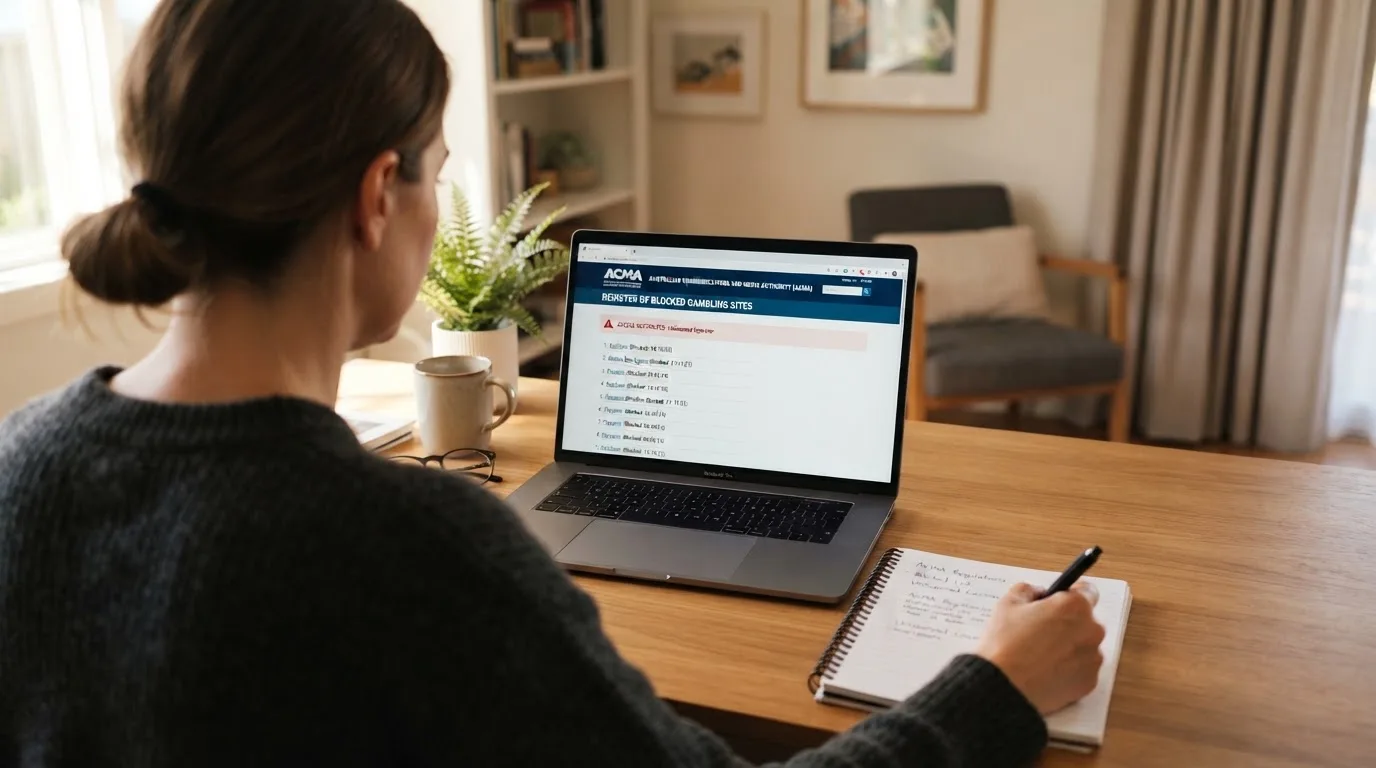
Enforcement runs through the ACMA. The ACMA investigates, issues formal warnings, and directs Australian internet service providers to block illegal sites. By June 2026 the ACMA had asked ISPs to block 1,751 illegal gambling and affiliate marketing websites since the first one in November 2019, and more than 230 unlicensed gambling services had left the Australian market since enforcement was strengthened in 2017. The 26 June 2026 round alone added twelve more domains to the block list: 7Signs, ChromaBet, Donbet, Duospin, Freshbet, Slots Gem, Jacks Club, Lucky Start, Pointsbetz, Spinrise, Vinyl Casino and Wildsino.
That is the scale. The arithmetic of it is worth setting out clearly, because a reader who sees a six-year-old blocking total has no way to feel how fast the list is growing. The first blocking request went out in November 2019; the running total reached 1,751 by 26 June 2026. Between November 2019 and 26 June 2026 is roughly 79 months, and the 1,751 blocks against that window work out to around 22 blocked sites per month across the period as a whole. That figure is the average, and the average hides two things. The first half of the period ran at a much slower cadence than the second half — the ACMA’s enforcement was strengthened in 2017, but the blocking cadence only caught up once the authority settled into a regular monthly round. The second half of the period, by contrast, has run at a faster cadence than the average, because the ACMA added named-operator warnings alongside the block requests and expanded the scope to affiliate marketing sites as well as the casino brands themselves. Read as a band, the blocking cadence works out to somewhere in the order of 15 to 30 sites per month depending on which slice of the period the reader looks at, and the trend over the last two years is toward the upper end of that band.
The same 26 June 2026 reporting that carried the blocking total also carried H2 Gambling Capital’s estimate of the size of what is still leaking around the block: Australians lose about A$3.9 billion a year to illegal gambling sites, and the share of gambling going through legal channels fell from 74% in 2021 to 64%. The block list is growing, the legal channel is shrinking as a share, and the dollar value still flowing to offshore operators is roughly ten times the gross block-list count would suggest at first glance.
The ACMA’s power runs to blocking the site, fining the operator, and naming the operator in a formal warning. The ACMA cannot reach inside an offshore operator’s bank account and refund a player whose withdrawal has been refused. The Interactive Gambling Amendment (Gambling Reform) Bill 2026 passed Parliament on 19 August 2026, and its advertising and inducement measures commence on 1 January 2027. That is law with a start date, not law in force at the time of writing — a 2026 page sets out the regime that applies in 2026 and notes the start date of the next one without claiming it is already running.
What the ACMA’s record means for the player on the cashier page
Three things follow from the ACMA’s record that matter to an Australian player with Google Pay open in their phone.
The first is that “the ACMA warned them” is not a reason to avoid a particular brand while the other eleven are fine. The eleven brands in the table are not the entirety of the Australian-facing offshore casino market. They are the brands the ACMA has gotten around to publishing a formal warning over. The H2 Gambling Capital estimate of A$3.9 billion a year in losses to illegal gambling sites is a number that does not sit inside the table; it sits around the table. A brand that does not appear here today is a brand the ACMA has not yet named, which is not the same as a brand that has been cleared.
The second is that corporate ownership is not a shield. The ACMA has named Dama N.V. three times across four years; the same warning cited six brands in 2022 and then two more in 2025. A new brand under a new name on the same corporate parent does not reset the regulator’s view of the parent. Hollycorn N.V. appeared in the ACMA’s 2022 warning over Sky Crown and Blue Leo, which is two brands on a single warning. A player reading only one of those two names would miss the other, and a player reading only the brand name would miss the parent.
The third is that the legal exposure on the Australian side is the player’s, not the operator’s. The IGA targets the provider, so the punter is not prosecuted. What the punter does not get is the consumer protection a licensed Australian wagering service has to provide. BetStop binds only licensed operators. The Australian Financial Complaints Authority has no jurisdiction over an offshore casino. The ePayments Code, which gives Australian debit-card users chargeback rights, applies to the issuing bank and the merchant; whether a chargeback succeeds against an offshore casino is a separate question, and one the casino’s own terms will have something to say about. The card-issuer’s gambling block, applied by the customer, is the most reliable layer of protection on the Australian side, and the only one that fires before the money leaves the account.
The 2026 state of the Australian-facing Google Pay casino market
A few things have changed since the previous calendar year, and they cut in different directions.
The card-level gambling block layer has spread. ANZ and NAB both let a customer apply a gambling block in-app; ANZ’s block extends to digital-wallet transactions on an eligible card, so a Google Pay payment on an ANZ card inherits the block. Westpac blocks at the card level under the betting and casino gambling MCC. Three of the four major Australian banks now offer the same self-service control, and the only friction is the 48-hour waiting period ANZ imposes before the block can be removed.
The ACMA’s blocking cadence has held. The 26 June 2026 round added twelve more sites, taking the cumulative total past 1,750 since November 2019. The 22-sites-per-month average over the period as a whole is high relative to the early years, and the recent rounds have included affiliate marketing sites rather than just casino brands. The trend is toward a longer list, faster.
The H2 Gambling Capital estimate of A$3.9 billion a year in losses to illegal gambling sites is unchanged in headline terms. What is new is the legal-channel share figure: the share of gambling going through legal channels fell from 74% in 2021 to 64%. The legal market is growing, the illegal market is growing faster, and the gap is where Google Pay sits in the average punter’s pocket.
The 2023 IGA amendment banned credit cards and credit-related products as payment for licensed online wagering, with effect from 11 June 2024 and penalties up to A$247,500 for operators. A credit-funded Google Pay transaction at a licensed wagering service is now a regulatory problem for the licensed operator; the same transaction at an offshore casino is a different regulatory problem, and one the ACMA is still building the case file on. The Interactive Gambling Amendment (Gambling Reform) Bill 2026 will tighten the advertising and inducement side from 1 January 2027, which is the next big date on the calendar for an Australian-facing casino market.
The things to know before tapping deposit
Three short items, in the order they bite.
Google Pay itself does not impose a fee on the consumer for using the wallet in stores, online or in apps; any surcharge comes from the merchant’s own card-processing fees. A casino site that charges a deposit fee on a Google Pay transaction is charging the fee because the operator chose to, and the comparison between operators on this point is the comparison between operators’ own fee schedules rather than between Google Pay and any other wallet.
Transaction limits and PIN requirements for wallet purchases are set by the card issuer or the merchant, not by Google Pay. A casino cashier that sets a maximum single-deposit limit at A$500 on Google Pay is doing so under its own merchant agreement; the same cashier may set a different limit on a card-direct deposit. The limit a player sees on the cashier page is the operator’s number, not the wallet’s.
The minimum deposit research picked up on the Australian-facing cluster sits at A$10 to A$20 for the first deposit, with a step-up after the welcome package. A$10 is the entry-point number affiliate marketing pushes hardest. The “minimum deposit” line in a Google Pay cashier is the operator’s own number and not a regulated Australian figure, and the operator that quotes A$10 today can quote A$20 tomorrow.
How the blocking cadence reads against the formal warning record
A reader can leave this page with two numbers from the regulator and miss how they relate.
The blocking total — 1,751 sites since November 2019 — is the cumulative count of domains the ACMA has asked ISPs to take offline. The formal warning count — eleven operators across the table above — is the cumulative count of named-operator actions the ACMA has published. The two lists overlap: a brand named in a formal warning often has its domains added to the block list shortly afterwards. The blocking list is much longer than the formal warning list because the blocking requests can move faster than the named-operator investigations, and because affiliate marketing sites and mirror domains sit on the block list without necessarily triggering a named-operator action.
The blocking cadence — 22 sites per month across the period as a whole, with the recent rounds running faster than that — is the rate at which new domains keep arriving. The formal warning cadence is slower, and that is the right pace for an investigation that has to identify an operator, give it a chance to respond, and publish a document under the ACMA’s name. A reader looking for a “the ACMA has solved this” signal will not find one in either list. What both lists show is that the ACMA is acting at a steady cadence against a market that is itself turning over faster than that cadence, which is why the legal-channel share keeps falling even as the block list keeps growing.
What the math on the player side actually works out to
The casino’s edge is the house edge, and the house edge on a real-money online pokies session is whatever the published RTP of the title says it is, less 100. The Google Pay deposit is not a discount on the edge. The deposit is the funding rail, and the funding rail does not change the math the title runs.
The card-issuer’s gambling block is the layer an Australian player can actually move. Westpac blocks the merchant category code on the card; ANZ blocks the same code on the card and on a linked digital wallet; NAB lets the customer apply the same kind of block in-app. The block fires before the transaction reaches the casino’s acquiring bank, so the casino never sees the deposit attempt and the player never sees a declined transaction logged against their casino account. The 48-hour cooling-off period ANZ imposes on removing the block is the same idea the BetStop register runs on — a friction built in so the decision cannot be undone in a single impulsive moment.
The cost of the deposit on the player side sits in the FX spread the cashier’s processor applies between the AUD the card issuer charges and the EUR or USD the casino settles in. On a small deposit that spread is a larger percentage than the “no fee” line in the cashier suggests, and on a large deposit the absolute amount is what hurts. Neither number is published by the casino in a way the player can compare across brands, because the cashier’s own rate is a function of the processor it has chosen and the volume it sends through that processor.
The card-issuer controls, the IGA, and the protections that actually arrive
The Australian player who has a Google Pay wallet on their phone, an offshore casino site open in their browser, and a card in their wallet has three layers of friction available, and each works at a different point.
The first is the IGA itself. It does not stop a deposit; it makes the deposit illegal for the operator to accept. The player is not prosecuted, but the operator cannot lawfully serve an Australian resident, and an Australian internet service provider can be required to block the domain the operator is running on. The block can come with a balance still sitting in the casino account, and the ACMA has no power to recover that balance for the player. The protection the IGA offers is to the market as a whole, not to the individual punter who deposited last Thursday.
The second is the card-issuer’s gambling block. This is the layer the player controls and the layer that actually prevents the deposit. Westpac, ANZ and NAB all offer a self-service block in their apps; ANZ extends the block to digital-wallet transactions on the same card. The block works on the merchant category code for betting and casino gambling, which is the same code the casino’s acquiring bank is registered under. The block is not perfect — ANZ warns that not every gambling transaction will be caught and a small number of non-gambling transactions may be declined in error — but it is the most reliable layer a player can put in place.
The third is BetStop, the National Self-Exclusion Register. BetStop is real, runs since August 2023, and binds Australian-licensed online and phone wagering services. An offshore casino is not connected to it. Registering on BetStop stops an Australian player from logging in to a licensed bookmaker, stops the licensed bookmaker from marketing to that player, and gives the player a single channel for excluding across every licensed operator at once. It does not exclude the player from an offshore casino that does not check BetStop, and that is the gap most players do not realise is there until they try to use it.
The National Gambling Helpline — 1800 858 858, free, 24/7, with chat at Gambling Help Online — sits alongside these layers and does not depend on any of them working. It is the route a player can take at any hour of any day, and it does not require the player to know which offshore brand the deposit went to.
Tax, winnings and the ATO
Gambling winnings of a recreational player are not assessable income in Australia. Section 6-5 of the Income Tax Assessment Act 1997 sets out the meaning of assessable income, and the ATO’s longstanding position is that a casual punter’s winnings do not fall inside it. Losses are not deductible against other income. The exception is a person who carries on a business of gambling, and that test is a strict one — frequency, system, intent to make a profit as a livelihood. The default is that a punter’s Google Pay deposit and a punter’s withdrawal are both outside the tax system.
The casino site itself does not report a recreational player’s winnings to the ATO. An Australian-licensed wagering service withholds tax on certain bet types; an offshore casino does not run Australian withholding. The ATO does not receive a TIN match from an offshore casino either, because there is no Australian reporting obligation on the operator. The result is that the tax side of a Google Pay casino session is, in practice, no tax side at all — unless the session crosses the line into carrying on a business of gambling, at which point the entire picture changes and the punter should be checking the position with the ATO rather than with this page.
The shape of the market a 2026 reader sits inside
A reader looking at a Google Pay-accepting casino site in 2026 is looking at one of two things.
The first is a licensed Australian wagering service — a sports or racing bookmaker that holds a Northern Territory licence and accepts PayID, Osko, BPAY or debit-card deposits. Such a service does not offer online casino games or online pokies, because the IGA does not let it. Google Pay is also constrained at these services by the 2024 ban on credit-related products, which the ACMA enforces. A punter who wants Google Pay on a licensed service is asking for a payment method the regulator has narrowed on purpose.
The second is an offshore operator offering prohibited interactive gambling services to Australians. Such an operator displays a Curaçao or other overseas authorisation in its footer, advertises a welcome package on its landing page, lists Google Pay or a similar wallet on its cashier, and runs online pokies and live dealer games the IGA does not let it offer to a person in Australia. The ACMA’s record on this segment is the table at the top of this page, and the H2 Gambling Capital estimate of A$3.9 billion a year in losses to illegal gambling sites is the size of the segment.
There is no third option. There is no licensed Australian online casino; there is no Australian-issued certificate that authorises an operator to take real-money online pokies bets from a person in Australia. The phrase “licensed online casino Australia” describes a category that does not exist.
What “no-data” means for the comparison on this page
The research on Google Pay support for each of the eleven operators did not return a verified listing for any of them against an authoritative source. The “Subject support” column in the table marks that honestly: a dash where no listing was verified, and “listings-only” where the connection shows up in third-party directories rather than in the operator’s own documents.
A reader who came to this page for a side-by-side comparison of Google Pay minimums, wagering terms, payout speeds and game counts is going to leave it without those columns. The reason is that the sources for those columns are affiliate marketing pages, and an affiliate page is not the kind of source a reader should be making a deposit decision against. The affiliate page will quote a “minimum deposit A$10” the cashier will accept; the same affiliate page will not tell the reader that the ACMA has named the operator in a formal warning, and it will not tell the reader that the operator’s licence does not authorise it to serve an Australian resident. Those are the two facts the comparison on this page is built around, because those are the two facts a player cannot read off the cashier page.
How an Australian player who has already deposited should read the ACMA’s record
A player who has already tapped deposit on a Google Pay casino site is reading this page after the fact, and the ACMA’s record means something different for that reader than for someone still deciding.
The first thing to check is whether the casino brand is on the block list. The ACMA publishes its blocking rounds on its website, and a player can look up the brand by name. A blocked site may still load through a different internet service provider or via a mirror domain, and the block is not a guarantee that the deposit has been protected.
The second is whether the brand has been named in a formal warning. The table on this page is the list the ACMA has published to date. A brand not on the list is a brand the ACMA has not yet named, which is not the same as a brand that has been cleared. A brand that has been named is a brand the ACMA has investigated and concluded was providing prohibited interactive gambling services to Australians.
The third is whether the card-issuer’s gambling block is on. If it is not, the next deposit will go through; if it is, the next deposit attempt will be declined by the issuing bank before it reaches the casino. The 48-hour cooling-off ANZ imposes on removing the block is the friction that gives a player thinking about lifting the block a window to think again.
The fourth is whether the balance is recoverable. The IGA does not give the ACMA the power to recover a balance from an offshore operator, and an Australian court order against an offshore operator is not a guaranteed path either. A player who has a balance at an offshore casino and is thinking about leaving it there should read the ACMA’s record as a signal about how long the operator is likely to keep honouring withdrawals.
The facts that change a reader’s decision, and the ones that do not
A reader’s decision on a Google Pay casino site turns on a small number of facts, and only some of them sit in the research.
The fact that does change the decision is the ACMA’s record on the specific brand. The table on this page carries that fact for eleven brands. For any brand not on the table, the ACMA has not published a formal warning as of the date on this page, which is information in itself but is not a clearance.
The fact that does not change the decision is the licence in the footer. A Curaçao or other offshore authorisation does not change the IGA position; the IGA applies to the act of providing prohibited interactive gambling services to a person in Australia, regardless of what licence the operator holds elsewhere. A footer licence that says the operator is regulated in another jurisdiction is a true statement about the operator’s status in that jurisdiction, and an irrelevant statement about the operator’s status in Australia.
The fact that does change the decision is whether the card-issuer’s gambling block is on. If it is, the deposit will not go through; if it is not, the deposit will go through, and the casino’s cashier will accept it. The block is the layer the player controls, and the only one that fires before the money leaves the account.
What the page does not claim, and why
A reader who came here looking for a “best Google Pay casino” recommendation will leave without one, and the reason is in the IGA. Recommending an Australian-facing casino site is recommending a service that is illegal to provide in Australia, and the ACMA’s record on eleven such brands is on this page as evidence that the regulator takes the same view.
A reader who came here looking for the smallest minimum deposit across Australian-facing Google Pay casinos will leave with a band — A$10 to A$20 for the first deposit, with the A$10 number pushed by affiliate marketing — and not with a single number, because the operator sets the minimum and can change it. The research does not pin a single figure on a single brand because the affiliate pages that publish those figures are not sources this page quotes.
A reader who came here looking for a payout-speed comparison across Google Pay casinos will leave with the mechanics — the casino’s processing window plus the card network’s clearing time — and not with a side-by-side table, because the operators’ own published payout times are not in the sources this page uses.
The information this page does carry — the ACMA’s record, the IGA’s prohibition, the card-issuer’s controls, the ATO’s tax position, the block list’s growth — is the information a reader cannot get off a casino’s own landing page. That is the comparison the page makes.
Frequently asked questions
Is it legal for an online casino to accept Google Pay from a player in Australia?
No. Under the Interactive Gambling Act 2001, as amended in 2017 and 2023, no operator may offer online casino games, online pokies or in-play betting to a person physically in Australia, regardless of the payment method. The brand’s licence in its footer is irrelevant to that position. The ACMA’s record of formal warnings — eleven operators since 2022 — sits on the ACMA’s website and is the regulator’s published view on the brands it has investigated.
What is the smallest deposit a Google Pay casino site usually asks for?
The Australian-facing cluster research picked up quotes minimum deposits in the A$10 to A$20 range for the first deposit, with a step-up after the welcome package. A$10 is the entry-point number affiliate marketing pushes hardest. The exact figure on a given cashier is the operator’s own and can change without notice; it is not a regulated Australian number.
Does a Google Pay withdrawal clear any faster than a card withdrawal at these sites?
No. Google Pay does not run a separate withdrawal rail; the refund goes back through the card network to the original funding source. The time a player actually waits is the casino’s own processing window plus the card network’s clearing time. A 24-hour casino approval plus an instant refund gives same-day arrival on a working day; a 72-hour approval plus a weekend plus a public holiday gives three to five working days.
Can Google Pay be used at every offshore pokies-style site, or only some of them?
Only some. The research on the eleven ACMA-named brands did not return a verified Google Pay listing for any of them against an authoritative source; third-party directories carry the connection for a handful but not the operators’ own documents. The wider offshore market shows the same pattern: a wallet option on the cashier is common, but a verified listing is not the same as a checkout button.
Does depositing with Google Pay add an extra fee at these casino sites?
Google Pay itself does not charge a consumer fee for using the wallet in stores, online or in apps; any surcharge comes from the merchant’s own card-processing fees. A casino site that adds a deposit fee on a Google Pay transaction is making a choice under its own fee schedule, and the comparison on this point is between operators’ own fee schedules rather than between Google Pay and any other wallet.
What should a player do if a Google Pay deposit does not appear in a casino account?
First, check the card statement to confirm whether the issuing bank actually authorised the transaction. A gambling block at the card level can decline a transaction before it reaches the casino’s acquiring bank, and the casino cashier will not see the attempt. Second, check the casino’s own pending-transactions screen; many sites hold a deposit for an internal review before posting it to the playable balance. Third, if neither of those explains the gap, contact the casino’s support and request the merchant reference for the transaction, which the issuing bank can match against the acquiring bank’s record. The National Gambling Helpline on 1800 858 858 is not the route for a missing deposit, but it is the route for the player who has decided the next deposit should not happen at all.