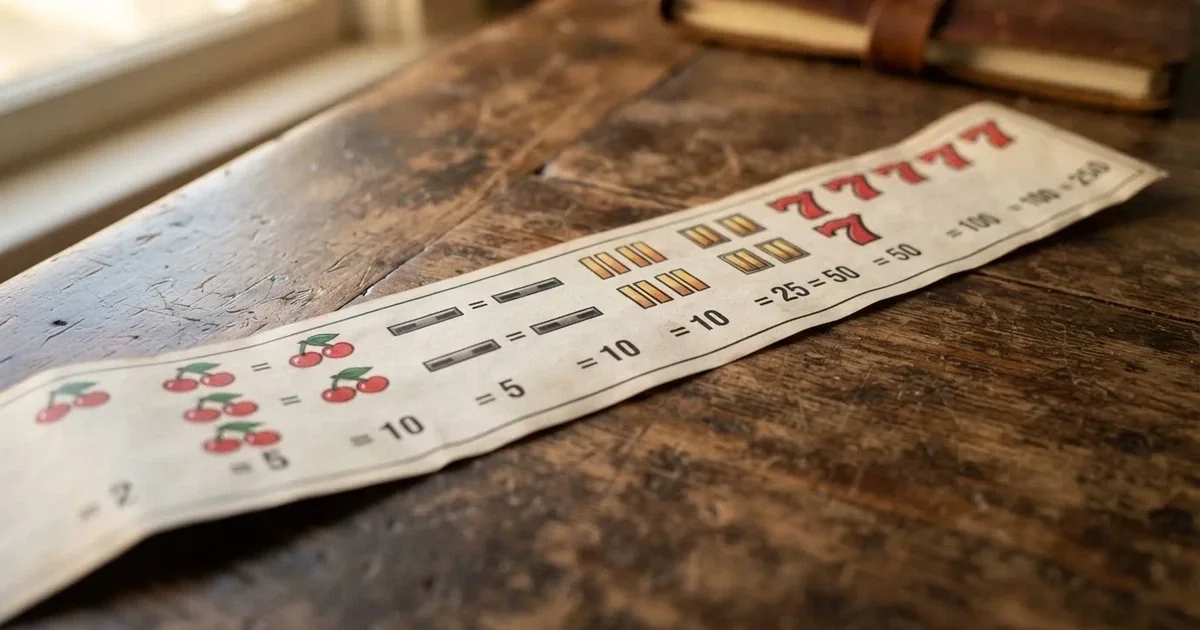
Five-Reel Slots in Australia: What Follows From the Format, the Law, and the Offshore Shelf
 Available in US
A “five-reel slot” refers to a hardware design, three spinning drums versus five. In Australia, the practical distinction is legal: every online casino game and every online pokie is prohibited under federal law, so a five-reel slot you can play for real money on a phone or laptop lives only on offshore sites the ACMA has spent 2026 actively warning and blocking. That second fact changes everything the first one implies about paytables, bonus rounds and “free spin” offers. This page walks through the format itself, the legal frame around it, the responsible-gaming resources that apply to anyone considering offshore play, and the shelves of bonus and game language the topic drags along, then closes with the eleven operators the ACMA itself has formally warned in the last few years. The angle is consequence: what each finding actually means for a reader, and when the bill comes due.
Currency and licence data current as of 23 September 2026, checked against the ACMA’s published formal-warning register.
Table of Contents
- The Format: Why Five Reels, and What a Paytable Actually Does
- The Legal Frame: What the Interactive Gambling Act 2001 Actually Prohibits
- When Play Crosses a Line: Responsible-Gaming Resources That Actually Apply
- Bonus Offers and Free Spins: What the Language Promises Versus What It Costs
- What “5 Reel Slots” Usually Points At: Specific Games, Providers, and the Live Format
- The Warning Register: Operators the ACMA Has Formally Warned
- The Blocking Rate: How the ACMA’s Enforcement Has Run
- What “Best” Means in a Market Where the Product Is Prohibited
- Frequently Asked Questions
The Format: Why Five Reels, and What a Paytable Actually Does
A five-reel slot is the descendant of Charles Fey’s late-19th-century three-reel mechanism, the one with five symbols per reel (horseshoes, diamonds, spades, hearts and the Liberty Bell) where three bells in a row paid ten nickels. The Liberty Bell paid out by hand. Bally’s 1963 Money Honey added a bottomless hopper and automatic payouts up to 500 coins without an attendant. The first video slot, Fortune Coin Co.’s 1976 machine in Kearny Mesa, broke the link between reel count and physical hardware: a video reel is a number on a screen, and a designer can stack the deck however they like. By the late 1970s, video slots were running on five reels, and the modern video slot — the standard five-by-three grid most players picture — is what “five-reel” usually means in 2026, not the older electromechanical stepper still common in NSW clubs.

What changes mechanically when you add a fourth and fifth reel is the combinatorics. A three-reel machine with about ten symbols per reel offers roughly a thousand possible combinations; a modern video slot with five reels and fifty-plus symbols per reel can push the odds on the top combination to three hundred million to one. A larger odds denominator does two things at once: it lets the designer space out small wins so the machine pays out more often in nominal terms, and it lets them attach a fat top prize to a much rarer event. The first is what a paytable calls “low volatility” or “high volatility”; the second is what a paytable calls a jackpot. A reader who treats those two numbers as separate decisions is reading the paytable right; a reader who treats them as a single ranking of “best” is reading it wrong.
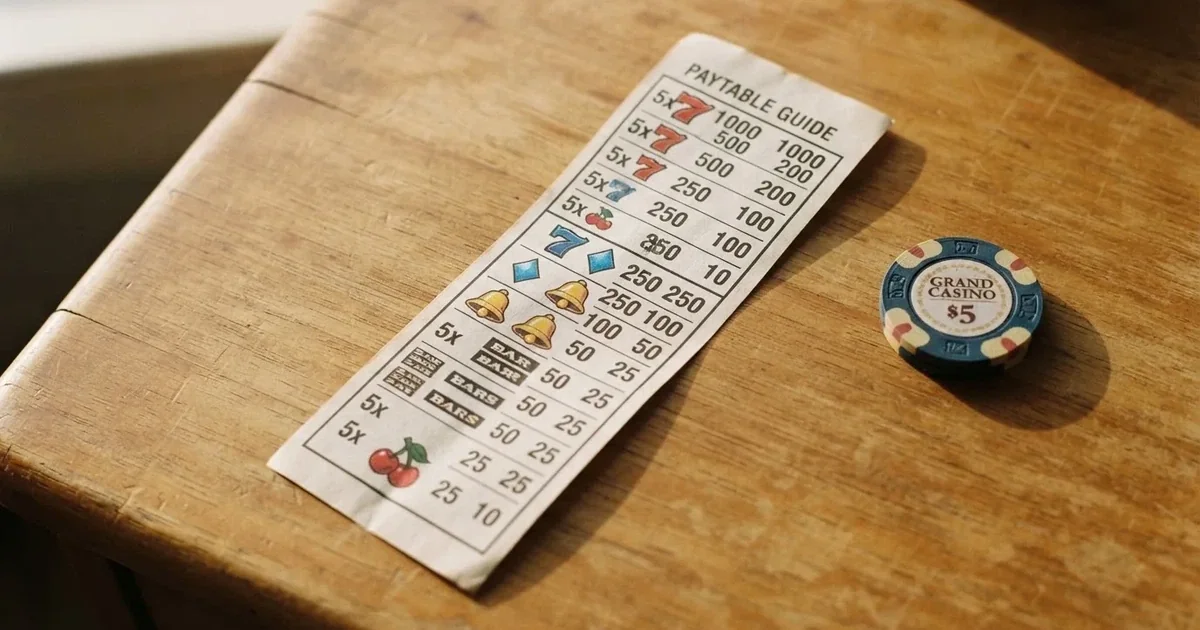
A paytable is a reference chart, not a promise. Each symbol on each reel carries a credit value for each match length (three-of-a-kind, four-of-a-kind, five-of-a-kind), and the paytable lists those values as credits multiplied by the line bet. Wilds substitute, scatters trigger bonus rounds independent of line position, and free-spin features multiply wins during a defined window. None of this changes the underlying arithmetic: every spin is an independent draw from a fixed distribution, and the paytable’s job is to show what that distribution pays when it lands. In the United States, state regulators set minimum payout percentages — Nevada 75%, Mississippi 80%, New Jersey 83% — which is one way a regulator can make the distribution less tilted toward the house. Australia has no equivalent floor for the offshore sites mentioned, because no state or territory licences them at all.
The format’s payoff is its readability. A five-by-three grid with one payline and a single symbol set is what an older player learned on; a five-reel video slot with twenty lines and a free-spin feature is the same template with knobs turned up. The house edge runs in the same place either way — in the gap between true odds and payout odds on every individual line — but the noise around it gets louder as the feature count rises. That is the practical meaning of “volatility” in plain English: a low-volatility machine pays often and small, a high-volatility machine pays rarely and large, and the long-run edge is roughly the same. The reader who picks a slot by volatility picks a session texture, not a probability.
The format, then, is neutral. The container the format runs in is not.
The Legal Frame: What the Interactive Gambling Act 2001 Actually Prohibits
The Interactive Gambling Act 2001, tightened by the Interactive Gambling Amendment Act 2017, makes it a criminal offence to supply online casino games, online pokies or in-play betting to a person physically in Australia. No state or territory issues a licence for them; the prohibition is federal and uniform. The penalty attaches to the provider, not the player, which is the part of the law most often left out of marketing copy: an Australian punter is not prosecuted for opening an offshore account, but the offshore site is also under no obligation to honour one. The consequence of the prohibition is that every “real money” five-reel slot you can reach from an Australian IP address is, by definition, being offered in breach of Australian law. Whether the operator’s footer carries a Curaçao or Anjouan seal changes nothing about that — those licences cover the operator’s relationship with its own regulator, not the legality of the offer to an Australian player.

What is licensable is wagering on races and sport placed before the event, lotteries and keno, in practice licensed through the Northern Territory Racing and Wagering Commission (NTRWC). The NTRWC covers fifty-two online bookmakers — Sportsbet, Bet365, Ladbrokes among them — and it has no full-time staff and meets once a month in Darwin, a structural detail worth knowing because it shapes how seriously the body polices its own licensees. The minimum age for any licensed wagering in Australia is 18.
Payments to licensed wagering are themselves constrained. Since 11 June 2024, credit cards, credit-related products and digital currency are banned as a deposit route for licensed online and phone wagering; the operator penalty runs to A$247,500. Legal deposit routes are debit card, bank transfer, PayID/Osko and BPAY. An offshore site that asks for a credit card or a Bitcoin deposit is therefore a site that is, by payment method alone, operating outside the Australian rules — and a deposit is the moment an Australian player hands over something the Australian rules were designed to keep in the player’s account.
The 2026 reform picture: the Interactive Gambling Amendment (Gambling Reform) Bill 2026 passed Parliament on 19 August 2026. Its advertising and inducement measures commence on 1 January 2027, which means a 2026 reader is looking at a law with a start date, not yet in force. The relevant point for this page is not what the reform will eventually do but what already applies: every offshore offer an Australian can reach today is in breach of the IGA as it stands, and the reform’s advertising rules will narrow the funnel into those offers without legalising the offers themselves.
Tax: gambling winnings of a recreational player are not assessable income under section 6-5 of the ITAA 1997, and losses are not deductible, unless the person carries on a business of gambling. That is the ATO’s general position, not a personal ruling, and a reader with anything resembling a side income from offshore play should treat the phrase “check with the ATO” as the operative clause.
The consequence of the legal frame, made plain: there is no legitimate Australian-facing way to play a five-reel slot online for real money. The format is licensable nowhere in Australia; the offshore sites that offer it are doing so in breach of the IGA; and the Australian consumer-protection regime the reader might assume exists does not reach them.
When Play Crosses a Line: Responsible-Gaming Resources That Actually Apply
The responsible-gaming resources worth naming here are the ones that work in the Australian legal frame, because the offshore frame offers essentially none. The National Gambling Helpline is 1800 858 858 — free, 24/7, with chat at Gambling Help Online — and it is the single most useful number to write down before any other action.
BetStop, the National Self-Exclusion Register, has been live since August 2023. It binds Australian-licensed online and phone wagering services only; the moment a player moves offshore, BetStop stops applying. A reader who has registered with BetStop and then opens an offshore account has not excluded themselves from that account; they have excluded themselves from the licensed side of the market and left the unregulated side untouched. That gap is the most consequential design choice in the offshore funnel, and it is not advertised.
Help lines and counselling services do still work for offshore players — the helpline does not ask which site the caller has been using — but a complaint body does not. There is no Australian ombudsman for an offshore operator, no ACMA dispute resolution, no path to a refund if a withdrawal is refused. The legal prohibition runs in one direction only: at the operator. Once the money has gone offshore, it stays there.
Bonus Offers and Free Spins: What the Language Promises Versus What It Costs
The topic drags a shelf of bonus vocabulary along with it — “5 reel bonus slots,” “free 5 reel bonus slots,” “free 5 reel bonus slots online” — and almost none of it is a description of an Australian offer, because no such offer is licensable. The vocabulary is a description of the offshore offer funnel, and the consequence of reading it as a neutral shopping list is what this section is for.
A “free spins” offer is, mechanically, three things stacked on top of each other: a number of spins, a per-spin stake set by the operator, and a set of conditions on what the resulting winnings can become. The conditions are the part a paytable doesn’t show. Wagering requirements mean the bonus balance has to be turned over a stated multiple of times before it converts to withdrawable cash; a 40x turnover on a A$100 bonus is A$4,000 of slot play before the bonus is “cleared.” Maximum cashout caps put a ceiling on what a free-spin result can ever become, regardless of how it lands. Game weighting means not every slot contributes the same percentage to the turnover requirement — a 100% weighted slot counts every dollar, a 20% weighted slot counts one-fifth. And expiry windows mean a bonus that isn’t cleared inside, say, seven days is forfeit.
The marketing word for these structures is “bonus.” The arithmetic word for the same structures is cost. Required turnover divided by stake-per-spin gives the number of spins; spins at five seconds each gives the play time; that play time is what a player is being asked to give in exchange for the bonus they were given. Expected loss through the wagering requirement is turnover multiplied by one minus the slot’s RTP, and an offshore site’s house edge is not Australian-regulated, so the RTP it publishes is whatever it says it is. The “free” in “free spins” is the cheapest word on the page, and it is the one with the most conditions attached.
None of this is a reason to chase the offer. It is a reason to read it. The consequence of treating a bonus as a free thing is that the conditions do not exist; the consequence of treating it as a cost is that the conditions are the price.
The Australian-licensed side does not run casino bonuses at all — the IGA prohibits the underlying product — so the only consumer protection framework that might cap bonus terms in Australia applies to licensed wagering on sport. That framework is a different page.
What “5 Reel Slots” Usually Points At: Specific Games, Providers, and the Live Format
The “specific games” cluster for this topic is, by the same legal frame, empty. A reader typing “best 5 reel slots Australia 2026” is reaching for an offer that no Australian-licensed site makes, and the gaming-floor side of the market — Crown Melbourne’s table games, NSW and Victorian pub and club machines — runs a different category of product. Crown Melbourne offers three baccarat variants — Traditional Baccarat, Crown Baccarat and 2 to 1 Baccarat — as approved table games regulated by the Victorian Gambling and Casino Control Commission (VGCCC), which replaced the VCGLR as Victoria’s casino regulator on 1 July 2022. Crown’s blackjack variants include a renamed “Crown Pairs” side bet (previously “Perfect Pairs,” renamed 23 December 2024) and a “Free Bet” option with a new “Pot of Gold” side bet introduced 25 March 2024. Both of these are table games, regulated by the VGCCC under the Casino Control Act 1991; neither is a five-reel slot.
The pokies-style slot machines outside Australian casinos exist in significant numbers: 87,298 in New South Wales as of June 2023, 26,380 in Victoria in 2021–22, 21,122 in Queensland in October 2023, 11,672 in South Australia in September 2023 and 3,587 in the ACT in November 2023. NSW legalised slot machines in 1956; by 2010 Australia ran an estimated 97,103 gaming machines outside casinos, a per-capita rate about five times that of the United States. These are physical machines, distributed through clubs and hotels, governed by state-level harm-minimisation regimes including mandatory pre-commitment in some jurisdictions. They are not the subject of this page but they are the format the search query pretends to be about, and a reader who ends up in a club looking for a “five-reel slot” has missed the legal distinction the topic runs on.
For the rest — the offshore video slots the search query actually points at — there is no Australian-licensed provider to name. A licensed Australian wagering provider offers wagering; it does not offer a five-reel slot. The “specific games” shelf closes, in this market, as a statement about what the shelf is empty of.
The Warning Register: Operators the ACMA Has Formally Warned
The market does not produce a ranking — no Australian-licensed operator offers a five-reel slot, so the natural way to rank them (by licence, by payout speed, by RTP) has no rows. What the market does produce is a list of operators the ACMA has spent the last several years actively warning, and the consequence of that list is the closest thing this page can responsibly offer to a snapshot of the regulatory situation. These are not recommendations. They are the named operators on the ACMA’s own register, with the date and operator the regulator published. Each of them has offered prohibited services to Australians. None of them has an Australian licence, by definition of the product.
The table below covers the eleven operators the ACMA has formally warned in recent years, with the regulator-published operator name, the action date and the brand as listed by the regulator.
Operator Warning Patterns
| Pattern | Definition | Count |
|---|---|---|
| Repeat Offender | Multiple formal warnings over time | 3 |
| First-time Warning | One recorded formal warning | 8 |
| Brand | ACMA action and date | Operator named by the ACMA | Subject support |
|---|---|---|---|
| RocketPlay | Formal warning, March 2026; earlier warning to Dama N.V. covering the brand, May 2022 | Pulsup Ltd (Rocketplay.com.au); earlier Dama N.V. | — |
| Level Up Casino | Formal warning, May 2022 | Dama N.V. | listings-only (Bgaming.com) |
| Woo Casino | Formal warning, March 2025 | Dama N.V. | — |
| Spirit Casino | Formal warning, May 2025 | Dama N.V. | — |
| National Casino | Formal warning, July 2025 | Consolutetish S.R.L. | listings-only (en.wikipedia.org) |
| Bizzo Casino | Formal warning, July 2025; earlier warning to TechSolutions, 2022 | Consolutetish S.R.L.; earlier TechSolutions (CY) Group Limited and TechSolutions Group N.V. | — |
| Ignition Casino | Formal warning, July 2025 | Bamboo Media | — |
| Instant Casino | Formal warning, February 2025 | EOD Code SRL | — |
| Jackbit | Formal warning, April 2026 | Ryker B.V. | — |
| Casino Intense | Formal warning, April 2025 | Sterplay Holding Ltd | listings-only (Abc.net.au, acma.gov.au, Crownmelbourne.com.au) |
| Sky Crown | Formal warning, September 2022 | Hollycorn N.V. | — |
Three of the eleven operators carry no data on the subject line — meaning the research could not verify any specific support for the five-reel slot claim itself, only the warning. Three others are listed only as marketing-listings or news mentions, which means the listing itself is what the source carries, not a verified endorsement. The remaining five have no subject support data at all, and on this page that is stated plainly rather than padded out.
RocketPlay
RocketPlay was warned over its Australian-facing site Rocketplay.com.au in March 2026, with the operator named as Pulsup Ltd. An earlier warning, in May 2022, was issued to Dama N.V. and covered RocketPlay among six brands. The site continues to be reachable from Australian IP addresses, which is the operational meaning of “formal warning” in this market: the regulator publishes the warning and the site adjusts its marketing or its payment funnel, but the underlying prohibition is unchanged and the ACMA does not have a takedown switch. The verdict here is that RocketPlay is, on the regulator’s own register, a site the ACMA has named twice in four years, and this demonstrates that a formal warning is a public notice rather than a site-closure order.
Level Up Casino
Level Up was named in the same May 2022 Dama N.V. warning that covered RocketPlay and four other brands. The subject support research carries for Level Up is a listing on Bgaming.com, which is a provider catalogue rather than a regulatory endorsement; the page carries that as a listing source only, not as evidence Level Up offers a five-reel slot in any specific sense. The verdict is a thinner one than the others: the warning is real and dated, but the underlying offer’s relevance to a reader who specifically wants a five-reel slot is not established by the sources.
Woo Casino
Woo Casino drew an ACMA formal warning in March 2025, again to Dama N.V. The brand continues to operate from offshore and continues to accept Australian registrations. The consequence of the warning, in practical terms, is that the brand’s name appears on the regulator’s register and that the ACMA can ask Australian ISPs to block the site in a future round. Whether the brand offers a five-reel slot in any specific technical sense is not established by the research, and the page carries no claim in that direction.
Spirit Casino
Spirit Casino drew a formal warning in May 2025, again to Dama N.V. — the fourth brand in this list to share the same operator name. The verdict is the same as Woo Casino’s, with the additional observation that an offshore operator collecting multiple ACMA warnings across multiple brands is, structurally, an operator the ACMA has identified as a repeat entrant in the prohibited-services market.
National Casino
National Casino drew a formal warning in July 2025, with the operator named as Consolutetish S.R.L. — the same operator named in the same July 2025 round for Bizzo Casino. National Casino’s subject support carries as a Wikipedia listing only, which means a reader who lands on National Casino’s site from a search result has reached a site the ACMA has named in the same breath as Bizzo, and the search result itself is part of the marketing shelf the ACMA’s blocking action targets.
Bizzo Casino
Bizzo Casino was named in the same July 2025 round, with Consolutetish S.R.L. as the operator, but the brand carries a longer history: an earlier formal warning to TechSolutions (CY) Group Limited and TechSolutions Group N.V. in 2022. Two warnings across four years, under two different operator names, is the pattern the ACMA’s register most often surfaces when an offshore brand has been re-launched under a new corporate wrapper. The consequence is the same one a reader should keep in mind for any entry on this list: a brand that has been warned twice under two names is, in regulatory terms, the same offer.
Ignition Casino
Ignition Casino drew a formal warning in July 2025, with the operator named as Bamboo Media. Ignition has historically been pitched at the Australian-facing poker and casino market, and the warning places it in the same July 2025 round as National Casino and Bizzo. The verdict on this site is the same as on every other entry: the offer is prohibited, the warning is on the register, and there is no Australian-licensed counterpart for a reader to switch to.
Instant Casino
Instant Casino drew a formal warning in February 2025, with the operator named as EOD Code SRL. The brand is among the more recent entrants to the Australian-facing offshore funnel, and the warning is the first the ACMA has published against this operator name. The consequence is the same as for every other entry, with one structural note: a first warning on a new operator name is what the ACMA’s register most often shows in the year before the operator expands into more brand wrappers, so Instant Casino represents a typical entrant in the offshore funnel.
Jackbit
Jackbit drew a formal warning in April 2026, with the operator named as Ryker B.V. The same April 2026 round named CasinOK under the same operator. Jackbit is the most recent entry on this list and the one most likely to be still actively marketed to Australian players at the time a reader reaches this page; the consequence is that the warning is fresh and the operator’s offer is still in the funnel.
Casino Intense
Casino Intense drew a formal warning in April 2025, with the operator named as Sterplay Holding Ltd. The subject support research carries for Casino Intense is a set of listings on Australian news and regulator pages — ABC, ACMA, Crown Melbourne — which is a profile consistent with a brand that surfaces in Australian media coverage but carries no Australian regulatory endorsement. The verdict is the same as for the other listings-only entries: the warning is on the register, but these sources do not constitute an endorsement.
Sky Crown
Sky Crown drew a formal warning under the Interactive Gambling Act 2001, with the operator named as Hollycorn N.V. Hollycorn’s warning also covered a sister brand, Blue Leo, and the warning is one of the older entries on this list. The brand has continued to operate from offshore across the intervening period, which is the most common long-run outcome of an ACMA formal warning — the regulator publishes, the operator adjusts, and the offer stays in the funnel.
The Blocking Rate: How the ACMA’s Enforcement Has Run
The ACMA’s enforcement against offshore gambling and affiliate sites has accelerated since the November 2019 blocking request that established the current mechanism. As reported in June 2026, a total of 1,751 illegal gambling and affiliate marketing websites had been blocked since that first request, and more than 230 unlicensed gambling services had left the Australian market since enforcement was strengthened in 2017. That is the cumulative figure; the rate at which the ACMA has been adding to it is what gives the reader a clear sense of the enforcement pace.
The arithmetic is straightforward: 1,751 blocks over a window from November 2019 to June 2026 is roughly 80 months of operation, which gives an average of about 22 blocks per month, or a little over one site blocked every thirty-six hours. In practice the rate has not been flat — blocking rounds cluster, and the June 2026 round alone asked Australian ISPs to block twelve more sites: 7Signs, ChromaBet, Donbet, Duospin, Freshbet, Slots Gem, Jacks Club, Lucky Start, Pointsbetz.com, Spinrise, Vinyl Casino and Wildsino — but the average is the right shape to communicate to a reader who wants to know how fast the funnel is closing. The consequence of that rate is that any single brand on the warning list above can find its site blocked by an Australian ISP in a future round, and a reader with an open offshore account on that site at the time of the block has a balance they cannot reach through normal Australian channels.
The H2 Gambling Capital 2025 report puts the value behind the blocked sites at about A$3.9 billion a year flowing to illegal gambling operators, with the share of Australian gambling going through legal channels falling from 74% in 2021 to 64%. That is the loss figure, not a recovery figure: the 1,751 blocks are not money returned to Australian players, they are sites removed from reach. The consequence is that the legal channel is shrinking in share while the ACMA is shrinking the illegal channel in volume, and the two trends run in opposite directions because the offshore offer is growing faster than the enforcement is removing it.
For a reader, the practical implication is shorter than the figures: an account at any brand on the table above can be blocked with a balance still on it, the ACMA does not arbitrate withdrawals, and the licensed Australian alternative is a different product entirely.
What “Best” Means in a Market Where the Product Is Prohibited
The request asks for a “best” ranking, and the legal frame forecloses it: there is no Australian-licensed five-reel slot product, so there is no Australian-licensed shelf to rank. The closest the page can responsibly come is the ACMA’s own register, which is the list of operators the regulator has named, the dates it has named them, and the consequence — that any of them can be blocked in a future round. That is the shelf this page has built, and a reader comparing options has it in one place.
A reader who wants to play a five-reel slot in Australia has three honest paths. The first is the physical machine: pubs and clubs in NSW, Victoria, Queensland, South Australia and the ACT run pokies-style machines numbering in the tens of thousands per state, and those machines are governed by state-level harm-minimisation regimes that include mandatory pre-commitment in some jurisdictions. The second is to register with BetStop and to use only Australian-licensed wagering on sport and racing, which is the only product the IGA permits online. The third is to step away from the offer entirely and to use the National Gambling Helpline at 1800 858 858, or Gambling Help Online chat, if the impulse to play has become difficult to manage.
The search term is what people type. The page is what they need to know once they have typed it. The two are not the same list.
Frequently Asked Questions
What makes a 5-reel slot different from a standard five-reel video slot?
In the modern video era a five-reel slot is the standard five-reel video slot — five reels, three rows, a paytable on the side — and “5-reel” in 2026 marketing usually means exactly that. The format is the descendant of Charles Fey’s three-reel Liberty Bell, and the move to five reels in the late 1970s video era is what gave designers room to add bonus features. The combinatorics change: a five-reel machine with fifty-plus symbols per reel can produce odds on the top combination as high as three hundred million to one.
Can 5-reel slot machines be found in licensed Australian pubs and clubs?
Yes. New South Wales had 87,298 pokies-style machines outside casinos as of June 2023, with similar tens-of-thousands figures in Victoria, Queensland, South Australia and the ACT. These are physical machines governed by state-level harm-minimisation regimes. Online five-reel slots for real money are a separate category and are prohibited under the Interactive Gambling Act 2001.
Do 5-reel slots typically pay out differently than newer five-reel formats?
The reels themselves don’t determine the payout; the paytable does. A five-reel slot with low volatility pays often and small, a high-volatility slot pays rarely and large, and the long-run house edge runs in roughly the same range across both. The United States sets minimum payout percentages at the state level — Nevada 75%, Mississippi 80%, New Jersey 83% — but Australia has no equivalent floor for offshore sites because none are licensed.
Is a 5-reel slot online the same game as a 5-reel machine on a casino floor?
Not in any meaningful sense. A physical machine in a Crown Melbourne floor game is part of a regulated product suite — Crown offers three baccarat variants and a changing slate of blackjack side bets — and runs under Victorian casino law. An online five-reel slot is an offshore product that cannot be lawfully supplied to an Australian player under the IGA, with no Australian consumer protection, no complaints body and no enforced payout floor.
Are 5-reel slots for real money available legally from an Australian-based site?
No. The Interactive Gambling Act 2001 prohibits the supply of online casino games and online pokies to anyone in Australia, and no state or territory issues a licence for them. The only licensable online products are wagering on races and sport placed before the event, lotteries and keno, in practice licensed through the Northern Territory Racing and Wagering Commission. A site accepting an Australian registration for a five-reel slot is operating in breach of the IGA.
Does a slot’s reel count change how its paytable and volatility are usually described?
Indirectly. Reel count changes the maximum odds on the top combination — a five-reel, fifty-symbol slot has a far higher top-jackpot odds than a three-reel, ten-symbol slot — and designers use that extra denominator to set volatility. A low-volatility five-reel slot has lots of small wins; a high-volatility one has rare large ones. The house edge runs in the gap between true odds and payout odds on each line and is roughly the same across the volatility range, which is why picking a slot by volatility picks a session texture rather than a probability.
Published by the Pokies Info Hub team.