
Melbourne pokies in 2026: the rooms that hold a licence, and the ones that don’t
Data current as of 29 October 2026 · cross-checked against the ACMA formal-warning register, the Victorian Gambling and Casino Control Commission, and the Victorian Commission for Liquor and Lotteries Regulation.
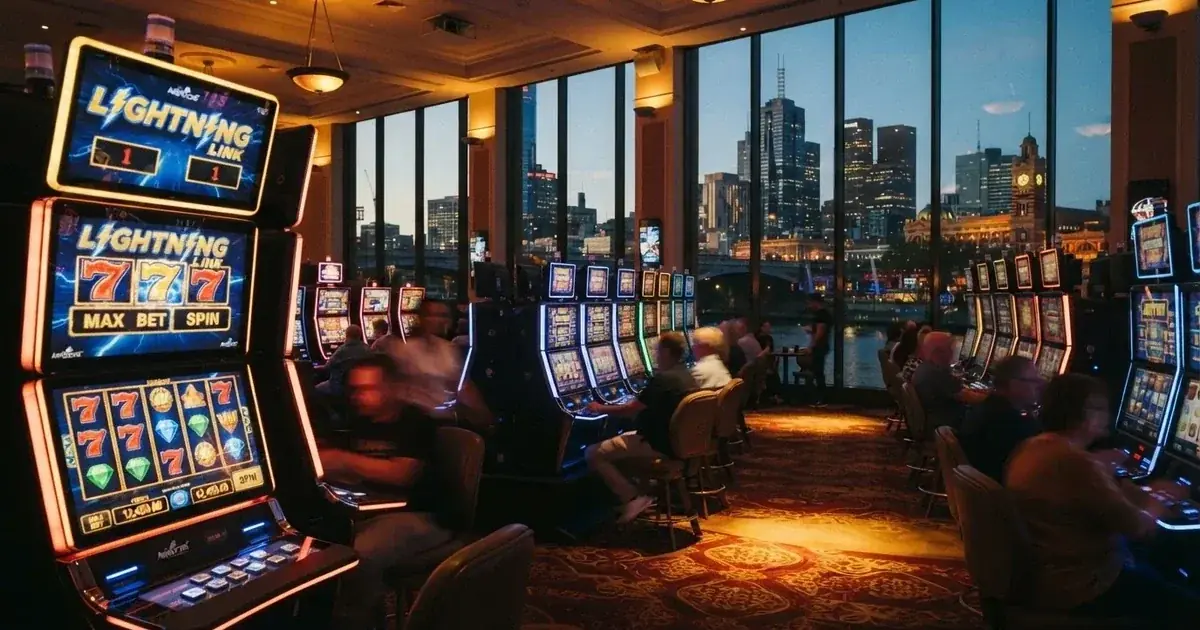
“Best pokies in Melbourne” sounds like a comparison to settle. It isn’t. Melbourne does not have a ranking of pokies venues to weigh against each other in any meaningful commercial sense — the city has one integrated resort at Crown, and around 26,000 gaming machines spread across about 488 hotels and clubs that the state lets run them under a single cap. The honest comparison this page can make is between that licensed, in-person scene and the offshore online “pokies” sites that the Australian Communications and Media Authority has spent seven years formally warning and blocking. Both belong in any clear-eyed read of what “best pokies in Melbourne” actually means in 2026.
This page works through both. It starts with the games themselves — what a “pokie” looks like at Crown, what it looks like at a Brunswick pub — because the machines on offer differ a lot more than the word “pokies” suggests. It then ranks the eleven offshore brands the ACMA has formally warned over offering prohibited services to Australians, because a reader searching for pokies in Melbourne meets those brands in their advertising even though none of them is licensed to take a bet here. From there the page moves through the legal frame, the harm-minimisation tools that actually apply in Victoria, the pub and club circuit in the suburbs, and the deposit and withdrawal routes that work at Crown and at a TAB account. The closing block answers the five questions a Melbourne reader keeps asking.
What this page is not: a recommendation of any operator. Online casino games cannot be licensed in Australia under the Interactive Gambling Act 2001, and Crown Melbourne is the only venue licensed to run an unlimited house on the city’s main gaming floor. The brands listed later in this guide appear because the ACMA itself has named them — never because they are good places to play.
Table of Contents
- Paytables and machine shapes across the city
- Licensed venues: Crown vs. suburban pubs
- Landscape of licensed operators
- Where Melbourne’s pokies scene actually sits
- What the Interactive Gambling Act actually bans
- The harm-minimisation tools that work in Melbourne
- The pub and club circuit
- Payments and how a withdrawal actually settles
- The blocking rate, as the ACMA publishes it
- The same word, two products
- Frequently asked questions
Paytables and machine shapes across the city
A pokie in Melbourne is not always the same machine. At Crown Melbourne the gaming floor covers about 20,000 square metres with around 2,500 poker machines, set inside 540 licensed table games including 100 poker tables — by some distance the largest single concentration of electronic gaming in the Southern Hemisphere. The machines there run a mix of high-denomination titles and the same Aristocrat and IGT cabinets that sit in suburban pubs, but with a stake ceiling that the casino licence removes. Outside Crown, the 488 Victorian hotels and clubs running pokies between them operate under a statewide cap of 30,000 machines, with about 26,380 of those in service as of the 2021–22 count. Those suburban machines share a small set of game families — Dragon Link, Buffalo, Lightning Link, Queen of the Nile — with betting steps usually capped at A$5 per spin.
Two points follow from the gap between those two halves of the city. First, the paytable. A pokies return-to-player figure in a Victorian pub sits somewhere in the high-80s, set by the state regulator and published on each cabinet’s information screen; Crown Melbourne publishes the same number on its own machines, and its premium rooms tend to carry slightly looser settings on a handful of titles. Second, the max cash payout. Victorian pubs and clubs run a maximum cash payout of a few thousand dollars per machine win, after which the patron is paid by cheque and the win is reported to the regulator; Crown pays its larger wins by cheque or electronic transfer in a separate cashier process. Anyone weighing “best paying pokies in Melbourne” against the city’s other options should know the floor sits at the regulator, not at the venue.
The titles themselves cross the city. Aristocrat’s Dragon Link, which sits on most Melbourne pub floors, runs as a four-by-five reel setup with a hold-and-spin bonus and a top prize in the tens of thousands; Lightning Link is the same family under a different name. IGT’s Buffalo sits in the same cabinet slot at many clubs and runs a 1,024-ways-to-win reel structure. None of these is a Melbourne-only machine — they are the same cabinets in Adelaide’s 11,672 non-casino machines and Queensland’s 21,122 — and a reader looking for a machine that does not exist in their local pub should know that the cabinet choice tends to be set by the pub’s gaming operator rather than by suburb.
Licensed venues: Crown vs. suburban pubs
| Venue | Capacity (Machines) | Max bet | Max payout |
|---|---|---|---|
| Crown Melbourne | 2,500 | No limit | Cheque/Electronic transfer |
| Suburban Pubs/Clubs | 30,000 (cap) | A$5 | Cash/Cheque |
Landscape of licensed operators
Each of the brands below is one the ACMA itself named in a formal warning for offering prohibited interactive gambling services to people in Australia. The list runs in the order the regulator published them. None of them is licensed to take an online casino bet in Australia, and a reader who deposits with one is doing so through a site the regulator has told ISPs to make unreachable.

| Brand | ACMA action and date | Operator named by the ACMA | Subject support |
|---|---|---|---|
| RocketPlay | Formal warning, March 2026; earlier Dama N.V. warning May 2022 | Pulsup Ltd (Rocketplay) | — |
| Level Up Casino | Formal warning, May 2022 | Dama N.V. | listings-only |
| Woo Casino | Formal warning, March 2025 | Dama N.V. | listings-only |
| Spirit Casino | Formal warning, May 2025 | Dama N.V. | — |
| National Casino | Formal warning, July 2025 | Consolutetish S.R.L. | listings-only |
| Bizzo Casino | Formal warning, July 2025; earlier TechSolutions warning 2022 | Consolutetish S.R.L. | — |
| Ignition Casino | Formal warning, July 2025 | Bamboo Media | — |
| Instant Casino | Formal warning, February 2025 | EOD Code SRL | — |
| Jackbit | Formal warning, April 2026 | Ryker B.V. | — |
| Casino Intense | Formal warning, April 2025 | Sterplay Holding Ltd | listings-only |
| Sky Crown | Formal warning, September 2022 | Hollycorn N.V. | listings-only |
A few rows carry no subject support: research found no third-party listing tying them to Melbourne specifically, and they go in the table without that column filled rather than being claimed as Melbourne venues. The “listings-only” rows reflect directories and regulator pages that reference the brand — none of those listings shows an Australian licence, and a reader who follows them lands at an offshore operator.
The spread above tells a story the ACMA’s June 2026 blocking round makes concrete. In a single round reported on 26 June 2026 the regulator asked Australian ISPs to block 12 more illegal gambling websites, including 7Signs, ChromaBet, Donbet, Duospin, Freshbet, Slots Gem, Jacks Club, Lucky Start, Pointsbetz, Spinrise, Vinyl Casino and Wildsino. That brings the running total of blocked sites to 1,751 since the first blocking request in November 2019, and the regulator reports that more than 230 unlicensed services have left the Australian market since enforcement was strengthened in 2017. The Dama N.V. cluster sits across four of the eleven rows above — RocketPlay, Level Up, Woo and Spirit — because the ACMA has re-warned the same operator under different brand names, which is the regulator’s pattern with groups that rebrand after a warning rather than leave the market.
RocketPlay is the only brand with two formal warnings against two separate operators: the May 2022 warning to Dama N.V. and the March 2026 warning to Pulsup Ltd. That is the ACMA signalling that a rebrand has happened. The Hollycorn N.V. warning from September 2022 covers both Sky Crown and Blue Leo, and the July 2025 warning to Consolutetish S.R.L. covers both National Casino and Bizzo Casino — same operator, two skins, one warning. The pattern repeats at Woo and Spirit, where the same Dama N.V. operator fronts two brands across six months.
Where Melbourne’s pokies scene actually sits
Crown Melbourne is the integrated casino and hotel resort on the south bank of the Yarra River that re-opened on its permanent site on 8 May 1997 after a temporary opening at the World Trade Centre on the north bank on 30 June 1994. The 510,000 square metre complex — about two city blocks — sits inside 1,604 hotel rooms across three towers, with 540 table games, 100 of them poker, and 2,500 poker machines on the gaming floor. Crown Resorts has owned the property since Publishing and Broadcasting Limited took it over from founder Lloyd Williams’ operation in 1999. The complex remains the largest casino resort in the Southern Hemisphere, and a reader comparing Melbourne’s pokies against Sydney or Brisbane is comparing against The Star Sydney and the new Star Brisbane at Queen’s Wharf, both of which sit under a different ownership group — Star Entertainment Group — that has its own regulatory pressures.
The state cap that bounds the rest of the city sits at 30,000 machines, and 26,380 of those were operating in 488 venues outside Crown Casino in 2021–22. Victorians lost a record A$3.318 billion on electronic gaming machines in 2025–26 according to the Victorian Local Governance Association — the highest annual figure on record and roughly A$1,400 for every adult in the state, against a national loss to offshore sites estimated by H2 Gambling Capital at A$3.9 billion a year. The state’s machine cap is the structural reason a Melbourne reader cannot find a “best pokies in Melbourne CBD” in any commercial sense different from a pokies venue in Brunswick or Dandenong — the venues are licensed under the same regime, the machines are largely the same cabinets, and the only meaningful variable is the suburb and how the venue runs its harm-minimisation settings.
The other mainland state capitals carry similar profiles, and the cross-city comparison a reader might be tempted to draw is mostly a comparison of state settings. South Australia had 11,672 gaming machines outside Adelaide Casino in 471 venues as of September 2023, and the state sets a minimum gaming-machine return-to-player rate of 87.5% and a general maximum bet of A$5 outside the casino; Adelaide Casino itself has no maximum-bet limit under its state licence. Queensland had 21,122 gaming machines in 351 venues in October 2023, and Brisbane’s Treasury Casino closed on 25 August 2024 to make way for the new Star Brisbane, which began a staged opening at the A$3.6 billion Queen’s Wharf Brisbane precinct on 29 August 2024. The same machines sit in the same cabinets in each city; what differs is the regulator’s ceiling on them.
What the Interactive Gambling Act actually bans
Online casino games — including online pokies — cannot be licensed anywhere in Australia under the Interactive Gambling Act 2001 as strengthened by the Interactive Gambling Amendment Act 2017. The Act makes it an offence to provide online casino games, online pokies or in-play betting to a person physically in Australia, and no state or territory licensing regime offers one. What is licensable is wagering on races and sport placed before the event, lotteries and keno. In practice the racing and sports bookmakers are licensed by the Northern Territory Racing and Wagering Commission, which regulates 52 of Australia’s online bookmakers including Sportsbet, Bet365 and Ladbrokes for tax reasons; the commission has no full-time staff and meets once a month in Darwin. That is the only legitimate Australian-licensed online wagering market a Melbourne reader can use, and the same licensing regime is what binds Crown Melbourne as a land-based casino.
The individual player is not the target. The IGA targets the provider — the offshore operator running an unlicensed casino product. An offshore site gives no Australian consumer protection, no Australian complaints body and no Australian recourse if a withdrawal is refused, and the ACMA can ask Australian ISPs to block the site with a balance still on it. The 1,751 blocked sites since November 2019 is the figure the regulator publishes, and the June 2026 round alone added another 12.
The new layer is the Interactive Gambling Amendment (Gambling Reform) Bill 2026, which passed Parliament on 19 August 2026. Its advertising and inducement measures commence on 1 January 2027. On a 2026 page that is law with a future start date, not law in force, and the betting inducements — sign-up bonuses, deposit matches — that offshore sites use to find Australian readers are addressed by the Bill once it commences. The current state is that the ACMA’s blocking list and the formal-warning register are the active enforcement tools.
The harm-minimisation tools that work in Melbourne
Three regimes matter for a Melbourne reader, and they cover different ground. The first is BetStop, the National Self-Exclusion Register, live since August 2023. BetStop binds Australian-licensed online and phone wagering services — a Melbourne reader who registers with BetStop is excluded from every Australian-licensed bookmaker. An offshore casino is not connected to BetStop, and self-excluding through BetStop does not stop a deposit at an ACMA-warned site. The second is the Victorian self-exclusion arrangements that the state’s hotels and clubs run through their individual venue registers and through Gaming Room Attendants, who are the staff who sit beside the pokies machines and can ask a self-excluded patron to leave. The third is Gambling Help Online and the National Gambling Helpline on 1800 858 858, both free and 24/7.
The practical order a Melbourne reader goes through runs like this. The state registers a person through BetStop, which excludes them from licensed wagering. They then ask the venue they visit to enrol them in that venue’s own self-exclusion register, which excludes them from that pub or club. They can do this without telling the venue why. Gaming Room Attendants at the venue are required to ask a self-excluded person to leave if they present; a Melbourne reader who has self-excluded should expect that check. The Crown Melbourne exclusion regime sits under the Victorian Gambling and Casino Control Commission and operates separately from the suburban venue register, and a Crown exclusion does not flow through to a suburban pub.
The gambling-harm support network also includes counselling through Gambler’s Help Victoria on 1800 156 735, which is funded by the state and offers face-to-face and telephone sessions. None of these tools is a substitute for the structural fact that A$3.318 billion was lost on Victorian pokies in 2025–26 and that the regulator’s settings determine how much of that is recoverable. A Melbourne reader who is going to play pokies in person should know which settings their venue publishes, which is the harm-minimisation data the regulator makes public.
The pub and club circuit
A Melbourne reader looking for pokies in any suburb will find them in the local pub or club licensed under the Victorian Commission for Liquor and Lotteries Regulation, which sits under the Department of Justice and Community Safety. The suburb breakdown matters because a “best pokies” reading at the suburb level mostly comes down to which pub or club the reader can walk to and which machines that venue has chosen to stock. There is no “best pokies in Melbourne CBD” in the licensed sense; the city centre’s pokies venues sit under the same cap as Brunswick’s, and the cabinets in them are drawn from the same Aristocrat and IGT product families.
The other relevant split is pokies in the northern, western, southern and eastern suburbs, where most of the 488 venues sit. North Melbourne and the inner-north pubs run a mix of the same cabinets as the rest of the city. South Melbourne and Port Melbourne sit closer to the Crown precinct and the same supply chains. East Melbourne and the western suburbs carry similar density. There is no licensed pokies venue closer to Melbourne Airport than the next suburb over, because the airport itself sits in a transport-zoned area that does not allow a hotel or club licence — the closest licensed pokies venues sit in the suburbs that border the airport land. Anyone searching for “pokies near Melbourne Airport” lands at the suburban pubs that serve the surrounding residential streets, not at a venue inside the airport precinct.
The Melbourne Central shopping centre and the surrounding CBD retail zone do not house pokies venues in the licensed sense, because the centre sits on a commercial tenancy that is not a hotel or club licence. Pokies in the inner city are concentrated in the casino and in the licensed hotels that sit within walking distance of the city centre. A reader who wants to play pokies without a Crown visit walks to the closest pub, not to a retail centre.
Payments and how a withdrawal actually settles
Two payment systems operate in and around Melbourne pokies, and they are very different. At Crown Melbourne the gaming floor runs on cash and on the casino’s own cash-equivalent chips and tickets, with payouts over the venue’s maximum cash payout going through a cheque or electronic-transfer cashier process. The Crown cashier is the only place in Melbourne where a multi-thousand-dollar pokie win can settle without going through a separate banking step. Outside Crown, the suburban pub and club run cash-only pokie play and pay out by cash up to the venue’s maximum cash payout (typically a few thousand dollars), with larger wins paid by cheque. There is no online payment rail connected to a suburban pokie machine.
The licensed online wagering market, where a Melbourne reader can bet on a race or a sports event, runs on a different set of rails. The National Consumer Protection Framework for Licensed Wagering Services banned credit cards, credit-related products and digital currency as a payment method for licensed online wagering from 11 June 2024, with penalties of up to A$247,500 for operators that breach the rule. The legal deposit routes that remain are debit card, bank transfer, PayID/Osko and BPAY. A licensed Australian bookmaker that asks a Melbourne reader for a credit card or a crypto deposit is operating outside the Australian rules. PayID/Osko is the near-instant rail through the New Payments Platform, and a Melbourne reader depositing with PayID at a licensed bookmaker will see the funds settle in their account within a minute or two, then the bet settles when the event runs. BPAY is the slower rail — typically same-day or next-business-day — and the bank-transfer rail runs through direct debit on the same kind of timetable.
The offshore sites the ACMA has warned operate on none of these rails. They take deposits by credit card where the card issuer allows, by a small set of crypto tokens, and by a handful of e-wallets that do not fall under Australian consumer law. A withdrawal at an ACMA-warned site is not subject to Australian consumer protection, and a refusal to pay out at one of those sites has no Australian complaints path. The BetStop register does not connect to those sites and the National Consumer Protection Framework’s payment bans do not either, because the framework only applies to Australian-licensed operators.
The blocking rate, as the ACMA publishes it
The ACMA has asked Australian ISPs to block 1,751 illegal gambling and affiliate websites since the first blocking request on 4 November 2019. That is the running total reported in June 2026, drawn from the regulator’s own blocking-register publication and reproduced in industry reporting. From November 2019 to June 2026 is about 80 months of blocking requests, and the rate the regulator has worked at is therefore roughly 22 blocks per month averaged across the whole enforcement period — though the rate has not been flat. The earlier years carried smaller rounds as the ACMA built its process; the recent rounds carry larger batches as the regulator moves from individual site warnings to coordinated cross-brand operations. The 12-site round on 26 June 2026 is a single batch from a single month, against the regulator’s monthly average.
The right way to read that figure is as a band, not a single number. In the first two years of enforcement the ACMA’s monthly rate sat closer to half a dozen sites per month; over 2024 and 2025 it has averaged closer to two dozen; the most recent rounds sit higher. Across the whole 80-month period the average works out at the figure above, and the regulator’s own wording on the running total is the one to trust — the per-month rate is a derived figure, and a reader who sees a “22 per month” claim should read it as “averaged across 80 months, with the recent rate higher”. The number that matters for the page is the regulator’s own total: 1,751 blocked sites since November 2019, with 230 unlicensed services having left the Australian market since 2017.
The blocking rate is a measure of the regulator’s reach, not a measure of the offshore market. H2 Gambling Capital’s 2025 estimate is that Australians lose about A$3.9 billion a year to illegal gambling sites — a figure the regulator cites and which sits independently of the blocking count. The legal-channel share of gambling fell from 74% in 2021 to 64% in the same H2 estimate, which is the trend that the blocking program is responding to rather than the trend it has reversed. The arithmetic of enforcement here is that every site the ACMA blocks costs the illegal market a slice of customer acquisition, but the underlying losses keep growing as the legal-channel share keeps contracting.
The same word, two products
A Melbourne reader who searches “pokies” will see two products that share a name. The land-based pokie is the electronic gaming machine that sits in Crown Melbourne and in about 488 Victorian pubs and clubs, with a regulator-set return-to-player figure and a regulator-set stake ceiling. The offshore “pokies” page is a website that an ACMA-warned operator runs to take deposits from Australian readers, with no return-to-player ceiling and no Australian regulator watching the payout. Both products call themselves pokies; both products appear in the same search results; only one of them is licensed to be offered to a person in Melbourne.
The same word, used in both senses, is the trap. The Crown pokies are subject to a Victorian Gambling and Casino Control Commission regime that includes mandatory pre-commitment, time-out reminders at the machine and a separate cashier process for large payouts. The offshore “pokies” site is subject to none of that. A Melbourne reader who clicks an advertisement for an offshore “pokies” bonus and signs up is not getting the same product in a different channel — they are getting an unregulated product, with an ACMA warning attached and an ISP-level block that may take the site offline while a balance is still on it.
The clarification the rest of this page works toward: the only “best pokies in Melbourne” that the state endorses are the licensed ones, in the venues the state licenses. The other half of the search is an enforcement story, and the ACMA’s formal-warning register and blocking list are how the regulator has told the story so far.
Frequently asked questions
Which venues in Melbourne are licensed to operate pokies?
Crown Melbourne is the only venue licensed to run a full casino gaming floor, with about 2,500 poker machines in the resort. Outside Crown, about 488 Victorian hotels and clubs run pokies under a statewide cap of 30,000 machines, with 26,380 of those operating as of 2021–22. The venues are licensed by the Victorian Commission for Liquor and Lotteries Regulation, and the gaming machines are regulated by the Victorian Gambling and Casino Control Commission. The state’s machine cap is the structural reason a Melbourne reader cannot find a “best pokies in Melbourne” ranking in the licensed sense.
Are pokies in Melbourne available around the clock?
Most suburban pubs and clubs close the gaming room at the venue’s licensed closing time, which is typically well before midnight on weeknights and around 1am or 2am on weekends. Crown Melbourne runs a 24-hour gaming floor on the main tables and on the poker machines in the premium rooms, with a small set of machines closed for cleaning on rotation. A Melbourne reader looking for late-night pokies play outside Crown will find the suburban gaming rooms close earlier than the casino and should plan around the venue’s licensed hours.
What identification do venues in Melbourne require before letting someone play pokies?
The minimum age for entry to a pokie gaming floor in Victoria is 18, and venues are required to check identification where they suspect a patron may be underage. Crown Melbourne enforces photo-ID checks at the entrance. Suburban pubs and clubs are required to ask a patron to produce identification where the patron appears under 25 or where the staff has reason to believe the patron may be underage. A Melbourne reader who looks under 25 should expect to be asked for ID at any licensed pokies venue in the city.
Can visitors to Melbourne use self-exclusion schemes at local pokies venues?
A visitor to Melbourne can self-exclude from licensed wagering through BetStop, the National Self-Exclusion Register, which binds every Australian-licensed bookmaker. They can also ask a suburban pub or club to enrol them in that venue’s own register, which excludes them from that venue. Crown Melbourne runs its own exclusion regime under the Victorian Gambling and Casino Control Commission, and a Crown exclusion does not flow through to suburban venues. BetStop is a national scheme and works for visitors in the same way as for residents.
How does the payout percentage on Melbourne pokies compare with other Australian cities?
South Australia sets a minimum gaming-machine return-to-player rate of 87.5% and a general maximum bet of A$5 outside the casino, and Adelaide Casino itself has no maximum-bet limit. Victoria’s pub and club machines run similar high-80s return-to-player figures under the Victorian Gambling and Casino Control Commission, with a similar A$5 stake ceiling outside Crown. The state-to-state comparison is mostly a comparison of the regulator’s settings, not a comparison of the cabinets — the same Aristocrat and IGT machines sit in pubs and clubs across South Australia, Victoria and Queensland.
Is it legal for an online casino to advertise ‘pokies’ in Melbourne the same way a pub or club does?
No. The Interactive Gambling Act 2001 makes it an offence to provide online casino games, including online pokies, to a person in Australia, and no state or territory licensing regime covers online casino games. A pub or club that advertises its gaming room is operating under a Victorian venue licence; an offshore site that advertises “pokies” to Melbourne readers is offering a prohibited service and has either been the subject of an ACMA formal warning, been added to the ACMA’s blocking list, or both. The Interactive Gambling Amendment (Gambling Reform) Bill 2026, which passed Parliament on 19 August 2026, adds advertising and inducement measures that commence on 1 January 2027, tightening the rules further.