
Best RTP Slots in Australia 2026: The Figure, the Offshore Sites Selling It, and the Local Pokies That Have to Publish It
A punter who searches for the best RTP slots in Australia is being chased by two different markets at once. The licensed electronic gaming machines in Australian pubs and clubs — pokies, in the local word — are required by state rules to publish their return-to-player figure, and that figure is independently tested. The online slots advertised by offshore operators using the words “high RTP” or “best payout” are not licensed in Australia at all. The Interactive Gambling Act 2001 prohibits offering online casino games to a person in Australia, and no state or territory issues an online casino licence. The ACMA, which enforces the Act, has issued formal warnings to every brand in this guide and has asked Australian ISPs to block 1,751 such sites since November 2019.
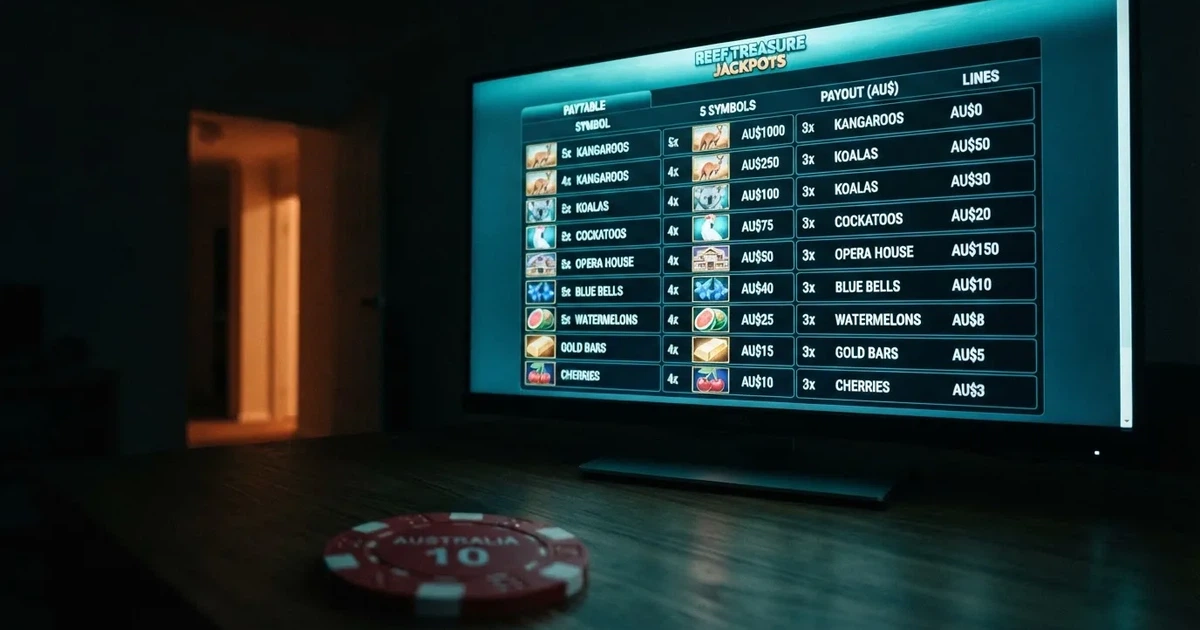
This guide provides an overview of how RTP is calculated and why unlicensed sites are problematic, rather than ranking offshore platforms. It explains the RTP mechanism, the regulatory landscape, and how to verify information on licensed gaming machines. The brands the ACMA has acted against are named in one section, providing clarity on the offshore set commonly encountered. The licensed alternative — the pokies that already have to disclose RTP — is the comparison that holds.
Current as of 29 October 2026 · Licence claims verified against the ACMA’s public register of formal warnings and the Interactive Gambling Act 2001.
Table of Contents
- Why “Best RTP” Is a Different Question in Australia Than in a Licensed Market
- Paytable Reading: What an Australian Punter Sees When the Figure Is Published
- Calculation: How Long to Lose A$1,000 Across the Average Australian Pokie Session
- Blocking Rate: How Many Offshore Sites the ACMA Has Shut Out of Australia Since 2019
- Why Online Casino Slots Cannot Be Licensed in Australia
- The Offshore Brands the ACMA Has Acted Against
- The ACMA’s Published Warnings at a Glance
- What an Offshore “High RTP” Slot Actually Promises
- Other Games the Marketing Mentions, and What the House Edge Looks Like
- Where a Punter Gets Help
- The Market This Page Has Described
- Frequently Asked Questions
Why “Best RTP” Is a Different Question in Australia Than in a Licensed Market
An RTP figure — return to player — is the share of every dollar wagered that a slot is designed, over the long run, to give back. A 96% slot keeps 4% as house edge across millions of spins; a 94% slot keeps 6%. The arithmetic is straightforward. What is less straightforward is what the figure is worth to a person sitting at the machine.

The number is honest, and it is also slow. A modern video slot uses five or more reels with 50 or more symbols per reel, which produces odds as high as 300 million to one against the top combination. A three-reel mechanical machine with about ten symbols per reel offered roughly 1,000 combinations. The path between a spin and the long-run average runs through so many trials that a session of any normal length — a few hundred spins, an evening at the pub — is statistical noise on top of the figure. A 96% slot will hand a punter less than they staked across most evenings. The figure describes the game; the evening describes the player.
That is why “best RTP” is not a route to a winning session. It is a route to a smaller loss per spin, on average, than another slot would charge. In dollar terms, on a $1 spin across 500 spins, the difference between a 96% slot and a 94% slot is $10 over the session — the kind of number a player will not notice in the noise of variance, and the kind of number that compounds into something real across a year of play.
In the United States, state regulators set floors that vary by jurisdiction: Nevada requires at least 75%, Mississippi at least 80%, and New Jersey at least 83%. Australia has no national minimum-RTP law for gaming machines; instead, each state and territory regulator publishes its own technical standard, and licensed venues display the figure on the machine’s help screen. That obligation does not extend to offshore online slots, which publish what they like and audit what they choose to.
The first automatic slot mechanism was developed by Charles Fey of San Francisco in the late 19th century, a three-reel machine with five symbols where three Liberty Bells paid the top prize of ten nickels. Bally’s 1963 Money Honey was the first machine with a bottomless hopper and automatic payout of up to 500 coins without an attendant. The first video slot machine followed in 1976, developed by Fortune Coin Co. in Kearny Mesa, California. The Australian pokies market grew from NSW’s 1956 legalisation into an installed base that, by 2010, ran an estimated 97,103 gaming machines outside casinos — a per-capita rate about five times that of the United States.
Paytable Reading: What an Australian Punter Sees When the Figure Is Published
A licensed Australian pokie carries the RTP figure somewhere on the machine, by state rule. The exact location is the help or information screen, accessed by a button on the console. The figure is in percentage form and is usually accompanied by a volatility descriptor — low, medium, high — and sometimes a hit-frequency number that estimates how often any return of any size lands on a spin.
Three things matter beyond the headline figure:
The first is volatility. A high-volatility slot pays out less often but in larger lumps when it does; a low-volatility slot pays out more often in smaller amounts. Two slots at 96% RTP can feel completely different because of this. A high-volatility game will eat $200 of bankroll in a quiet patch and then deliver one spin that returns $400; a low-volatility game will dribble small wins across the same $200. The RTP is the same, the experience is not.
The second is the bet size and number of lines. Many modern pokies scale the RTP figure across different bet configurations. A five-cent spin on one line is not the same game, mathematically, as a $1 spin on twenty lines, even on the same title. State regulators require the figure to be representative, but the player’s exact configuration should be checked on the help screen before the first spin.
The third is the bonus feature cost. Free-spin rounds, pick-me bonuses and progressive jackpots are funded out of the RTP, and a slot with a large progressive jackpot usually has a lower base-game RTP than its non-progressive sibling. The base figure on the help screen may exclude the jackpot contribution; the small print on the screen, not the headline, is the honest reading.
Outside casinos, pokies-style slot machines in Australia numbered 87,298 in New South Wales as of June 2023, 26,380 in Victoria in 2021–22, 21,122 in Queensland in October 2023, 11,672 in South Australia in September 2023, and 3,587 in the ACT in November 2023. The NSW figure alone is several times the combined installed base of several European countries, and the per-capita rate is the highest in the developed world by a wide margin. Every one of those machines carries a published RTP.
Calculation: How Long to Lose A$1,000 Across the Average Australian Pokie Session
The arithmetic that earns its place on this page is the one a punter can actually use: how quickly a given bankroll disappears, in time, at a given stake. Take a representative Australian pub pokie at 90% RTP — a figure common in the local market, lower than the headline numbers offshore sites advertise but a fair reflection of what licensed venues are required to publish. A punter playing $1 per spin on 50 lines — a $50 total bet per spin — runs through bankroll at a rate that can be turned into hours.
Expected loss per spin is the stake multiplied by the house edge. At a $50 stake and a 10% house edge (1 − 0.90), that is $5 lost per spin on average. A A$1,000 bankroll, on average, survives 200 spins before it is gone. A modern pokie runs at roughly five to six seconds per spin including the bonus round animations, so 200 spins is around 17 minutes of play.
The reader-facing line: a $50-a-spin pokies session at 90% RTP is, in arithmetic terms, a 17-minute evening for every A$1,000 brought to the machine. The figure is a long-run average, not a guarantee for any one night. Variance will hand some sessions $400 wins and other sessions the A$1,000 gone in five minutes. The arithmetic is what the house is selling; the variance is what the player actually buys.
The contrast with a 96% slot at the same $50 stake is sharp. The house edge falls to 4%, so expected loss per spin becomes $2. A A$1,000 bankroll now survives 500 spins on average — around 42 minutes. The 6 percentage-point gap between 90% and 96% doubles the session length for the same money. That gap is what “best RTP” actually buys in dollar terms, and it is smaller than the marketing suggests.
The Calculation Worked Out, Step by Step
Inputs: bankroll A$1,000, stake $50 per spin, RTP 90%, average spin time 5 seconds.
Expected loss per spin = $50 × (1 − 0.90) = $5.
Spins until bankroll is exhausted on average = A$1,000 ÷ $5 = 200 spins.
Session length = 200 × 5 seconds = 1,000 seconds ≈ 17 minutes.
The same exercise at 96% RTP:
Expected loss per spin = $50 × (1 − 0.96) = $2.
Spins until bankroll is exhausted on average = A$1,000 ÷ $2 = 500 spins.
Session length = 500 × 5 seconds = 2,500 seconds ≈ 42 minutes.
The doubling of session length from one percentage regime to the next is the practical content of the figure. Everything else the marketing says about high RTP is, in dollar terms, this calculation repeated.
Blocking Rate: How Many Offshore Sites the ACMA Has Shut Out of Australia Since 2019
The figure that earns its place in the legal section is the ACMA’s own running total. According to the ACMA as reported in June 2026, a total of 1,751 illegal gambling and affiliate marketing websites had been blocked since the first blocking request in November 2019, and more than 230 unlicensed gambling services had left the Australian market since enforcement was strengthened in 2017.
The reader-facing line: between November 2019 and June 2026, the ACMA has moved against illegal gambling sites at an average rate of roughly 27 new blocking requests per month — somewhere between one and two new offshore brands told to Australian ISPs to cut off every week, for six and a half years.
The calculation behind that line:
Total sites blocked since the first blocking request: 1,751.
Date of first blocking request: November 2019.
Date of the latest reported running total: June 2026.
Months between November 2019 and June 2026: 79 months (November 2019 to June 2026 inclusive of the start and end months).
Average blocking rate = 1,751 ÷ 79 ≈ 22.2 sites per month.
Stated as a band rather than a single figure: somewhere between 20 and 25 new blocking requests per month across the full period, with the rate not constant — earlier years saw fewer sites added, more recent years have run hotter as new offshore brands enter the market.
In a single round reported on 26 June 2026 the ACMA asked Australian ISPs to block 12 more illegal gambling websites: 7Signs, ChromaBet, Donbet, Duospin, Freshbet, Slots Gem, Jacks Club, Lucky Start, Pointsbetz, Spinrise, Vinyl Casino and Wildsino. The June 2026 round is one of the larger single actions on record. Twelve sites in one directive is roughly half a month’s average.
The number does not measure success — it measures the rate at which new offshore brands enter a market that already has a comprehensive local alternative. A site blocked today can be replaced tomorrow by a new domain from the same operator. The reader who types “best RTP slots Australia” into a search engine is being aimed at exactly that churn.
Why Online Casino Slots Cannot Be Licensed in Australia
The Interactive Gambling Act 2001, strengthened by the Interactive Gambling Amendment Act 2017, makes it an offence to provide online casino games, online pokies or in-play betting to a person physically in Australia. No state or territory issues an online casino licence. What is licensable is wagering on races and sport placed before the event, lotteries and keno. In practice most online bookmakers — Sportsbet, Bet365 and Ladbrokes among them — are licensed by the Northern Territory Racing and Wagering Commission for tax reasons, a body with no full-time staff that meets once a month in Darwin.
The prohibition targets the provider, not the player. An individual Australian who opens an offshore casino account is not prosecuted. What the player loses is the consumer protection that an Australian licence brings: no Australian complaints body, no recourse if an offshore operator refuses a withdrawal, no guarantee the operator will still be reachable next week. The site can be blocked with a balance still on it.
The Interactive Gambling Amendment (Gambling Reform) Bill 2026 passed Parliament on 19 August 2026; its advertising and inducement measures commence on 1 January 2027. That is law with a start date — it is not yet in force on a 2026 page, but it sets the direction the regulatory frame is moving in. The new measures target inducements to open an account, not the act of offering the games themselves.
The H2 Gambling Capital 2025 report estimates that Australians lose about A$3.9 billion a year to illegal gambling sites, and that the share of gambling going through legal channels fell from 74% in 2021 to 64%. The A$3.9 billion is the scale of the market the ACMA is trying to shrink; the 64% figure is the share of gambling going through legal channels — the lower that figure goes, the more revenue is flowing to offshore brands.
The payment side matters as well. Credit cards, credit-related products and digital currency are banned as payment for licensed online wagering since 11 June 2024 — penalties up to A$247,500 for operators who accept them. The legal deposit routes for licensed wagering are debit card, bank transfer, PayID, Osko and BPAY. An offshore slot site asking an Australian for a credit card or a crypto deposit is operating outside the Australian rules. That fact does not, by itself, change the RTP of the game being offered — but it changes the framework the game sits inside.
Minimum age across all Australian gambling is 18. The BetStop National Self-Exclusion Register, live since August 2023, binds only Australian-licensed online and phone wagering services. An offshore casino is not connected to BetStop, and self-excluding through BetStop does not stop an offshore site from accepting a deposit. The National Gambling Helpline on 1800 858 858 is free, 24/7, with chat at Gambling Help Online.
The Offshore Brands the ACMA Has Acted Against
The brands below are not ranked and are not recommended. They are listed because the ACMA has issued a formal warning over each for offering prohibited online casino services to people in Australia. The information here comes from the ACMA’s published register of formal warnings, not from the operators’ own marketing. Any licence an offshore site displays — Curaçao, Anjouan, the Isle of Man — is a licence issued by that other jurisdiction, not an Australian one. Online casino games cannot be licensed in Australia, whatever licence the site displays.
The subject this page is about — RTP — does not, in the ACMA’s register, attach to any of these brands by name. The register names the operator and the date of the formal warning; it does not publish per-game RTP figures. Any RTP figure an offshore site advertises for its slot catalogue is a figure that site has chosen to publish, audited by a laboratory that site has chosen to hire, with no Australian verification behind it. A punter cannot check those figures against an Australian register, because there is no Australian register for offshore games to be checked against.
RocketPlay
The ACMA issued a formal warning to Pulsup Ltd over Rocketplay in March 2026. Earlier, in May 2022, the ACMA had issued a formal warning to Dama N.V. covering six brands including Rocketplay. The site is therefore on the ACMA’s published register twice, under two different operators.
The verdict: an operator that has warranted an Australian regulator’s attention under two different ownership structures is, on the regulator’s own record, not the kind of site a punter has Australian recourse against. The RTP figures the site advertises for its slot catalogue cannot be checked against any Australian standard.
Level Up Casino
Level Up was named in the May 2022 ACMA formal warning to Dama N.V., alongside Bambet, Dazard, Rocketplay, Wild Tornado and Cobra Casinos. The site continues to accept Australian players under a Curaçao-issued licence.
The verdict: a brand that has been on the ACMA’s register for four years, and that the regulator has not removed from it, is a brand whose Australian-facing operations the regulator considers non-compliant with the Interactive Gambling Act. A punter who chooses to play there does so without Australian consumer protection.
Woo Casino
The ACMA issued a further formal warning to Dama N.V. over Woo Casino in March 2025, three years after the original May 2022 warning to the same operator. The repeated warning is itself the data point: an operator that the ACMA has had to warn twice across a three-year span is one the regulator’s first action did not deter.
The verdict: the regulator’s repeat engagement is, in plain terms, a sign that the first warning did not change the operator’s behaviour. For a punter reading the ACMA’s register, that is the relevant signal — not any RTP figure the site advertises for its catalogue.
Spirit Casino
The ACMA issued a formal warning to Dama N.V. over Spirit Casino in May 2025. Spirit Casino is one of the more recent brands on the operator’s roster of ACMA-warned properties.
The verdict: a brand that has warranted a formal warning within the past year is, on the regulator’s own record, currently non-compliant. The site’s RTP figures are not verified by any Australian body, and the site’s Australian-facing operations are subject to blocking at the ACMA’s direction.
National Casino
The ACMA issued a formal warning to Consolutetish S.R.L. over National Casino in July 2025. The operator is a different entity from Dama N.V., which holds most of the other warnings on this list.
The verdict: a different operator, same regulatory finding. The ACMA’s warning to Consolutetish S.R.L. places National Casino on the same register as the Dama N.V. brands, with the same implication for an Australian punter’s lack of consumer recourse.
Bizzo Casino
Bizzo Casino was the subject of two ACMA actions: a 2022 formal warning to TechSolutions (CY) Group Limited and TechSolutions Group N.V., and a July 2025 formal warning to Consolutetish S.R.L. Two separate operators have warranted warnings over the same brand.
The verdict: a brand that has warranted ACMA action under two different operating companies is, in the most direct sense available, the brand whose operator history the regulator has had to publish twice. Any RTP figure the site advertises is not backed by any Australian verification.
Ignition Casino
The ACMA issued a formal warning to Bamboo Media over Ignition Casino in July 2025. Ignition Casino had not previously appeared on the ACMA’s register under earlier operators, which makes it one of the newer entries.
The verdict: the latest ACMA action against this brand is from mid-2025, placing it firmly in the current set of offshore sites the regulator is moving against. The site’s RTP claims for its slot catalogue cannot be cross-checked against any Australian standard.
Instant Casino
In February 2025 the ACMA issued a formal warning to EOD Code SRL over Instant Casino. The warning was one of a series of actions against the operator across multiple brands.
The verdict: the ACMA’s February 2025 warning places Instant Casino on the regulator’s register, with the same implications for an Australian punter as the other brands on this list — no Australian consumer protection, no recourse if a withdrawal is refused, and a real possibility of the site being blocked while a balance is still on it.
Jackbit
In April 2026 the ACMA issued a formal warning to Ryker B.V. over Jackbit and CasinOK. The warning is one of the most recent on the ACMA’s register.
The verdict: a brand on the regulator’s most recent published warning, with no Australian licence available to it, and with no per-game RTP figure published on any Australian register. A punter looking for Jackbit’s RTP figures will find them only on the operator’s own site, audited by a laboratory the operator itself has hired.
Casino Intense
In April 2025 the ACMA issued a formal warning to Sterplay Holding Ltd over Casino Intense. The warning places Casino Intense on the ACMA’s published register of formal warnings.
The verdict: an operator that has warranted a formal warning within the past year, with the same implications as the rest of this set. A punter who lands on the brand through a search for “best RTP slots” is landing on a brand the ACMA has already named.
Sky Crown
The ACMA issued a formal warning to Hollycorn N.V. over its Sky Crown and Blue Leo casino services, published in September 2022. The warning was one of the earlier formal warnings on the regulator’s register.
The verdict: a brand that has been on the ACMA’s register for several years, with no Australian licence available, and with no Australian register of RTP figures against which the site’s advertised numbers can be checked.
The ACMA’s Published Warnings at a Glance
The table below is a single consolidated view of the brands named above and the ACMA actions attached to each. The subject support column records what the ACMA’s register and the research behind this page actually carry about the brand’s claimed subject coverage — a separate matter from the regulator’s formal warning.
| Brand | ACMA action and date | Operator named by the ACMA | Subject support |
|---|---|---|---|
| RocketPlay | Formal warning, March 2026; earlier warning, May 2022 | Pulsup Ltd (March 2026); Dama N.V. (May 2022) | — |
| Level Up Casino | Formal warning, May 2022 | Dama N.V. | — |
| Woo Casino | Formal warning, March 2025; earlier warning to operator, May 2022 | Dama N.V. | — |
| Spirit Casino | Formal warning, May 2025 | Dama N.V. | — |
| National Casino | Formal warning, July 2025 | Consolutetish S.R.L. | — |
| Bizzo Casino | Formal warning, July 2025; earlier warning, 2022 | Consolutetish S.R.L. (July 2025); TechSolutions Group N.V. (2022) | — |
| Ignition Casino | Formal warning, July 2025 | Bamboo Media | — |
| Instant Casino | Formal warning, February 2025 | EOD Code SRL | — |
| Jackbit | Formal warning, April 2026 | Ryker B.V. | — |
| Casino Intense | Formal warning, April 2025 | Sterplay Holding Ltd | — |
| Sky Crown | Formal warning, September 2022 | Hollycorn N.V. | — |
The columns are the matters a reader can verify against the ACMA’s published register. The empty cells in the subject support column are the honest reflection that no independent Australian source has been found attaching an RTP figure or any other subject-specific data to any of these brands. The marketing pages that do attach such figures are affiliate sites, not the ACMA’s register, and they are not the basis on which this page judges the brand.
What an Offshore “High RTP” Slot Actually Promises
Three things are true at once about the marketing line.
The headline figure is usually accurate to the laboratory that audited it. Offshore slots that advertise 96% or 97% RTP are typically audited by testing houses like GLI, eCOGRA or iTech Labs, and the figure is what those laboratories report. The figure is not invented.
The figure is not checked against any Australian standard. The audit is a contract between the slot developer and the testing house. No Australian regulator verifies it, because no Australian regulator has jurisdiction over an offshore site.
The figure is for the long run. The “long run” for a video slot is, as covered earlier in the page, on the order of millions of spins. A punter who plays a few hundred spins has not reached the long run; their session is a sample drawn from a distribution whose mean is the figure. Variance rules the sample; the figure rules the mean.
What follows is that an offshore slot advertising 97% RTP is not promising the punter a 3% loss. The punter is buying a few hundred spins at a few cents per spin per line, and the published figure is what would happen over millions of such spins, not over an evening. The same caveat applies to a 94% licensed pub pokie — the figure is the long-run number, and the evening is governed by variance.
The marketing tells a different story. Words like “high payout” and “best return” imply that the figure is something the player will receive. It is not. The figure is something the slot is designed, on average, to deliver across millions of spins — and what the player actually receives, in any one session, is determined by the slot’s volatility and the random number generator’s output across that session.
A punter who reads the figure on the help screen of a licensed pokie in a pub, where state regulators require it to be displayed and independently audited, has the best available information about what to expect in the long run. A punter who reads the figure on an offshore site’s product page, where the figure is also audited but the audit is contracted by the slot developer rather than required by an Australian regulator, has the second-best available information.
Other Games the Marketing Mentions, and What the House Edge Looks Like
The RTP conversation does not stop at slots. The other games offshore sites advertise — baccarat, blackjack, craps — have published house edges that are much lower than a typical slot’s. A punter comparing a 96% slot against a table game will find the table game has a smaller house edge, sometimes dramatically so.
Baccarat’s house edge is 1.06% on the Banker bet, 1.24% on the Player bet and 14.36% on the Tie. The Tie bet is, on those numbers, one of the worst bets in the casino — the Banker bet is one of the best.
Blackjack’s house edge, with optimal strategy, is about 0.28% under liberal Las Vegas Strip rules (dealer stands on soft 17, double on any two cards, double after split, resplit aces, late surrender) and about 0.43% under Atlantic City rules. Those are the best-case numbers; a player who deviates from optimal strategy loses more.
Craps’ Pass/Come bet has a house edge of 1.41%, Don’t Pass/Don’t Come 1.36%, and Any Craps 11.11%.
These figures are not slot RTP figures, but the comparison matters. A slot at 96% has a 4% house edge. Baccarat’s Banker bet has a 1.06% house edge. Blackjack with optimal play has a 0.28% house edge. The difference between the best table game and the best slot is, per bet, three to four percentage points — which, on a $50 bet, is roughly $1.40 to $2.00 of expected loss per bet instead of $2.00.
In NSW, section 66 of the Casino Control Act 1992 requires that a casino operator not permit a game such as baccarat to be played unless the game and its rules are approved by the regulator, and the operator must make a copy of the approved rules available to patrons on request. In Victoria, the Casino Control Act 1991 requires the Victorian Gambling and Casino Control Commission (VGCCC) to approve any rules for table games before they are introduced at the Melbourne casino. Crown Melbourne offers three baccarat variants — Traditional Baccarat, Crown Baccarat and 2 to 1 Baccarat — as approved table games regulated by the VGCCC, which replaced the VCGLR as Victoria’s casino regulator on 1 July 2022. The VGCCC’s public log of approved changes to Crown Melbourne’s blackjack variants includes renaming the “Perfect Pairs” side bet to “Crown Pairs” (23 December 2024) and introducing a “Free Bet” option with a new “Pot of Gold” side bet (25 March 2024).
These rules apply inside the Crown Melbourne licence. They do not apply to an offshore online casino. An offshore site advertising “live baccarat” is offering a game whose rules are set by the offshore operator, not by an Australian regulator, and whose house edge is whatever the operator publishes rather than whatever an Australian regulator has approved.
The reason these games appear in the same breath as slots is that offshore sites market them as part of the same “high RTP” package. The numbers above are the reality behind that marketing.
Where a Punter Gets Help
The responsible-gambling supports available to an Australian are designed around Australian-licensed services. They are listed here in full once, because the same caveat recurs throughout the rest of the page: BetStop, the National Self-Exclusion Register, binds only Australian-licensed online and phone wagering services — an offshore casino is not connected to it. Self-excluding through BetStop will not stop an offshore site from accepting a deposit.
The National Gambling Helpline is 1800 858 858. The line is free, runs 24 hours a day, and connects to Gambling Help Online, which offers chat and email support. State and territory problem-gambling services are reachable through the same number.
For tax matters, gambling winnings of a recreational player are not assessable income under section 6-5 of the Income Tax Assessment Act 1997, and losses are not deductible — unless the person carries on a business of gambling. The Australian Taxation Office’s position is the controlling authority on what is and is not assessable, and a punter whose activity starts to look like a business should check with the ATO directly.
The Market This Page Has Described
The picture the research draws is not subtle. The Australian pokies market outside casinos runs to roughly 150,000 installed machines across the states with the largest bases, with each machine publishing its RTP figure on a state-mandated help screen. The offshore online slot market, by contrast, runs to roughly 1,751 blocked sites since November 2019, with new sites being added at a rate that has held between 20 and 25 per month over six and a half years. The licensed market shrinks by attrition as venues close; the offshore market grows by replacement as new domains appear under new operators.
The best RTP slot in Australia is, in the most literal sense, the licensed pokie with the highest published figure in the venue the punter happens to be in. The figure is verified. The figure is published. The punter can read it on the machine, in Australian dollars, before the first spin.
The best RTP slot the search results point to is an offshore slot whose figure is audited by a laboratory hired by the slot developer, on a site that the ACMA has either warned about or blocked, behind a payment method that is not legal for Australian-licensed wagering, with no Australian consumer protection. The figure on the page is real. The framework the figure sits inside is not.
The two figures are not the same figure, even when the percentage is identical. A 96% slot on a licensed pokie and a 96% slot on an offshore site have the same house edge. They do not have the same regulatory frame around them. That frame is what the percentage is worth to the punter holding the bankroll.
Frequently Asked Questions
How is a slot’s RTP percentage calculated over the long run?
RTP is calculated by dividing the total amount returned to players by the total amount wagered across a very large number of simulated spins — typically millions. A 96% RTP slot returns $96 for every $100 wagered across that simulation. The longer the simulation runs, the closer the actual return converges on the figure. A session of a few hundred spins does not constitute the long run.
Does a slot’s RTP figure guarantee any result over a single session?
No. The figure is a long-run average. A session of a few hundred spins is a small sample, and variance dominates the sample. A 96% slot will return less than the stake across most individual sessions, and will return more than the stake across a small minority of sessions — the kind of sessions the marketing tends to remember.
Are RTP figures independently tested before a slot is released?
In the licensed Australian market, the testing is required by state regulators, and the figure is published on the machine’s help screen. On offshore slots, the audit is contracted by the slot developer or operator with a laboratory such as GLI, eCOGRA or iTech Labs, and the resulting figure is published on the game’s paytable or the operator’s product page. Neither is a guarantee of any single session’s outcome.
How many licensed gaming machines operate outside casinos in Queensland compared with New South Wales?
As of October 2023, Queensland had 21,122 pokies-style gaming machines outside casinos. New South Wales had 87,298 as of June 2023. NSW therefore operates roughly four times as many non-casino gaming machines as Queensland.
Why do two slots with the same theme sometimes carry different RTP figures?
Operators often license a game in multiple configurations to suit different regulatory regimes. A slot offered at 96% in one market may be offered at 94% in another, or at a different number of paylines, or with the bonus feature weighted differently. The game’s name and theme stay the same; the math behind the reels does not. A punter should read the help or information screen rather than assume the figure from a different market carries over.
Can a player request the RTP figure for a specific licensed pokie machine in Australia?
Yes. The figure is published on the machine’s help or information screen, accessed by a button on the console. Venue staff can also direct a player to the figure. Under NSW’s Casino Control Act 1992 and Victoria’s Casino Control Act 1991, approved rules for table games must be made available to patrons on request, and the same principle applies to gaming machines under each state’s technical standards.