
Best Pokies in Canberra 2026: The Honest Shortlist of Licensed Venues
A punter searching “best pokies in Canberra” is usually after one of three things: a club or pub that runs gaming machines in the territory, the only casino in town, or a straight answer about why the online casinos advertising “pokies” to Australians are not what they look like. This page works through all three. It treats the licensed ACT venues as the real choice set, names the offshore sites the ACMA has warned or blocked for offering the same product to Australians, and lays out what a player in Canberra is actually deciding between.
Currency stamp: figures current as of 29 October 2026, checked against the ACMA register, the ACT Gambling and Racing Commission register and the ACT Gambling Support Service.
Table of Contents
- Paytables and Game Mechanics on ACT Gaming Machines
- The Operator Landscape: How the ACMA-Acted-Against Brands Line Up
- What “Best Pokies in Canberra” Actually Means
- Legality: What the Interactive Gambling Act 2001 Actually Prohibits
- Responsible Gambling: Where Help Actually Lives in the ACT
- Land-Based Venues: Where the Machines Actually Live in the ACT
- Payments and Payout Speed: How Money Actually Moves
- RocketPlay — Current ACMA Action and Where It Sits
- Level Up Casino — The 2022 Warning and the Listings Trail
- Woo Casino and Spirit Casino — Dama N.V.’s 2025 Pair
- National Casino and Bizzo Casino — The 2025 Consolutetish Warnings
- Ignition Casino, Instant Casino, Jackbit, Casino Intense and Sky Crown — The Rest of the List
- The Blocking Math: How Fast the ACMA Has Cleared Sites Since 2019
- Where a Canberra Punter Should Land
- Frequently Asked Questions
Paytables and Game Mechanics on ACT Gaming Machines
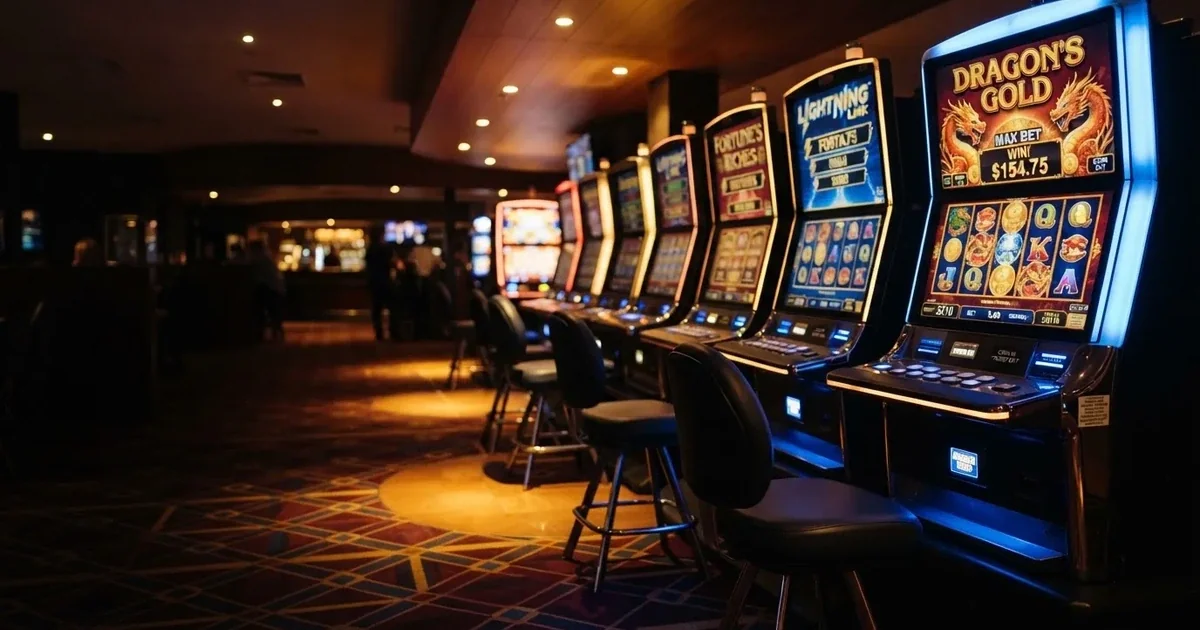
A gaming machine in an ACT club looks and behaves like a poker machine anywhere else in Australia: a digital reel set behind a return-to-player rate set in legislation, with bet sizes, paylines and bonus features dictated by the manufacturer. The interesting variation sits one level up, in the paytable displayed on the machine itself and in the denomination. A A$1 machine at a Canberra club is not the same game as the A$1c machine in the same row; both are “pokies” and both are on the floor, but they sit at opposite ends of what counts as a session.

ACT venues run machines supplied by the manufacturers licensed to sell in NSW and the ACT — Aristocrat, IGT, Konami and AGS are the names that show up most often in this territory’s clubs. A machine’s theoretical return is set by the manufacturer and locked in before it ships; clubs cannot tune a game to be tighter or looser than the file it arrived with. The variation a punter sees between venues comes from denomination mix, hold limits, and the kinds of features the venue chooses to stock, not from any knob the venue can turn on the game.
The ACT does not publish a single mandated RTP figure for every machine the way South Australia sets a 87.5% minimum. What it does publish, through the ACT Gambling and Racing Commission, is the register of approved games and the venue-level machine counts, which let a reader check what a particular venue actually has on the floor. A player who wants a specific game in a specific denomination can find it by name through the commission’s game register; a player who wants the loosest machine in town cannot, because no comparable ACT-wide RTP table exists in the public domain.
Cashless card-based play is rolling out across NSW and the ACT under the state’s carded-play reforms. A venue running the cashless system reads a player’s card at the machine, deducts from the prepaid balance and logs every session centrally. For a punter, the practical change is that money is no longer fed into a machine bill acceptor at the rate it used to be — it is loaded onto a card before play and tracked. The behavioural change the reform targets, and that venues have talked about since the rollout began, is the removal of the “one more A$20” impulse at the machine itself.
A few specifics worth keeping in mind. ACT gaming machines can run at a maximum bet of A$10 per spin on standard machines, with higher limits only on premium configurations that the commission approves individually. Jackpot links on Aristocrat and IGT machines network across the ACT and into NSW, so the A$10,000-plus jackpot a player sees in Civic might be the same network link a player sees in Queanbeyan. Bonus features — free games, pick-a-prize trails, hold-and-spin mechanics — are baked into the paytable file and not adjustable by venue staff.
The Operator Landscape: How the ACMA-Acted-Against Brands Line Up
The set below is not a ranking and not a recommendation. Each brand is on this page because the ACMA itself issued a formal warning over it for offering prohibited online casino services to people in Australia. Under the Interactive Gambling Act 2001, online casino games and online pokies cannot be licensed anywhere in the country, whatever offshore licence the site displays in its footer. The table below lays out the ACMA’s published actions in date order, so a reader can see who has been warned, by which operator, and when.
| Brand | ACMA action and date | Operator named by the ACMA | Subject support |
|---|---|---|---|
| RocketPlay | March 2026 (also May 2022, Dama N.V.) | Pulsup Ltd (current) / Dama N.V. (2022) | — |
| Level Up Casino | May 2022 | Dama N.V. | listings-only |
| Woo Casino | March 2025 | Dama N.V. | listings-only |
| Spirit Casino | May 2025 | Dama N.V. | — |
| National Casino | July 2025 | Consolutetish S.R.L. | listings-only |
| Bizzo Casino | July 2025 (also 2022, TechSolutions) | Consolutetish S.R.L. (current) / TechSolutions (2022) | — |
| Ignition Casino | July 2025 | Bamboo Media | — |
| Instant Casino | February 2025 | EOD Code SRL | — |
| Jackbit | April 2026 | Ryker B.V. (also CasinOK) | — |
| Casino Intense | April 2025 | Sterplay Holding Ltd | listings-only |
| Sky Crown | September 2022 | Hollycorn N.V. (also Blue Leo) | listings-only |
Two patterns jump out from that list. First, the same corporate names recur: Dama N.V. accounts for four of the eleven warnings, with two brands warned in 2022 and two more in 2025; TechSolutions was warned for Bizzo in 2022 and the site is back under a new operator three years later. Rebranding under a fresh parent company is the standard offshore move after a formal warning, and the ACMA’s response has been to keep naming the new parent in fresh warnings. Second, the dates cluster: six of the eleven warnings landed in the eighteen months from February 2025 to April 2026, suggesting the ACMA’s enforcement tempo has tightened rather than slackened since the 2017 amendments.
The subject support column tracks what the listings — primarily the ACMA’s own register and public coverage — say about whether each brand is positioned for the local market at all. Five brands show no evidence of a Canberra-specific offering in those listings; the rest carry listings-only entries, meaning they are catalogued but not documented as serving ACT players in any structured way. None of them has been the subject of an ACT-specific investigation, and none holds an Australian wagering licence.
For a reader in Canberra, the table tells a simple story. Every brand on it offers online casino games to Australians through a website that, by the ACMA’s own assessment, breaches the Interactive Gambling Act. Several have been blocked by Australian ISPs under section 313 of the Telecommunications Act after ACMA referral. Playing on any of them is not illegal for the individual — the IGA targets the provider — but a balance held offshore has no Australian consumer protection behind it, no complaints body to escalate to, and no guarantee the site is still reachable tomorrow morning.
What “Best Pokies in Canberra” Actually Means
A clean answer to the search query is short: the best pokies in Canberra are the gaming machines in the ACT’s licensed clubs and the ACT’s only casino. That sounds like a marketing line until the licensing facts land. ACT venues operate under the territory’s Casino Control Act 2006 (for the casino) and the Gaming Machine Act 2004 (for clubs and hotels). Both regimes are administered by the ACT Gambling and Racing Commission, which approves games, audits payouts and disciplines venues that breach the rules. No offshore website meets that bar, because no offshore website is licensable in Australia for online casino games.
The harder answer is what “best” actually distinguishes. Three things separate one Canberra venue from another once the licensing baseline is met. First, machine count and mix — a Civic club with 200 machines in A$1-A$5 denominations is a different proposition from a Woden club with 60 machines mostly at A$1c. Second, opening hours and cash access — a venue with 24-hour gaming under a club licence is rare in the ACT; most close their gaming floor by midnight or 1am and reopen at 10am. Third, the venue’s responsible-gambling posture — how visible the signage is, how easy it is to ask for a break, whether the venue actively tracks player card data and offers interventions.
The Casino Canberra question comes up whenever someone asks the “best” question, because it is the only casino in the territory. Casino Canberra runs 39 gaming tables across blackjack, roulette, baccarat and others, plus a poker lounge and a sports lounge, and it sits on land excised from Glebe Park under a 99-year lease. The detail that often surprises first-time visitors: Casino Canberra does not hold a licence to operate poker machines. The venue runs table games only, which means a punter looking for slots on the casino floor walks into a casino without any. For pokies specifically, the answer is the clubs.
The 24-hour framing also matters. The ACT does not licence 24-hour gaming as a default; clubs that operate 24-hour gaming floors do so under specific approvals from the commission. A player used to the round-the-clock pokies floors of some NSW clubs will find that the bulk of ACT gaming floors close overnight, with a small number of venues running late on weekends. The hours on a club’s licence are published in the commission’s venue register, and a player who needs a late session should check that register before assuming the gaming floor matches the bar.
Legality: What the Interactive Gambling Act 2001 Actually Prohibits
The Interactive Gambling Act 2001, strengthened by the Interactive Gambling Amendment Act 2017, makes it an offence to provide online casino games, online pokies and in-play betting to a person physically in Australia. No state or territory licenses these services. The licensed Australian online gambling market is wagering on races and sporting events placed before the event, lotteries, and keno — in practice licensed by the Northern Territory Racing and Wagering Commission (NTRWC), which holds 52 of Australia’s online bookmaker licences, including the major names.
Enforcement sits with the ACMA. The regulator investigates complaints, issues formal warnings to operators it identifies as offering prohibited services to Australians, and can direct Australian internet service providers to block illegal sites. As of June 2026, the ACMA’s running tally since the first blocking request in November 2019 was 1,751 illegal gambling and affiliate marketing websites blocked. In the June 2026 round alone, twelve more sites were referred for blocking: 7Signs, ChromaBet, Donbet, Duospin, Freshbet, Slots Gem, Jacks Club, Lucky Start, Pointsbetz.com, Spinrise, Vinyl Casino and Wildsino.
The practical shape of the prohibition is what matters to a player. The IGA targets the provider, not the punter. Sitting down and playing on an offshore site is not, in itself, a criminal offence for the individual. What is true, and what the ACMA’s own messaging has reinforced repeatedly, is that the offshore site gives no Australian consumer protection: no right of complaint to an Australian body, no guarantee a withdrawal request will be honoured, and no certainty the site will remain reachable. The blocking power is real — the ACMA can and does direct ISPs to add sites to the blocklist — and a balance held offshore at the moment of blocking is, in practice, hard to recover.
Two further pieces of law shape what a Canberra player meets at the licensed end. First, credit cards, credit-related products and digital currency are banned as payment for licensed online wagering since 11 June 2024, with penalties for operators up to A$247,500. Legal deposit routes for licensed wagering are debit card, bank transfer, PayID/Osko and BPAY. A site asking an Australian for a credit card or a crypto deposit is running outside the Australian rules, even if it holds a foreign licence. Second, winnings of a recreational player are not assessable income under section 6-5 of the Income Tax Assessment Act 1997, and losses are not deductible; a person carrying on a business of gambling is a different matter and the ATO is the right reference point for that case.
The Interactive Gambling Amendment (Gambling Reform) Bill 2026 passed Parliament on 19 August 2026. Its advertising and inducement measures commence on 1 January 2027, so on a 2026 page the bill is law with a start date, not yet in force. The practical effect on a player is forward-looking: tighter advertising rules and inducement restrictions will land in the next calendar year, with the operational details to be set by the ACMA in regulations between now and commencement.
Responsible Gambling: Where Help Actually Lives in the ACT
Canberra runs a different responsible-gambling machinery than the rest of Australia in one specific respect: BetStop, the National Self-Exclusion Register, covers Australian-licensed online and phone wagering services only. It does not bind in-venue gambling, and Casino Canberra is not connected to it. A Canberra resident wanting to self-exclude from Casino Canberra uses the ACT Gambling Harm Prevention team’s own self-exclusion process, available for periods of six months to three years. The detail is small enough that a player can miss it: BetStop on the marketing page looks comprehensive, and only the small print makes clear it stops at the licensed online wagering boundary.
The ACT Gambling Support Service runs a free, 24/7 Gambling Helpline on 1800 858 858, offering telephone, online and face-to-face gambling and financial counselling. The service is funded by the ACT Gambling Harm Prevention and Mitigation Fund, which pools a levy on gambling operators in the territory. Gambling Help Online carries the chat-based service that players in other states reach through the same front door. Both routes are free, confidential, and operate outside the gambling industry.
For the ACT’s clubs, the commission’s venue-level rules carry the responsible-gambling obligations onto the floor. Venues are required to display signage, to offer self-exclusion mechanisms at the venue level, and to train staff in identifying and responding to problem gambling indicators. The cashless carded-play system rolling out across ACT and NSW clubs gives venues a session-level data feed that, in principle, makes intervention easier — a venue can see a player’s session length and spend and act on it. The behavioural question, still being measured, is whether that visibility translates into fewer problem-gambling outcomes in practice.
The point worth keeping in mind, particularly for a reader comparing Canberra’s offering with another city’s: the responsible-gambling infrastructure in the ACT is mature at the venue level, and it is fragmented at the cross-jurisdictional level. BetStop will not catch a problem at Casino Canberra; the ACT’s own self-exclusion process will. A punter who has self-excluded through BetStop and then turns up at Casino Canberra has not excluded at all.
Land-Based Venues: Where the Machines Actually Live in the ACT
The ACT had 3,587 gaming machines operating across 46 venues on 1 November 2023, with 5,091 machines approved in total — the gap between approved and operating is the unused approval headroom venues hold. Player losses across the territory totalled A$0.19 billion in 2022-23, which is a small fraction of the Australian total and reflects both the ACT’s smaller population and its tighter machine count. The venue count is the interesting figure: with 46 venues sharing roughly 3,500 machines, the average ACT club runs around 75 machines, with a long tail of smaller venues and a small number of larger ones.
Casino Canberra sits at the top of the venue list by table-game count but not by machine count — it runs zero gaming machines under its current licence, only 39 tables. The territory’s machine stock lives in its clubs, not its casino. The casino’s regulatory home is the Casino Control Act 2006 and Casino Control Regulation 2006, administered by the ACT Gambling and Racing Commission, which also issues casino employee licences — short-term licences valid for up to six months, full licences for three years.
The licence history of Casino Canberra is short and worth noting for anyone trying to understand who actually runs the place. Aquis Canberra Pty Ltd was issued the ACT casino licence on 23 December 2014 under section 22 of the Casino Control Act 2006, to operate the casino at 21 Binara Street. The licence is now held by Casino Canberra Limited. The handover does not change the regulatory frame; the casino continues to operate under the same statutory regime with a different licensee on the paper.
Reading a venue register is its own skill. The commission publishes each venue’s approved gaming machine count, opening hours for the gaming floor, and any specific conditions attached to the licence. A player can check a particular club’s machine count and hours without leaving home, which is the practical answer to “where are the best pokies near me” — the answer is whichever licensed club the register confirms is open with the denomination mix the player wants.
The Australian comparison sharpens the picture. Adelaide Casino, South Australia’s sole licensed casino under the Casino Act 1997, runs 90 gaming tables and 950 gaming machines inside the heritage-listed Adelaide railway station on North Terrace. South Australia had 11,672 gaming machines outside Adelaide Casino across 471 venues in September 2023, with player losses of about A$0.92 billion in 2022-23. Queensland had 21,122 gaming machines across 351 venues in October 2023, with Brisbane’s Treasury Casino having closed on 25 August 2024 to make way for the new Star Brisbane at Queen’s Wharf, which opened in stages from 29 August 2024.
The South Australian comparison is the cleanest one for a reader thinking about RTP. South Australia sets a minimum gaming-machine return-to-player rate of 87.5% and a general maximum bet of A$5.00 outside the casino, while Adelaide Casino itself has no maximum-bet limit. The ACT does not set an equivalent single RTP floor for clubs and does not cap bets in the same way; the commission’s game-approval process certifies each machine’s paytable, but the floor of theoretical return across the venue’s stock is set manufacturer by manufacturer rather than by a single statutory number. A player moving from South Australia to the ACT will not find a headline RTP figure to compare against — the comparison has to be machine by machine, through the game register.
Payments and Payout Speed: How Money Actually Moves
The payment story for ACT venues is straightforward, because the venues are bricks-and-mortar: cash, EFTPOS, and on the cashless system, a prepaid card that the venue issues against a deposit. There is no offshore payment route to worry about, no foreign-currency conversion, and no credit-card ban to navigate — the ban applies to licensed online wagering, not to in-venue play.
The speed question is a different one. Cash is instant at the machine. EFTPOS is instant at the cashier. The cashless system deducts from the prepaid balance as the player plays, and cashing out at the venue’s cashier is the standard route. The slow path, where one exists, is the bank: a player who takes winnings home in cash and deposits them at a bank faces the bank’s own processing window, not the venue’s.
The legal payment routes for licensed online wagering are debit card, bank transfer, PayID/Osko and BPAY. PayID and Osko settle in near-real-time through the New Payments Platform; BPAY runs on the bank’s bill-payment schedule, usually overnight or same-day. The credit-card ban since 11 June 2024 closes off the most common offshore deposit route that Australians used to hit: a credit card deposit to an offshore casino is now a breach of the rules that bind the licensed Australian wagerer, and an offshore site that still asks for one is running outside the frame.
For a player considering the offshore route despite the ACMA’s actions, the practical payment pattern is debit card or e-wallet in, and either e-wallet or cryptocurrency out — with the payout time stretching from “next business day” through to “indefinite” depending on the operator. Several of the brands the ACMA has warned in the past eighteen months had withdrawal complaints logged against them in the public record before the formal warning landed. The pattern is consistent enough that a player who wants to use any of those sites should assume the slowest published payout time is the floor of what is realistic.
RocketPlay — Current ACMA Action and Where It Sits
RocketPlay is the most recently ACMA-warned brand on this page: a formal warning was issued in March 2026 to Pulsup Ltd over Rocketplay.com.au. That warning sits on top of an earlier May 2022 warning to Dama N.V. that covered Rocketplay alongside five other brands — Bambet, Dazard, Level Up, Wild Tornado and Cobra Casinos. The 2026 warning lands three and a half years after the first, which suggests the brand survived the 2022 warning under a fresh corporate parent and the ACMA has now caught up to the new ownership structure.
The brand carries no data on whether its product offering extends specifically to ACT players; the listings available do not position it as Canberra-specific. For a reader in Canberra, the practical issue is not which suburb the site is “for” — it is that the product itself is prohibited for Australians under the Interactive Gambling Act, and the ACMA’s most recent enforcement action names this brand directly. A formal warning is the regulator’s documented step before a blocking referral, and RocketPlay has now received two of them in two different corporate hands.
The verdict is straightforward. RocketPlay is not a venue option for a Canberra punter; it is the brand that the ACMA has chosen to warn twice in four years. The pattern across the eleven brands on this page — operator warning, rebrand, fresh warning — suggests that playing on RocketPlay is playing on a brand whose corporate parent has been on the ACMA’s radar since at least 2022, and whose current operator was named specifically in March 2026.
Level Up Casino — The 2022 Warning and the Listings Trail
Level Up Casino was one of six Dama N.V. brands named in the ACMA’s May 2022 formal warning, alongside Bambet, Dazard, Rocketplay, Wild Tornado and Cobra Casinos. The 2022 warning is the only ACMA action in the public record for this brand; no fresh warning has been issued under a new operator since, which is unusual given the pattern across the rest of this list. The site has been operational throughout the period since the warning, and the listings that mention it position it in the offshore online casino category rather than as anything specific to the ACT market.
The listings-only tag in the table captures what is publicly documented about the brand without reaching for an endorsement. The available listings — primarily Wikipedia and the Victorian regulator’s catalogue — track the brand’s appearance in industry coverage rather than its standing with any Australian regulator. The 2022 ACMA warning remains the regulator’s published position on this brand.
For a Canberra player, the absence of a fresh warning does not change the legal position. The May 2022 formal warning is still on the ACMA’s register, the product is still prohibited under the IGA, and the brand’s continuing availability to Australian players is itself the basis on which a fresh warning could land. The honest read is that Level Up Casino has stayed on the ACMA’s perimeter without crossing it again in public record, which is not the same as being compliant.
The verdict sits on a clean factual line. Level Up Casino is one of the brands the ACMA named in its first major 2022 enforcement round, and the warning has not been superseded. Playing on it from Canberra is playing on a brand the regulator has explicitly named in print.
Woo Casino and Spirit Casino — Dama N.V.’s 2025 Pair
Woo Casino and Spirit Casino are the two 2025 warnings that landed on Dama N.V. after the 2022 round. Woo Casino was warned in March 2025, Spirit Casino in May 2025, two months apart. The pattern is the one the ACMA’s enforcement tempo has produced repeatedly since 2017: a warning lands, the corporate structure shifts, the new operator continues offering the same product to Australians, and a fresh warning follows.
The two brands together account for Dama N.V.’s full 2025 output on the ACMA register, alongside the earlier 2022 round that covered RocketPlay, Bambet, Dazard, Level Up, Wild Tornado and Cobra Casinos. Across the two years, Dama N.V. has been named in formal warnings covering at least eight distinct brands. The volume makes Dama N.V. the most heavily warned operator on the Australian enforcement record, and the only one whose warnings span both the 2022 and 2025 rounds.
Woo Casino carries listings-only entries in the public catalogue, which means it appears in industry coverage but is not documented as ACT-specific or licensed by any Australian regulator. Spirit Casino carries no data in the listings at all. Neither brand has any documented standing that would override the ACMA’s published position that both are offering prohibited services to Australians.
The verdict on the pair is that they represent the same enforcement pattern under a single parent. A Canberra player choosing between them is choosing between two brands the ACMA has named in the same calendar year, both operating under the same corporate parent, both offering the same prohibited product. The choice is not material — the regulator’s position is identical for both.
National Casino and Bizzo Casino — The 2025 Consolutetish Warnings
National Casino and Bizzo Casino were both named in the ACMA’s July 2025 formal warnings to Consolutetish S.R.L. Bizzo Casino had been the subject of an earlier 2022 formal warning to TechSolutions (CY) Group Limited and TechSolutions Group N.V., making it the brand on this page with the longest ACMA trail. The 2025 warning suggests the brand continued offering the same product to Australians under a new corporate parent after the 2022 action, exactly the pattern that recurs across this list.
National Casino carries listings-only entries in the available records, primarily from public broadcaster coverage and the infrastructure portfolio. Bizzo Casino carries no data in the listings, despite its longer ACMA trail. Neither brand has any documented standing with an Australian regulator beyond the formal warnings.
The two brands together illustrate the working of the ACMA’s enforcement regime in a slightly different way than the Dama N.V. cluster. Consolutetish S.R.L. has not been named on this page before July 2025, which means the 2025 warnings are the regulator’s first published action against this particular corporate parent — but Bizzo Casino is, by then, a known name on the ACMA’s record through its earlier TechSolutions incarnation. The regulator’s warning to Consolutetish for the same brand name is itself a finding: the corporate parent may be new, but the brand is not.
For a Canberra player, the verdict is unchanged. Both brands are on the ACMA’s published register of formal warnings in 2025, both have been offering online casino games to Australians, and neither has any documented standing with an Australian regulator. The TechSolutions-to-Consolutetish handover at Bizzo Casino is the cleanest example on this page of why a “new operator” line on a casino footer is not, by itself, a clean slate.
Ignition Casino, Instant Casino, Jackbit, Casino Intense and Sky Crown — The Rest of the List
The five remaining brands complete the ACMA-acted-against set. Each carries its own warning date and corporate parent, and each sits on the ACMA register for the same reason: offering prohibited online casino services to Australians.
Ignition Casino was the subject of a July 2025 formal warning to Bamboo Media, alongside a separate warning to Consolutetish S.R.L. for National Casino and Bizzo Casino the same month. The pairing puts Bamboo Media and Consolutetish S.R.L. as two new corporate parents on the ACMA register in a single enforcement round, alongside Dama N.V.’s existing presence through Woo Casino and Spirit Casino. Ignition Casino carries no data in the listings, which means its positioning in the broader offshore market is not documented beyond the warning.
Instant Casino received a formal warning in February 2025 to EOD Code SRL — the earliest 2025 warning on this list, before Dama N.V.’s March and May actions, before Consolutetish’s July round, before Bamboo Media’s same-month action. The early-year timing puts EOD Code SRL at the front of the ACMA’s 2025 enforcement push. Instant Casino carries no data in the listings.
Jackbit was warned in April 2026 to Ryker B.V., alongside a parallel warning for CasinOK. Both brands appear in the same enforcement action, and the 2026 date places Ryker B.V. at the front of the regulator’s current-year activity. CasinOK does not appear separately on this page, but its inclusion in the same warning suggests it operates on the same product offering and the same corporate footing.
Casino Intense received a formal warning in April 2025 to Sterplay Holding Ltd, sitting between the February 2025 Instant Casino action and the May 2025 Spirit Casino action. Casino Intense carries listings-only entries in the available records, suggesting an appearance in industry coverage without any Australian regulatory standing.
Sky Crown was the subject of a September 2022 formal warning to Hollycorn N.V., which also covered the Blue Leo casino service. The 2022 warning is the earliest on this page after the May 2022 Dama N.V. round, making Sky Crown one of the brands the ACMA named in the same enforcement era as Level Up Casino and the original Bizzo Casino. Sky Crown carries listings-only entries in the public catalogue.
For a Canberra player, the verdict on the five is identical to the verdict on the rest of the list. Every one of these brands sits on the ACMA’s published register for offering prohibited online casino services to Australians, every one offers the same product the regulator has documented, and none has any documented standing with an Australian regulator. The variation between them is in the corporate parent and the warning date, not in the regulatory position.
The Blocking Math: How Fast the ACMA Has Cleared Sites Since 2019
The blocking rate is the one figure on this page that lets a reader see what the ACMA’s enforcement tempo actually looks like over time, and the inputs come straight from the regulator’s published totals. The ACMA’s running total as of June 2026 was 1,751 illegal gambling and affiliate marketing websites blocked since the first blocking request in November 2019 — roughly six and a half years of enforcement. The total works out to a band somewhere between 260 and 280 blocks per year on average, with the per-year rate varying as the ACMA’s referral pipeline has filled and emptied.
| Measure | Figure |
|---|---|
| Sites blocked since the first request, to June 2026 | 1,751 |
| First blocking request | November 2019 |
| Average blocks per year | 260 to 280 |
| Sites added in the 26 June 2026 round | 12 |
| Formal warnings on this page issued February 2025 – April 2026 | 6 of 11 |
The latest published round, 26 June 2026, added twelve more sites to the blocklist in a single referral — 7Signs, ChromaBet, Donbet, Duospin, Freshbet, Slots Gem, Jacks Club, Lucky Start, Pointsbetz.com, Spinrise, Vinyl Casino and Wildsino. That single round alone covers about 0.7% of the running total, which is consistent with the ACMA’s recent pattern of issuing multi-site referrals rather than one-off blocks. The pace at the front of the list — twelve sites in one round — is faster than the long-run average of just under one per working day, suggesting the regulator is grouping referrals rather than spacing them out.
The honest read of those numbers is that the blocklist has grown faster over the past eighteen months than it did over the first five years of the regime, because the ACMA’s enforcement tempo has visibly tightened. The formal warning list tells the same story from the operator side: six of the eleven warnings on this page landed between February 2025 and April 2026. The combination — more warnings per year, multi-site blocking referrals — is what the published record shows.
For a Canberra player, the blocking rate matters for a reason that is not in any of the headline figures: a balance held on an offshore site at the moment the ACMA refers that site for blocking is, in practice, hard to recover. The regulator’s power sits at the ISP level — Australian internet providers are directed to add the site to the blocklist — and the offshore operator has no obligation to return funds to a player who can no longer reach the site. A player who reads the blocking rate and treats it as background is making a different choice from a player who reads it as a warning about where their money sits.
Where a Canberra Punter Should Land
The cleanest landing point is this. The ACT has 46 licensed venues operating roughly 3,500 gaming machines, regulated by the ACT Gambling and Racing Commission. Casino Canberra runs table games and no poker machines, under a separate Casino Control Act 2006 licence. The ACT’s own responsible-gambling machinery — Gambling Support Service on 1800 858 858, plus the territory’s self-exclusion process — is the right place to start if play has become a problem.
The offshore brands on this page are not options for a Canberra player. The ACMA has warned each of them in print, by operator and date, for offering prohibited online casino services to Australians. Several have been the subject of multiple warnings across corporate restructures. The legal prohibition is the same for every brand on the list: the Interactive Gambling Act 2001, strengthened by the 2017 amendments, makes the provision of online casino games to Australians an offence, and the ACMA is the body that enforces it. The reader’s job is to pick a venue, not a brand; the venue is local, licensed, and on the ACT register.
The comparison the reader is actually making — between an ACT club in Civic, an ACT club in Woden, a venue in Queanbeyan across the border, and the table-game-only Casino Canberra — is a real comparison with a real answer. The right club depends on denomination mix, hours, and the responsible-gambling posture the player is looking for. The ACT Gambling and Racing Commission’s venue register is where that answer lives, and it costs nothing to check before walking in.
Frequently Asked Questions
Which venues in Canberra are licensed to operate pokies?
ACT clubs and hotels are licensed to operate gaming machines under the Gaming Machine Act 2004, administered by the ACT Gambling and Racing Commission. The territory had 3,587 machines operating across 46 venues on 1 November 2023, with 5,091 machines approved in total. Casino Canberra runs table games only and does not hold a licence to operate poker machines.
Are pokies in Canberra available around the clock?
Not as a default. ACT clubs generally close their gaming floors overnight, with most reopening at 10am and closing by midnight or 1am. A small number of venues operate 24-hour gaming floors under specific approvals from the commission, and the venue register lists each licence’s hours. A player used to round-the-clock NSW club floors will find the ACT’s standard hours tighter.
What identification do venues in Canberra require before letting someone play pokies?
ACT venues require proof of age (18+) before entry to the gaming floor and may require photo ID at the cashier. Under the territory’s carded-play reforms rolling out across clubs, players are issued a venue card tied to their identity, and balances are loaded and tracked through that card rather than through cash.
Can visitors to Canberra use self-exclusion schemes at local pokies venues?
BetStop, the National Self-Exclusion Register, covers Australian-licensed online and phone wagering services only. It does not bind in-venue gambling such as Casino Canberra. ACT residents and visitors wanting to self-exclude from ACT venues use the ACT Gambling Harm Prevention team’s own self-exclusion process, available for periods of six months to three years.
How does the payout percentage on Canberra pokies compare with other Australian cities?
The ACT does not publish a single mandated RTP floor across all gaming machines the way South Australia sets a 87.5% minimum. Each machine’s paytable is approved by the commission through the game register, manufacturer by manufacturer. South Australia’s comparable figure for venue losses outside Adelaide Casino was about A$0.92 billion in 2022-23 against the ACT’s A$0.19 billion, reflecting both population and machine-count differences rather than RTP gaps.
Is it legal for an online casino to advertise ‘pokies’ in Canberra the same way a pub or club does?
No. The Interactive Gambling Act 2001 makes it an offence to provide online casino games, including online pokies, to a person in Australia, and the ACMA enforces the prohibition through formal warnings and ISP blocking referrals. An offshore casino advertising ‘pokies’ to Australians is offering a prohibited product regardless of the licence it displays in its footer, and the ACMA has issued formal warnings covering every brand on this page.