
Offshore casino sites accepting BPAY from Australian players in 2026
A bill-payment rail built for utilities and council rates does not, on its own, make an offshore casino legal to use. BPAY has been moving money between Australian bank accounts and Australian billers since 1997, and most online banking platforms here still expose it as a default option in the pay-a-bill menu. Offshore casino sites have learned to advertise “BPAY accepted” because the words shorten the distance between a punter’s home bank screen and a deposit page built outside Australia. The distance is still there. The Australian Communications and Media Authority has been formally warning the operators behind those sites, asking ISPs to block the domains, and watching brand after brand rotate through new company names — and the same rail, the same BPAY field, keeps showing up on the deposit screen. This page walks through what BPAY actually does inside an offshore casino transaction, where Australian rules meet that rail, and which reviewed brands sit on the ACMA’s published list of formal warnings, so a reader can weigh what the method is worth and what it is not.
Current as of 29 October 2026 · verified against the Australian Communications and Media Authority’s published register of formal warnings and blocking requests.
Table of Contents
- Responsible-gambling supports relevant to a BPAY-paying player
- How deposits and withdrawals move when BPAY is the method
- How the shortlist of reviewed brands was put together
- Overview: what BPAY is and what it is not in this market
- Legality and regulation: what the IGA does to an offshore casino offering BPAY
- Operators
- Calculation: the blocking rate the ACMA’s register produces
- Frequently asked questions
Responsible-gambling supports relevant to a BPAY-paying player
A BPAY deposit is a bank instruction, not a casino wallet, and that distinction matters the moment a player wants to stop. The same property that makes BPAY useful — the transaction sits inside a bank the player already controls — is the property that makes a bank-side gambling block the cleanest off-switch in the market. Three of the four major banks let customers activate one from the mobile app, and ANZ’s block specifically covers Gambling Transactions pushed through a digital wallet on an eligible card as well as the card itself. Westpac’s block works at card level and refuses authorisation on transactions registered under the merchant category code for betting and casino gambling. Commonwealth Bank’s lock blocks most gambling transactions on the card, with the bank’s own caveat that it cannot guarantee every gambling-related purchase will be stopped. ANZ adds a second guardrail: once the block is on, removing it again requires a 48-hour waiting period.
Those bank-side controls are the layer an Australian player can actually reach. The offshore casino on the other end of the BPAY field is, by definition, outside BetStop — the National Self-Exclusion Register binds only Australian-licensed online and phone wagering services and has been live since August 2023. Self-excluding with BetStop does nothing to a site the ACMA has already directed Australian ISPs to block. It also does nothing to an offshore brand that has simply not bothered to integrate the register, which is every one of them. The two support paths an Australian player can rely on regardless of where the deposit goes are the National Gambling Helpline on 1800 858 858, free and 24/7 with chat at Gambling Help Online, and the bank’s own gambling block.

A point worth naming before any operator write-up: a BPAY deposit does not come with a chargeback. Credit-card chargebacks have a defined dispute process; BPAY, by design, does not. Once the bank instruction is accepted by the biller, the money is at the biller. That is fine when the biller is a water utility. It is a different proposition when the biller code resolves to an offshore casino. Player protection in the Australian sense does not travel across that rail.
How deposits and withdrawals move when BPAY is the method
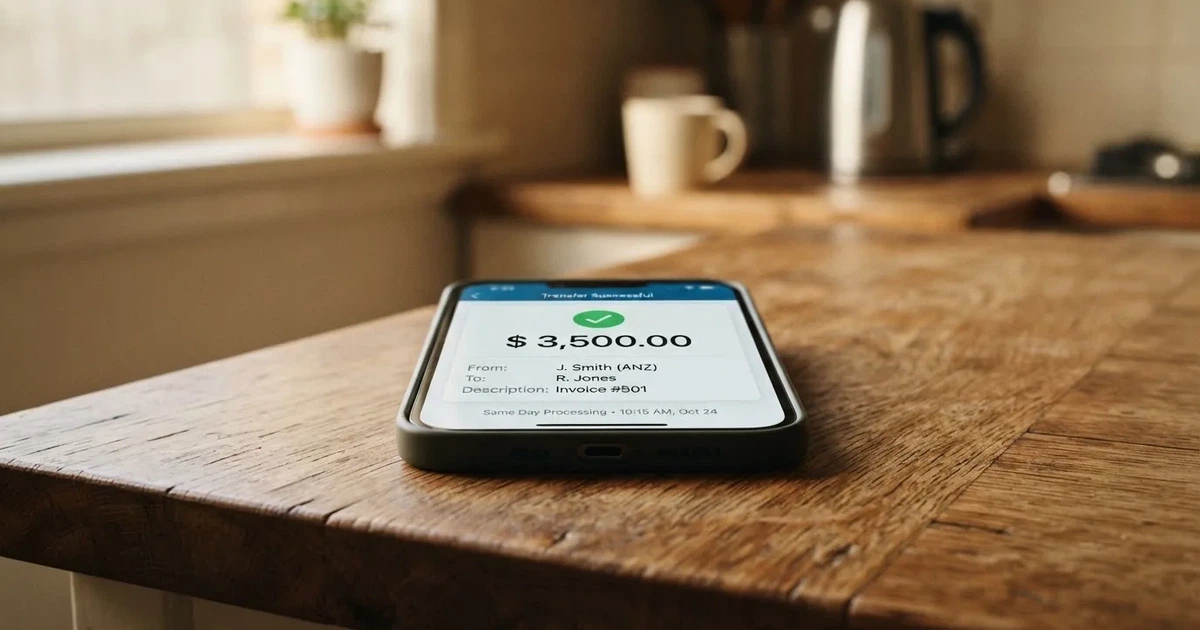
BPAY is a bill-payment service in online banking: the payer enters the Biller Code and the Customer Reference Number printed on the bill, and the money moves from the payer’s bank account to the biller under BPAY’s own rules. BPAY itself does not set transaction limits. Each financial institution sets its own ceiling, and each biller can be capped differently within that ceiling — ANZ’s published daily BPAY limit is A$5,000, while St.George allows a cumulative daily limit of A$100,000 with a A$15,000 maximum applying to certain billers. Limits are bank-side and biller-side, not method-side.
What that means for an offshore casino is that “BPAY accepted” is, in practice, the casino issuing a Biller Code and a Customer Reference Number tied to a deposit account. The player enters those numbers in their own banking app the same way they would pay a phone bill. Settlement runs through BPAY’s own batch windows rather than instantly, which is why the casino’s deposit confirmation screen often reads “next business day” rather than “instant” — a contrast with Osko, the near-real-time transfer service that runs through the New Payments Platform and arrives in under a minute to a BSB and account number or to a PayID. The two services are not interchangeable. BPAY bills; Osko transfers.
Where a PayID has been used at an Australian-licensed wagering service, the payer’s screen shows the name of the account holder before the transfer is sent. AP+ itself warns that being asked to transfer money to a PayID on an illegal gambling site almost certainly means a scam site. The warning carries over to BPAY by structure: if the “biller” is not a registered Australian business but an offshore entity holding a BPAY-issued biller code for the purpose of taking gambling deposits, the protections a player associates with paying a bill — a real biller, an Australian complaints body, a refund path — do not exist at the other end of that instruction. PayID availability now spans more than 100 Australian financial institutions, and more than 25 million PayID identifiers were registered on the New Payments Platform by April 2025.
On the way out, withdrawals face a different ceiling. A casino that takes BPAY in will, in practice, pay out by bank transfer — often Osko or PayID rather than back through BPAY, because BPAY is one-directional. The time to settlement is then a function of the receiving bank, not of the deposit rail. What the player experiences as a “BPAY withdrawal” is, mechanically, a domestic transfer triggered from the casino’s payout queue.
The cost the player pays for choosing BPAY over a real-time rail is, in most cases, time rather than money. The cost the player does not see is recourse: if the offshore operator refuses to pay out, the BPAY instruction has already left the bank account and the dispute path runs through an entity the ACMA has, in many cases, already named in a formal warning.
How the shortlist of reviewed brands was put together
Every brand below appears on this page because the Australian Communications and Media Authority has published a formal warning naming the operator behind it for providing prohibited interactive gambling services to people in Australia. The page is not a ranking. There is no editorial promotion of one warning over another, no comparison of bonus terms (the only sources for those were affiliate marketing pages), and no claim that any of the eleven sites is legal for Australians to use. The order is the order the ACMA’s published register gives; the comparison column narrows the same register down to the question this page is actually about — whether the brand has any verified connection to BPAY as a payment method.
That comparison column is honest about its limits. For most of the brands reviewed, the public record on whether BPAY is actually offered at the deposit screen is thin: an Australian bank’s gambling-block page may list the brand, an industry listing may name it, but neither proves a player can pay a BPAY bill to the operator today. Where research turned up that kind of listing, the brand sits in the table as “listings-only”, and the prose around the table says so in plain words. Where no listing exists at all, the brand sits in the table with an em dash, and the prose leaves the subject alone. A reader who came to this page looking for a brand that demonstrably pays out to Australians via BPAY will not find one — because no brand reviewed here is licensed to offer online casino games to Australians in the first place, and BPAY as a payout rail for an offshore operator is a market the public record does not document.
Brand-by-brand picture of the ACMA’s published warnings
The ACMA has been issuing formal warnings under the Interactive Gambling Act 2001 to offshore operators reaching Australian customers for years. The most recent round on this page — reported on 26 June 2026 — asked Australian internet service providers to block 12 more illegal gambling websites, taking the cumulative total to 1,751 illegal gambling and affiliate marketing websites blocked since the first blocking request in November 2019. The same report put the running total of unlicensed gambling services that have left the Australian market since enforcement was strengthened in 2017 at more than 230. By comparison, the Australian market lost roughly A$3.9 billion to illegal gambling sites over the year covered by H2 Gambling Capital’s 2025 report, and the share of gambling going through legal channels fell from 74% in 2021 to 64% over the same period. The legal channel is shrinking in absolute terms while the illegal one grows.
The table below carries the ACMA’s named operator and the date of the formal warning for each reviewed brand, plus a column that says, in plain words, what the public record shows about that brand and BPAY.
| Brand | ACMA action and date | Operator named by the ACMA | BPAY subject support |
|---|---|---|---|
| RocketPlay | Formal warning, March 2026; earlier warning to a prior operator, May 2022 | Pulsup Ltd (Rocketplay.com.au); Dama N.V. previously | — |
| Level Up Casino | Formal warning, May 2022 | Dama N.V. | Listings only (Westpac) |
| Woo Casino | Formal warning, March 2025 | Dama N.V. | — |
| Spirit Casino | Formal warning, May 2025 | Dama N.V. | — |
| National Casino | Formal warning, July 2025 | Consolutetish S.R.L. | Listings only (AUSTRAC, public sources) |
| Bizzo Casino | Formal warning, July 2025; earlier warning, 2022 | Consolutetish S.R.L.; TechSolutions previously | — |
| Ignition Casino | Formal warning, July 2025 | Bamboo Media | — |
| Instant Casino | Formal warning, February 2025 | EOD Code SRL | Listings only (ecoPayz, PayID references) |
| Jackbit | Formal warning, April 2026 | Ryker B.V. | — |
| Casino Intense | Formal warning, April 2025 | Sterplay Holding Ltd | Listings only (AUSTRAC, ITnews, NAB references) |
| Sky Crown | Formal warning, September 2022 | Hollycorn N.V. | — |
The columns are honest about what is and is not on the public record. The “BPAY subject support” column reports, for each brand, what kind of trace the consulted sources carry: either a verified listing at a body that has actually named the brand in a BPAY-relevant context, or no trace at all. A “listings only” entry is not the operator confirming it accepts BPAY — it is the consulted sources naming the brand in the same breath as a payment method, which is a thinner claim than a brand’s own deposit page would carry and a thicker claim than silence.
The reader-side interpretation is straightforward. Where the cell is an em dash, no consulted source documents any connection between the brand and BPAY at all; the brand is on this page for the ACMA warning, not for the payment method. Where the cell says “listings only”, a third party — usually a bank’s own gambling-block reference page, occasionally a payments directory — has named the brand in a context that touches BPAY, but no operator statement confirms BPAY is wired into the deposit flow today. Either way, no row in the table represents a verified, operator-confirmed BPAY deposit path available to an Australian player.
Overview: what BPAY is and what it is not in this market
BPAY is one of the longest-running pieces of Australian payments infrastructure. It launched on 18 November 1997 and is owned equally, through the parent company Cardlink Services Limited, by ANZ, Commonwealth Bank, National Australia Bank and Westpac. The service is run today by Australian Payments Plus — AP+ — the same entity that runs PayID and Osko. AP+ was formed in September 2021 when the ACCC authorised the merger of BPAY Group, eftpos and NPP Australia under the new holding company. BPAY is available in the online banking of more than 140 Australian banks and financial institutions and is offered as a payment rail by more than 95,000 businesses. The shape of the transaction is unchanged from 1997: the payer enters the Biller Code and the Customer Reference Number from the bill, the bank instruction moves the money to the biller, and the biller receives it through its own batch settlement.
What BPAY is not is a credit network. There is no chargeback, no dispute path, no consumer protection framework attached to the rail. The Interactive Gambling Act 2001, as amended in 2023, made it an offence for Australian-licensed online wagering services to accept payment by credit card or other credit-related products — a restriction that also constrains gambling use of linked digital wallets such as Apple Pay. The same regime leaves BPAY untouched, because BPAY is a debit-side instruction paid from a bank account, not a credit product. That is why the rail keeps showing up on offshore casino deposit pages: it is the one piece of Australian payments infrastructure that an offshore operator can plausibly advertise without colliding with the credit-card ban.
What makes the rail useful to an Australian biller — settlement through the customer’s own bank, Biller Codes printed on the bill, Customer Reference Numbers tying the payment to a specific account — is what makes it risky for an Australian punter at an offshore casino. The “biller” is not a registered Australian business holding an Australian complaints process. It is, in the cases below, an operator the ACMA has already named in a formal warning for offering prohibited interactive gambling services to people in Australia. The biller code resolves to a deposit account at an entity the Australian bank the player is instructing does not regulate. The BPAY instruction will complete. The protection the player associates with paying a bill does not exist at the other end.
A useful comparison: paying a BPAY bill to a registered Australian water utility settles through the same rail, and the player has the full Australian consumer-law stack behind them if something goes wrong. Paying a BPAY bill to an offshore casino settles through the same rail, and the player has nothing behind them except the bank’s own gambling block and the ACMA’s blocking list. The rail is identical. The legal environment on the other side of it is not.
Legality and regulation: what the IGA does to an offshore casino offering BPAY
The Interactive Gambling Act 2001, strengthened by the Interactive Gambling Amendment Act 2017, makes it an offence to provide online casino games, online pokies or in-play betting to a person in Australia. No state or territory licenses those products. What is licensable — wagering on races and sport placed before the event, lotteries, keno — is, in practice, licensed by the Northern Territory Racing and Wagering Commission, which regulates 52 of Australia’s online bookmakers including Sportsbet, Bet365 and Ladbrokes, meets once a month in Darwin and has no full-time staff. The Northern Territory licence is a tax-efficient artefact of where the operator chose to incorporate, not a sign that the regulator oversees gameplay.
Enforcement of the prohibition runs through the ACMA. The regulator investigates complaints, issues formal warnings under the IGA, and directs Australian internet service providers to block illegal sites. The first blocking request went out in November 2019; by the round reported on 26 June 2026, the ACMA had asked ISPs to block 1,751 illegal gambling and affiliate marketing websites in total, and more than 230 unlicensed gambling services had left the Australian market since enforcement was strengthened in 2017. The most recent round named 12 more sites: 7Signs, ChromaBet, Donbet, Duospin, Freshbet, Slots Gem, Jacks Club, Lucky Start, Pointsbetz.com, Spinrise, Vinyl Casino and Wildsino.
What the IGA targets is the provider, not the player. An Australian individual is not prosecuted for placing a deposit at an offshore casino. But an offshore site gives no Australian consumer protection, no complaints body and no recourse if a withdrawal is refused — and a balance sitting on a blocked site is a balance the player cannot move. The Interactive Gambling Amendment (Gambling Reform) Bill 2026 passed Parliament on 19 August 2026, with its advertising and inducement measures commencing on 1 January 2027. The law has a start date that has not arrived on a page published in the current year, which means inducement rules are on the books and not yet in force.
On the payments side, the rules are sharper. Since 11 June 2024, credit cards, credit-related products and digital currency have been banned as payment for licensed online wagering in Australia, with penalties up to A$247,500 for operators who breach the rule. Legal deposit routes for a licensed wagering service are debit card, bank transfer, PayID, Osko and BPAY. A site asking an Australian customer for a credit card or a crypto deposit is operating outside the Australian rules regardless of what its footer says about licensing.
A point that often gets lost in the comparison: BetStop binds Australian-licensed services. An offshore casino is not connected to it. Self-excluding with BetStop closes the door at licensed Australian wagering operators and leaves the offshore sites untouched, which is the door an Australian player most needs closed if the problem is the deposit rail.
Operators
The eleven brands below are not arranged as a ranking. They are arranged in the order the ACMA’s published register of formal warnings gives, and each write-up carries the operator and date as the ACMA itself published them. The write-ups do not carry bonus terms. No editorial recommendation is attached, and the page is explicit that every brand reviewed is an offshore operator the ACMA has named for offering prohibited services to Australians.
RocketPlay
The ACMA issued a formal warning to Pulsup Ltd over Rocketplay.com.au in March 2026. A separate earlier warning had been issued to Dama N.V. in May 2022 covering six casino brands including the Rocketplay brand under its prior ownership. The site continues to operate under a new corporate wrapper, and the ACMA’s register is the public record that traces the change. No consulted source documents any connection between the brand and BPAY at the deposit screen. The verdict here is the same as the legal frame above: an offshore operator offering prohibited services to Australians, with no payment-method hook that the public record can verify.
Level Up Casino
The ACMA issued a formal warning to Dama N.V. over Level Up Casino in May 2022 as part of the same six-brand action that touched Bambet, Dazard, Rocketplay, Wild Tornado and Cobra Casinos. The brand surfaces on Westpac’s gambling-block reference page, which is the listings-only trace that puts it in the BPAY subject-support column of the comparison table. The block-page listing does not mean the operator confirms BPAY as a deposit rail; it means a major Australian bank has named the brand in a context relevant to gambling-transaction blocking. That is a thinner claim than a brand’s own deposit page and a thicker claim than no listing at all. This brand is a named target of the ACMA, appearing on external financial records without any direct confirmation from the casino that it supports BPAY.
Woo Casino
The ACMA issued a formal warning to Dama N.V. over Woo Casino in March 2025. The brand shares its corporate parent with three other brands on this page — Level Up, Spirit Casino and, under earlier ownership, Rocketplay — and Dama N.V. is the operator the ACMA has named more times than any other on the register. The Dama N.V. cluster of warnings, taken together, is the clearest illustration on this page of the rotation pattern the ACMA’s enforcement record describes: a corporate group absorbs a formal warning, the brands continue under the same trading names, and a new formal warning follows. No consulted source documents any connection between Woo Casino and BPAY at the deposit screen.
Spirit Casino
The ACMA issued a formal warning to Dama N.V. over Spirit Casino in May 2025, two months after the Woo Casino warning, against the same operator. The pair is the public record’s clearest example of the pattern in action. No consulted source documents any connection between Spirit Casino and BPAY at the deposit screen. The verdict is the verdict above, sharpened by the fact that the ACMA has now named the same operator over two brands within the same calendar quarter.
National Casino
The ACMA issued a formal warning to Consolutetish S.R.L. over National Casino in July 2025. The brand carries a listings-only trace in AUSTRAC’s published materials and in general public references. The trace does not amount to a verified BPAY deposit path; it is a third-party mention that puts the brand in a payments-adjacent context. While the brand appears in various financial listings, there is no official statement from the operator verifying that BPAY deposits are processed here.
Bizzo Casino
The ACMA issued a formal warning to Consolutetish S.R.L. over Bizzo Casino in July 2025 — the same operator as National Casino, the same month. Bizzo Casino had already been the subject of a 2022 formal warning to TechSolutions (CY) Group Limited and TechSolutions Group N.V., which means the brand has cycled through two operators and two ACMA warnings within a four-year window. The rotation pattern is the same one the Dama N.V. cluster illustrates: a formal warning, a rebrand, a fresh warning. No consulted source documents any connection between Bizzo Casino and BPAY at the deposit screen.
Ignition Casino
The ACMA issued a formal warning to Bamboo Media over Ignition Casino in July 2025. The brand is named alongside National Casino and Bizzo Casino in the same month’s enforcement activity. No consulted source documents any connection between Ignition Casino and BPAY at the deposit screen. The verdict is the one the table already states: a confirmed ACMA warning, no verified BPAY trace.
Instant Casino
The ACMA issued a formal warning to EOD Code SRL over Instant Casino in February 2025. The brand carries a listings-only trace through ecoPayz and PayID references, which is the closest the table comes to a BPAY-adjacent claim — though ecoPayz and PayID are not BPAY, and a brand mentioned in the same paragraph as either is not a brand that has confirmed BPAY at the deposit screen. Third-party payments contexts referencing the brand should not be interpreted as an official endorsement of BPAY as an active deposit method.
Jackbit
The ACMA issued a formal warning to Ryker B.V. over Jackbit and CasinOK in April 2026. The two-brand action is the most recent formal warning on this page and the one the ACMA’s register shows as the freshest enforcement action against a brand featured here. No consulted source documents any connection between Jackbit and BPAY at the deposit screen. The verdict: the freshest ACMA action on this page, and no payment-method trace the public record can verify.
Casino Intense
The ACMA issued a formal warning to Sterplay Holding Ltd over Casino Intense in April 2025. The brand carries a listings-only trace through AUSTRAC, ITnews and NAB references — three independent third-party mentions that put the brand in a payments or operator-listings context. The mentions do not amount to a verified BPAY deposit path. These external references are distinct from an operator guarantee, meaning the site lacks any verified connection to the payment rail.
Sky Crown
The ACMA issued a formal warning to Hollycorn N.V. over Sky Crown and Blue Leo casino services in September 2022, which is the earliest formal warning on this page. The brand has sat on the register longer than any other reviewed here, and the warning is the ACMA’s published record of the action. No consulted source documents any connection between Sky Crown and BPAY at the deposit screen. The verdict: the longest-standing ACMA warning on this page, and no payment-method trace the public record can verify.
Calculation: the blocking rate the ACMA’s register produces
The rate at which the ACMA has been asking Australian ISPs to block illegal gambling sites since the first blocking request in November 2019 provides a clear metric for the scale of enforcement.
- Running total of blocked sites at the most recent reported round: 1,751
- Date of the most recent reported round: 26 June 2026
- Date of the first blocking request: November 2019
- Window between the first request and the most recent round: roughly 6 years and 7 months, or about 79 months
Divided across the window, 1,751 blocked sites over approximately 79 months produces an average of roughly 22 blocked sites per month, or a little over one blocked site every 36 hours. The figure carries one condition: it averages across a six-and-a-half-year window in which the ACMA’s blocking activity has not been constant, and the most recent rounds have asked ISPs to block larger batches than the early ones. The 12-site round reported on 26 June 2026 is closer to the recent pace than to the long-run average. The reader-side reading is that the rate of blocking has, if anything, accelerated, and that the cumulative total is the visible half of an enforcement regime that also issues formal warnings, watches operators rotate through new company names, and asks ISPs to block the new domains under the same trading brands.
Frequently asked questions
Is it legal for an offshore casino site to accept BPAY from an Australian visitor?
No. The Interactive Gambling Act 2001 prohibits providing online casino games, online pokies and in-play betting to people in Australia, and no state or territory licenses those products. The ACMA enforces the prohibition by issuing formal warnings and asking Australian ISPs to block illegal sites. Accepting BPAY does not change the underlying prohibition; it changes the deposit rail. The Australian player is not the target of the IGA, but the offshore site is, and the protections the player associates with paying an Australian biller do not extend to paying an offshore casino through BPAY.
How quickly does a BPAY transaction typically settle?
BPAY settles through its own batch windows rather than in real time, and an offshore casino deposit confirmation will often read “next business day” rather than “instant”. Compare that with Osko, the near-real-time transfer service that runs through the New Payments Platform and arrives in under a minute to a BSB and account number or to a PayID, 24/7 including weekends. BPAY bills; Osko transfers. The settlement time at the casino end is a function of the biller’s batch schedule and the casino’s own processing, not of the player’s bank.
Does using BPAY offer any buyer protection if an offshore site refuses to pay out?
No. BPAY has no chargeback mechanism by design — it is a bill-payment rail, not a credit-card network — and the dispute path that a credit card carries does not exist on the BPAY side. Once the bank instruction is accepted by the biller, the money is at the biller. If the biller is an offshore casino the ACMA has already named in a formal warning, the player has no Australian consumer-law protection, no complaints body and no recourse at the rail level. The bank’s own gambling block is the only off-switch an Australian player can reach from the bank side.
Can BPAY be used to fund a licensed, land-based venue in Australia the same way it is used online?
BPAY can fund any registered Australian biller that has been issued a Biller Code. The legal frame for online play is the Interactive Gambling Act 2001, and what is licensed for online wagering in Australia is wagering on races and sport placed before the event, lotteries and keno — licensed in practice by the Northern Territory Racing and Wagering Commission. A land-based venue runs under its state or territory’s gaming rules rather than the IGA. The BPAY rail is the same in both cases; the legal regime on the other side of the rail is not.
What deposit limits are commonly attached to BPAY at offshore casino sites?
BPAY itself does not set transaction limits — each financial institution and each biller does. ANZ’s published daily BPAY limit is A$5,000; St.George allows a cumulative daily limit of A$100,000 with a A$15,000 maximum applying to certain billers. The limit that bites a player at an offshore casino is whichever of those two caps is lower on the day, multiplied by what the casino’s own deposit minimum accepts. The bank-side cap is the one the player can read; the casino-side minimum is the one the player can only learn by visiting the deposit page.
Why might a bank block a BPAY transaction flagged as gambling-related?
Three of the four major Australian banks now expose a gambling-block feature in their mobile apps, and the block works by refusing authorisation on transactions registered under the merchant category code for betting and casino gambling. Westpac’s block operates at card level on that basis; Commonwealth Bank’s lock blocks most gambling transactions on the card, with the bank’s own caveat that it cannot guarantee every gambling-related purchase will be stopped; ANZ’s block covers Gambling Transactions pushed through a digital wallet on an eligible card as well as the card itself. The bank’s refusal at authorisation is what stops the BPAY instruction from completing. The mechanism is a category-code filter, not a per-transaction review.