
High RTP on Australian pokies: what the figure delivers, what it doesn’t, and where the offshore pitch breaks down
Return-to-player is the one number on a pokies machine that the marketing page quotes and the player rarely interrogates. A 96 per cent RTP means that, across a very long run of spins, the machine returns A$96 of every A$100 staked. It tells you nothing about the next spin, nothing about the next session, and almost nothing about an offshore casino that prints the figure in a banner. This page is about what that gap costs — the difference between a licensed Australian machine with a state-set minimum, and an offshore site that has been on the wrong end of an ACMA warning and is not, in any meaningful sense, regulated for an Australian player.
Data current as of 29 October 2026, checked against the Australian Communications and Media Authority’s published enforcement record and state gaming-commission figures.
Table of Contents
- Responsible gambling: where to start before the RTP question matters
- Paytable realities: how RTP is built into an Australian pokies machine
- Game studios, mechanics, and the licensed machine
- Enforcement record: eleven offshore casinos, one Australian problem
- The Australian landscape at a glance
- Legality: the Interactive Gambling Act and what it prohibits
- Payment rules and what they reveal about an offshore site
- What the numbers do and don’t tell a player
- Baccarat and blackjack: what high RTP looks like at the table end of the floor
- What this page is for, and what it isn’t
- Frequently asked questions
Responsible gambling: where to start before the RTP question matters
A high return-to-player figure shifts the long-run arithmetic in the player’s favour by a few percentage points. It does not change the fact that pokies remain the highest-loss gambling product per adult in Australia, and that the machines in clubs and pubs in NSW and Victoria swallow more money, in aggregate, than any other legal gambling format. Anyone choosing a machine on its RTP should already have the support lines in place, because the better return does not blunt the design.

Gambling Help Online runs the National Gambling Helpline on 1800 858 858 — free, twenty-four hours a day, with web chat for people who’d rather type. BetStop, the National Self-Exclusion Register, has been live since August 2023 and lets a person exclude themselves from every Australian-licensed online and phone wagering service in one registration. That last point matters for the offshore discussion later: BetStop binds licensed Australian operators. An offshore casino with a Curacao or Anjouan licence is not connected to it, and a self-excluded Australian who drifts onto one of those sites will find their exclusion does not follow them there.
State-level help exists alongside the national line. Each state runs its own problem-gambling programme, and the clubs and pubs that host poker machines are required to display the helpline number and a self-exclusion notice on or near the machine. The notices are easy to miss; the number is worth keeping somewhere it isn’t.
The responsible-gambling framing sits first in this review on purpose. An RTP comparison that ignores it is a marketing document, and the offshore sites named further down have invested heavily in making their pages read like one.
Paytable realities: how RTP is built into an Australian pokies machine
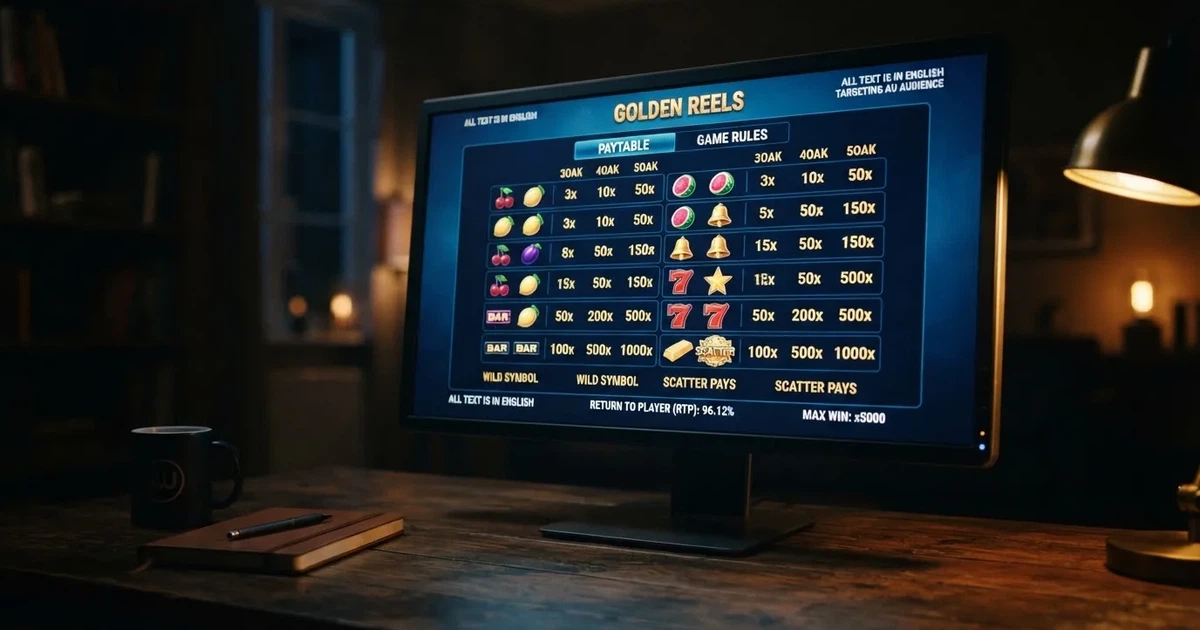
A pokies machine’s RTP is the product of two things: the symbol set on the reels and the paytable that prices each combination, and the game’s volatility — the spread between small, frequent returns and rare, larger ones. The number sits on a dial inside the machine’s settings, locked in by the regulator at the time the game is approved, and printed either on the help screen of the game itself or in the venue’s game information. In NSW, that dial cannot fall below 85 per cent. In Victoria, the floor is the same outside Crown Melbourne, where it rises to 87 per cent. The ACT and Tasmania set 87 per cent, South Australia 87.5 per cent, and Western Australia 90 per cent — the highest jurisdictional minimum in the country, and one reason Crown Perth’s roughly 2,500 machines sit in a single venue rather than across the state’s pubs.
These floors are not what the marketing copy celebrates. A 96 or 97 per cent pokies is the high end of the published range, not the legal minimum, and the difference between 85 and 96 is roughly A$11 per A$100 over a long run — meaningful, but a figure that takes hundreds of thousands of spins to express. The first consequence of the RTP conversation, then, is the speed at which it shows up in a real session: not at all. A player who puts A$200 through a 96 per cent machine in an evening will see a result somewhere in a wide band around A$192 of returns, with most of the spread coming from volatility rather than from the long-run average itself.
Volatility is the second number to read. A high-RTP, high-volatility game pays out less often, with bigger wins when it does. A high-RTP, low-volatility game pays smaller amounts more regularly. Both return 96 per cent across enough spins; they feel utterly different across an evening. The paytable screen on the machine shows the symbol values; the volatility class is usually described in the game’s information sheet, and a player who cares about the distinction should look for it before they sit down.
The third consequence is jurisdictional. Western Australia’s 90 per cent floor applies to every machine in Crown Perth. NSW’s 85 per cent floor applies to every pub and club machine in the state, including the 87,298 outside casinos across 2,195 venues. There is no Australian machine with a return lower than the state floor, and there is no offshore site whose claimed RTP an Australian regulator has checked.
Game studios, mechanics, and the licensed machine
The pokies on Australian club and pub floors come from a small set of local and international studios — Aristocrat and IGT being the dominant names on the east coast, with Ainsworth, Konami and a handful of boutique studios filling the long tail. The games pass state-by-state approval before they can be deployed, and the approval includes the locked-in RTP setting. A venue cannot change that setting afterwards, even if the venue wanted to: the regulator’s approval is tied to the configuration tested.
What this means for a player is that the figure on the help screen is the figure that runs. It is not a marketing number the venue can dial up or down to manage a busy Saturday night. It is also not a number an offshore site has any obligation to honour: the offshore site’s “96 per cent” is a number in a game’s specification sheet, run on a server outside Australia, with no Australian regulator checking that the running configuration matches it. Two consequences follow. First, a player who has sat down at a 96 per cent Aristocrat title in a NSW pub knows what they are getting, because the configuration has been approved by Liquor & Gaming NSW and cannot be changed without re-approval. Second, an offshore site claiming 96 per cent cannot show the same audit trail, and a player who has any doubt has no Australian body to ask.
The licensed machine also pays out in a defined way. A spin’s outcome is generated by a random number generator approved as part of the game’s certification, and the RTP figure is a long-run property of that generator. It is not a guarantee on any individual spin — no return-to-player figure is — but it is a guarantee that the random number generator is the one that was tested and approved. An offshore site’s “provably fair” pitch usually refers to a cryptographic check on each spin’s randomness, which is a different claim entirely. It tells a player the spin was not tampered with; it does not tell them the game’s payout structure matches what the marketing page claimed.
A small group of game mechanics recur across the high-RTP end of the Australian pub market. Five-reel video pokies with twenty-five to fifty paylines are standard. Free-spin features, usually triggered by three or more scatter symbols, are the dominant bonus mechanic. Multi-level second-screen features — picking games, hold-and-spin bonus rounds — appear on the higher-volatility titles and are usually where the larger wins sit. None of this is exotic; it is the licensed-machine vocabulary, and the same vocabulary is what the offshore site is mimicking when it puts a 96 per cent figure next to a screenshot.
Enforcement record: eleven offshore casinos, one Australian problem
The eleven operators below are not a ranking of where to play. They are the operators the Australian Communications and Media Authority has issued formal warnings to, under the Interactive Gambling Act 2001, for offering prohibited online casino services to people in Australia. The page treats them as the ACMA’s own record treats them: as enforcement actions, not as endorsements. The reason to read them in this order — and the reason the order itself is a useful piece of information — is that the warnings span four years and four different operator-company structures, which makes the offshore site’s pitch to Australian players not a one-off mistake but a continuing pattern.
Each operator write-up closes on the page’s own read of what the ACMA action means for an Australian player who lands on the site today.
RocketPlay
The ACMA issued a formal warning to Pulsup Ltd in March 2026 over RocketPlay, after an earlier warning to Dama N.V. had covered the same brand in May 2022. Two warnings, four years apart, both to the same brand under different operating-company names, is a stronger signal than either warning alone. The site is still reachable from Australia in the moments between the ACMA asking Australian ISPs to block it and the ISPs completing the block, and the brand has cycled through at least two parent companies in that time. For an Australian player, the consequence is that the brand’s domain and the entity behind it are not the same thing across the warnings, and a complaint that names the brand may not reach the same company that took the deposit.
Level Up Casino
The May 2022 warning to Dama N.V. covered Level Up alongside five other Dama brands — Bambet, Dazard, Wild Tornado, Cobra Casinos and Rocketplay. A single warning covering six brands at once is the ACMA’s way of saying the operator is running a portfolio of look-alike sites rather than one rogue brand. Level Up is the only one of the six that the game’s own publisher, BGaming, lists in its public studio catalogue, which is the closest the operator gets to an external vouching on the software side — and it is not vouching on the operator side, where the ACMA’s action sits.
Woo Casino
The ACMA issued a further formal warning to Dama N.V. over Woo Casino in March 2025. Woo was not on the May 2022 list. The pattern is the same operating company, Dama N.V., extending the portfolio to a brand that did not yet exist when the first warning landed. Three years after the first warning, the same operator-company structure is adding new brand names and offering them to Australians anyway. The consequence for an Australian player is that the brand on the welcome page is the thinnest part of the picture; the operating company behind it has been warned repeatedly, and the warning has not slowed new launches.
Spirit Casino
Spirit Casino received a Dama N.V. warning in May 2025, two months after Woo. Two new Dama brands warned in two months is the pace of portfolio expansion the ACMA’s record shows — not the pace of a company winding down. For a player who has been on the site under a different Dama brand and moved across, the operator-company structure remains unchanged, and the warning serves as a continuing signal of regulatory non-compliance.
National Casino
Consolutetish S.R.L. received an ACMA warning in July 2025 covering National Casino alongside Bizzo Casino. National Casino is the more established of the two brands in the Australian market, and the warning matters here because the brand has been around long enough that an Australian player is more likely to have seen it advertised. The Australian-licensed wagering market runs a hard line on inducements to gamble; offshore sites with Australian-facing ads run through that line routinely, and the ACMA’s action is the regulator’s response rather than a one-off.
Bizzo Casino
Bizzo carries the same Consolutetish S.R.L. warning as National Casino — July 2025 — and an earlier 2022 warning to TechSolutions (CY) Group Limited and TechSolutions Group N.V., which is the operator-company structure the brand sat under first. Two operator structures, two warnings, six years apart. The Bizzo case shows the operator-side rotation in slow motion: a brand that has been the subject of Australian regulatory action under at least two different parent companies.
Ignition Casino
Bamboo Media received an ACMA warning in July 2025 over Ignition Casino, which is the brand Australian-facing affiliate sites have used to reach poker and casino players for several years. The Ignition case is the cleanest example of an offshore brand whose entire Australian footprint sits on the wrong side of the Interactive Gambling Act. The site is reachable, the welcome page reads in Australian English, and the ACMA’s warning is the regulator’s statement that none of that makes the offering legal here.
Instant Casino
EOD Code SRL received an ACMA warning in February 2025 over Instant Casino. The warning sits earlier in the timeline than the Consolutetish and Bamboo Media actions, and it is the first sign of a different operator-company structure being added to the ACMA’s list. An Australian-based player waiting on a withdrawal here faces the reality that the service was prohibited from the outset, a fact documented in the ACMA’s formal findings.
Jackbit
Ryker B.V. received an ACMA warning in April 2026 over Jackbit and CasinOK. Jackbit is one of two brands in the same warning, and the second — CasinOK — is the first time that brand name has appeared in the ACMA’s published record. Two new brands in one warning is the same portfolio-expansion pattern the Dama and Consolutetish records show. Any promotional material found on these sites is being distributed with full knowledge of the regulator’s stance.
Casino Intense
Sterplay Holding Ltd received an ACMA warning in April 2025 over Casino Intense, which is one of the older brand names in the ACMA’s record. The relevant comparison is with Crown Melbourne — both offer baccarat variants as approved table games, but only Crown is regulated by an Australian casino control regime, and only Crown’s machine-level RTP settings have been checked against the Victorian Gambling and Casino Control Commission’s requirements. The brand-name overlap between offshore casino sites and Australian-licensed venues is part of why the regulatory line matters: a player looking for a “Crown baccarat” experience online is not getting one, whatever the welcome page claims.
Sky Crown
Hollycorn N.V. received an ACMA formal warning over Sky Crown and Blue Leo. Sky Crown is the brand the operator named after Australia’s best-known casino licence holder, and the consequence for an Australian player who has landed on it expecting a Crown-tier experience is sharp: there is no Australian regulatory connection, the ACMA’s letter is on file, and a complaint made via an offshore licence jurisdiction runs through a process that does not have Australian consumer protection as its frame.
The Australian landscape at a glance
The onshore machine market is large, regulated state by state, and older than most players realise. Registered clubs installed Australia’s first legal poker machines in New South Wales in 1956. Western Australia banned poker machines in pubs and clubs when Crown Perth opened in 1985, and that ban has held; Crown Perth’s machine count has grown from about 200 in 1985 to roughly 2,500. Tasmania ended the Federal Group’s monopoly over its machines in November 2021, with mandatory pre-commitment cards now planned for late 2025. NSW had 87,298 gaming machines outside casinos across 2,195 venues in June 2023, with player losses of A$8.18 billion in 2022-23. Queensland had 21,122 machines across 351 venues in October 2023. Victoria had 26,380 outside Crown Casino across 488 venues in 2021-22, under a 30,000-machine statewide cap.
In 2020-21 Australians bet almost A$150 billion through gaming machines and lost A$12.18 billion on them, against a population that holds about 0.3 per cent of the world’s people and roughly 3 per cent of its pub and club poker machines. The density is the story the headline number doesn’t tell: this is the world’s most concentrated legal pokies market by a wide margin, and the offshore sites’ marketing pages are written for the Australians that density produces.
The minimum return-to-player floors state by state are the only set of RTP figures an Australian regulator guarantees:
| Jurisdiction | Minimum RTP |
|---|---|
| New South Wales | 85 per cent |
| Northern Territory | 85 per cent |
| Queensland | 85 per cent |
| Victoria | 85 per cent (87 per cent Crown Melbourne) |
| Australian Capital Territory | 87 per cent |
| Tasmania | 87 per cent |
| South Australia | 87.5 per cent |
| Western Australia | 90 per cent |
Every state sets a floor, not a ceiling. Individual games on a venue floor can — and many do — return more than the floor, with high-RTP Aristocrat and IGT titles commonly sitting in the 94 to 96 per cent range. The state floor is what cannot be undercut; the published figure on a particular machine is what has been approved. The two numbers together — floor and approved figure — are the closest thing to an Australian RTP guarantee that exists.
Legality: the Interactive Gambling Act and what it prohibits
The Interactive Gambling Act 2001, strengthened by the Interactive Gambling Amendment Act 2017, makes it an offence to provide online casino games, online pokies or in-play betting to a person in Australia. No state or territory licenses them. The product the offshore sites named above are offering — an online casino with pokies — is the specific product the IGA prohibits, and a licence displayed in the footer of an offshore site (Curacao, Anjouan, the Malta Gaming Authority) is a licence issued by another jurisdiction that does not authorise the offering of those games to Australians.
The ACMA is the regulator that enforces this. It investigates, issues formal warnings to the operators, and directs Australian internet service providers to block illegal sites. As reported in June 2026, a total of 1,751 illegal gambling and affiliate marketing websites had been blocked since the first blocking request in November 2019, and more than 230 unlicensed gambling services had left the Australian market since enforcement was strengthened in 2017. In a single round reported on 26 June 2026 the ACMA asked ISPs to block twelve more: 7Signs, ChromaBet, Donbet, Duospin, Freshbet, Slots Gem, Jacks Club, Lucky Start, Pointsbetz, Spinrise, Vinyl Casino and Wildsino.
The blocking rate — the ACMA’s own pace — is the one number on this page that lets a reader feel the scale of the enforcement. Starting from a first blocking request in November 2019 and reaching 1,751 blocked sites by June 2026 — roughly six and a half years — the average works out at the order of 22 to 23 sites blocked per month, or 260 to 270 per year, over the life of the regime. That is the steady-state pace the ACMA has held across the second half of the 2017-stronger-enforcement period and into 2026, and it is the pace that explains why a site blocked today is unlikely to be the last site the same operator runs.
The IGA targets the provider, not the player. An Australian who plays on an offshore site is not personally at risk of prosecution under the Act. What they are at risk of is the absence of Australian consumer protection: no Australian complaints body, no Australian recourse if a withdrawal is refused, no connection to BetStop, and no guarantee that the offshore operator will still be reachable when a withdrawal is processed. H2 Gambling Capital’s 2025 report estimated that Australians lose about A$3.9 billion a year to illegal gambling sites, and that the share of gambling going through legal channels fell from 74 per cent in 2021 to 64 per cent — a 10-point shift over four years, and the most concrete figure available on the size of the offshore market for Australian players.
The 2026 reform sits in the middle of this. The Interactive Gambling Amendment (Gambling Reform) Bill 2026 passed Parliament on 19 August 2026; its advertising and inducement measures commence on 1 January 2027. Law with a start date, not law in force on a 2026 page — the consequence of which is that any change a reader sees in the way offshore sites advertise to Australians will arrive in the first weeks of 2027, not in the months preceding.
ACMA formal warnings to offshore operators offering prohibited services to Australians
| Brand | ACMA action and date | Operator named by the ACMA | Subject support |
|---|---|---|---|
| RocketPlay | Formal warning, March 2026; earlier May 2022 | Pulsup Ltd; earlier Dama N.V. | — |
| Level Up Casino | Formal warning, May 2022 | Dama N.V. | BGaming-listed studio (BGaming) |
| Woo Casino | Formal warning, March 2025 | Dama N.V. | — |
| Spirit Casino | Formal warning, May 2025 | Dama N.V. | — |
| National Casino | Formal warning, July 2025 | Consolutetish S.R.L. | Wikipedia coverage |
| Bizzo Casino | Formal warning, July 2025; earlier 2022 | Consolutetish S.R.L.; earlier TechSolutions (CY) / TechSolutions Group N.V. | — |
| Ignition Casino | Formal warning, July 2025 | Bamboo Media | — |
| Instant Casino | Formal warning, February 2025 | EOD Code SRL | — |
| Jackbit | Formal warning, April 2026 | Ryker B.V. | — |
| Casino Intense | Formal warning, April 2025 | Sterplay Holding Ltd | Cross-referenced coverage (sourced from the ACMA, ABC, and Crown Melbourne) |
| Sky Crown | Formal warning, September 2022 | Hollycorn N.V. | — |
The pattern the table shows is not the brand rotation in isolation — it is the operator-company rotation beneath the brands. Dama N.V. accounts for four of the eleven entries; Consolutetish S.R.L. accounts for two under one warning; Hollycorn N.V. and the TechSolutions entities account for one each. The same operator-company structures have been on the ACMA’s published list across at least four years, and the warning is what the regulator does when the structure continues to operate.
Payment rules and what they reveal about an offshore site
Australian-licensed wagering has been banned from accepting credit cards, credit-related products and digital currency since 11 June 2024, with penalties of up to A$247,500 for operators that take them. Legal deposit routes for licensed wagering are debit card, bank transfer, PayID and Osko, and BPAY. An offshore site that asks an Australian player for a credit card number or a cryptocurrency deposit is not running under Australian rules. The payment method a site requests is, in practice, one of the cleanest signals an Australian player has of whether the site is operating inside or outside the local regime, and a credit-card or crypto deposit request is a strong “outside” signal.
The second signal is the complaints pathway. An Australian-licensed operator is subject to Australian consumer law and to the dispute-resolution arrangements of its state regulator. An offshore operator is not. A withdrawal refusal that an Australian player could escalate to a state gaming commission or to the Australian Financial Complaints Authority cannot be escalated through the same channels when the operator is offshore, because those channels do not reach the offshore entity.
What the numbers do and don’t tell a player
A 96 per cent RTP on a licensed Australian machine is a long-run figure, calculated over millions of spins, with the configuration approved by the regulator and unchanged since approval. A 96 per cent RTP on an offshore site is a specification-sheet number on a server outside Australia, with no Australian regulator checking that the running game matches the spec sheet. The two numbers use the same label, and they are not the same thing.
The licensed machine’s number is also a slow number. Across an evening, a player will see a result that is much closer to volatility than to the long-run average. Across a year of regular play, the result will start to track the average, but only as one component of the total — and the total includes the time-cost of the play, which the RTP figure does not speak to at all. A 96 per cent machine played for an hour at A$1 per spin returns, on average, A$0.96 per A$1. It also takes an hour, and the hour is the part of the transaction a player cannot recover regardless of how the RTP arithmetic resolves.
For a player who has decided to play, the responsible-gambling supports above are the priority and the state helpline is the call to keep handy. For a player choosing between an Australian venue and an offshore site, the ACMA enforcement record is the comparison that matters — and the comparison does not run in the offshore site’s favour.
Baccarat and blackjack: what high RTP looks like at the table end of the floor
Two table games sit alongside the pokies on Australian casino floors, and both have return-to-player figures higher than the pokies they share the venue with. Baccarat’s house edge is 1.06 per cent on the Banker bet, 1.24 per cent on the Player bet and 14.36 per cent on the Tie — the Tie bet’s edge is what makes it uninteresting despite the 8-to-1 payout. Punto banco, the variant most played today, was developed in Havana during the 1940s and is dealt from a six- or eight-deck shoe, with the casino banking both hands under fixed drawing rules. Crown Melbourne offers three baccarat variants — Traditional Baccarat, Crown Baccarat and 2 to 1 Baccarat — as approved table games regulated by the Victorian Gambling and Casino Control Commission.
Blackjack, played with optimal strategy, returns close to its theoretical maximum: about 99.72 per cent under liberal Las Vegas Strip rules, about 99.57 per cent under Atlantic City rules. The variant count is wider than baccarat’s — Spanish 21 (without tens but with liberal player rules), Double Exposure (both dealer cards face up), Blackjack Switch (swap cards between two hands) and Super Fun 21 (up to four splits) — and the house edge on each variant is a function of the rule set rather than the brand name. The same logic that applies to the pokies applies here: the configuration has been approved by the regulator, the dealer’s rules are on a printed card at the table, and the player who knows the rules has a better handle on the long-run return than one who doesn’t.
For a player who prefers the table end of the floor, blackjack’s RTP sits well above any pokies. The catch is that blackjack requires optimal play for the figure to hold, and most players do not play optimally — a 99.72 per cent edge in optimal hands becomes a much weaker figure in average hands, and the difference is the price of not knowing the basic strategy chart.
What this page is for, and what it isn’t
This page is for an Australian reader who has seen a high-RTP figure quoted on an offshore welcome page and wants to know whether the figure means what it sounds like. The answer is that on a licensed Australian pokies machine it does — within the long-run arithmetic it always describes — and on an offshore site it doesn’t, in the sense that an Australian regulator has not checked it. The responsible-gambling supports at the top are the safety net for any reader who is still deciding whether to play; the ACMA enforcement record is the safety net for any reader who is choosing where.
It is not a recommendation list. The eleven operators named above are the operators the ACMA has acted against, and the page describes what the ACMA has done. The page does not describe what to do next with that information — that is the reader’s call, made with the helpline number and the BetStop registration if the call needs support.
Frequently asked questions
What counts as a “high” RTP figure on an Australian pokies machine?
A figure materially above the state floor counts as high. Western Australia’s 90 per cent floor is the highest jurisdictional minimum in Australia, and a 94 or 96 per cent machine there is the high end of the local range. In NSW, where the floor is 85 per cent, a 96 per cent pokies sits eleven points above the legal minimum and is the kind of figure a venue displays on its game-information sheet. The published figure on a particular machine, not the state floor, is the one that applies to the game in front of you.
Is RTP the same thing as the chance of winning on any single spin?
No. RTP is a long-run average calculated over millions of spins. On any single spin, the result is determined by the random number generator the regulator approved, and the outcome can be anything from a small return to a maximum-prize combination. A 96 per cent machine pays out, on average, A$96 of every A$100 staked across enough spins; on any one spin, the player either wins a combination or doesn’t, with no reference to the long-run average at all.
Where is a pokies machine’s RTP figure legally required to be disclosed in Australia?
Each state regulator requires the figure to be available to players, in practice on the machine’s help or information screen and in the venue’s game-information sheet. A player who cannot find the figure on the machine or in the venue’s printed material should ask venue staff before playing. The disclosure obligation sits with the venue operator, and the figure disclosed must match the configuration the regulator approved.
Can a venue change a machine’s RTP setting after it’s installed?
No. The RTP setting is part of the regulator’s approval of the game, and the venue cannot change it without re-approval. A venue can swap a machine of one approved configuration for a machine of another, but it cannot dial the setting on the machine in front of you up or down. This is the structural difference between a licensed Australian pokies and an offshore site whose configuration an Australian regulator has not checked.
Does a high RTP figure mean smaller or larger individual wins?
It depends on volatility, which is the second number to read on any pokies. A high-RTP, high-volatility game pays out less often with larger wins; a high-RTP, low-volatility game pays smaller amounts more regularly. Both return the same long-run percentage across enough spins. A player who wants a steady run of small wins should look for a low-volatility title in the high-RTP range; a player who can stomach longer dry patches for the chance of a larger return should look at the high-volatility end.
How does the number of pokies machines vary between Australian states?
NSW has the largest fleet outside casinos, with 87,298 machines across 2,195 venues as of June 2023. Victoria had 26,380 outside Crown Casino across 488 venues in 2021-22 under a 30,000-machine statewide cap. Queensland had 21,122 machines across 351 venues in October 2023. Western Australia has the smallest fleet by design: pokies are banned in pubs and clubs, and Crown Perth holds roughly 2,500 machines under Gaming and Wagering Commission approval. Tasmania, South Australia, the ACT and the Northern Territory operate under their own caps and approvals.