
BGaming-powered online casinos in Australia: what a real-money search runs into in 2026
29 October 2026 — checked against the ACMA’s register of formal warnings and blocking actions.
Someone typing this phrase into a search box is, in practice, asking two questions at once. The first is narrow: which sites carry BGaming titles, the way a player might look for a NetEnt casino or a Pragmatic Play casino. The second is structural: whether any of those sites can legally take a real-money bet from someone sitting in Australia. The two questions do not point to the same answer. BGaming, the studio, is a real company with a real Malta Gaming Authority licence and a real catalogue of more than 250 games, and the operator names behind it are a real roster of offshore brands. None of that, on its own, puts a single one of them inside Australian law. The Interactive Gambling Act 2001 prohibits the supply of online casino games and online pokies to anyone in Australia, no state or territory issues a licence for them, and the brands a BGaming search surfaces are exactly the ones the ACMA has been warning and blocking for years. This page is built around that collision: what BGaming is as a content supplier, what the offshore market around it looks like, and what an Australian reader is actually comparing when they line these brands up.
Table of Contents
- BGaming bonuses, free spins and welcome packages — what the marketing describes
- Mobile play and the BGaming casino app question
- BGaming as a studio — what the catalogue is, and what a paytable shows
- The eleven BGaming-adjacent brands — what an Australian-facing comparison looks like
- The Australian market in 2026 — the shape of the legal frame
- Responsible gambling — what is available, and what is not
- Payments and payout speed — the offshore side, in general terms
- The ACMA’s blocking round — what a running total tells us
- Other providers in the same tier — what a comparison outside BGaming looks like
- The page’s overall verdict
- Frequently asked questions
BGaming bonuses, free spins and welcome packages — what the marketing describes
A welcome package is the first thing an offshore casino prints on the landing page, and the BGaming-tagged brands in this market follow the same template. The headline number is the deposit-match percentage, usually phrased as “100% up to” a four-figure cap in euros or in Bitcoin, and the second line is a tally of free spins attached to the same first deposit. The two elements are bundled because both are subject to the same wagering requirement — a multiplier, typically between thirty-five and fifty times the bonus amount (or the bonus plus deposit, depending on the fine print), that has to be turned over before anything can be withdrawn. Free spins come with their own conversion cap, because winnings earned from a free spin are usually credited as bonus money rather than cash, and the wagering multiple applies to that credited amount too. The minimum deposit to trigger the package is small — A$20 or its crypto equivalent — and a “no deposit” line is sometimes tacked on as a separate offer, ten to thirty free spins on a named slot, again with the bonus-money wrapper.
The numbers are not the only thing on the page. A “max bet while wagering” clause sets a ceiling — often A$5 or the crypto equivalent per spin — and exceeding it voids the bonus and any winnings earned under it. A “max cashout” clause caps how much of a bonus-derived balance can be withdrawn even after the wagering is cleared. Game weighting is the quieter catch: not every game contributes 100% to the turnover requirement, and slots usually do while live tables and most card games contribute nothing. A bonus is therefore a contract with a handful of conditions, and the conditions are what determines whether the headline number is worth anything.
None of this is being recommended as something to claim. The point of writing it down is so that when the same shape appears on a BGaming-tagged landing page, a reader recognises the parts.
Mobile play and the BGaming casino app question
The mobile question splits into two parts, and the two parts are not the same. The first is whether BGaming itself builds a mobile experience, and the answer is yes by default — the studio’s catalogue is built in HTML5, which is the browser-native standard for touch-screen devices, and the games render on a phone or a tablet through a mobile browser without a download. The second is whether any BGaming-powered offshore casino offers a downloadable app, and the answer is uneven: some publish a wrapper app in the Apple App Store or Google Play, others route everything through a mobile-responsive website and actively steer players away from installing anything. A genuine app, where one exists, is usually a thin shell around the same web product — it does not add games, it adds a launcher icon and a push-notification channel.
The mobile experience a player actually sees depends on three things that have nothing to do with the app decision: the casino site’s mobile build, the game’s own mobile layout, and the network the player is on. BGaming’s HTML5 build is designed to behave on a low-bandwidth connection, which matters in regional Australia, and the controls on most of its slots collapse to a single tap on smaller screens rather than splitting across two hands. Live dealer tables, which some BGaming-powered sites carry from third-party studios, are the heaviest part of a mobile session, because the video stream is not compressible in the same way and the battery cost is real on a long session.
A practical note, again without recommending anything: a mobile session on an offshore casino is still a session on a site the ACMA has acted against, and the same legal frame applies regardless of whether the entry point is an app, a browser bookmark, or a typed URL.
BGaming as a studio — what the catalogue is, and what a paytable shows
BGaming is operated by Stable Games Ltd, a Maltese company headquartered in Valletta, and the brand debuted in 2018, although the team behind it has been working on games since 2012. The studio holds a Malta Gaming Authority Critical Gaming Supply Licence (MGA/B2B/785/2020), issued on 18 March 2021, covering Type 1 B2B gaming services — the licence the studio needs to supply its games to licensed operators, not the licence a casino needs to take bets from players. The catalogue sits at more than 250 certified titles across video slots, video poker, lottery, card, scratch, crash and casual games, and the studio reports its content is used by more than 3,000 operators worldwide. Among the named examples are Blaze, Pin-Up and Gamdom — none of which hold an Australian licence for online casino play, and all of which sit in the same offshore market this page is describing.
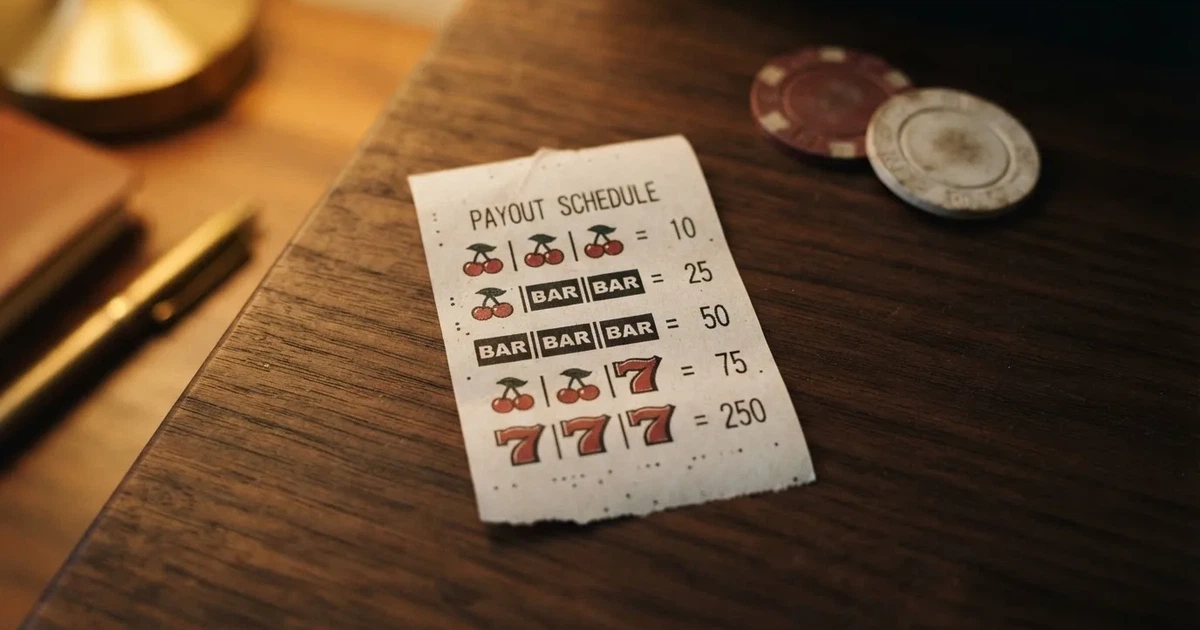
The paytable is the document that determines what a slot actually pays, and reading one is the part of the comparison that does not depend on the operator behind it. A standard BGaming paytable lists the symbol values at the maximum coin value, the number of paylines (or, for the studio’s TRUEWAYS mechanic, the number of ways — up to 262,144 on the titles that carry it), the wild symbol’s behaviour, the scatter symbol’s free-spin trigger, and any bonus round entry condition. The published return-to-player figure sits at the bottom of the page as a percentage. RTP is the theoretical long-run return to the player across millions of spins, not a guarantee for any single session, and it is the single most important number on the paytable even though it is the last thing most players look at.
The studio’s own mechanics — TRUEWAYS, MultiDice X, Merge UP — show up as named features in the paytable, and they are the visible reason a BGaming slot looks different from a slot built on a more conventional payline grid. Other studios in the same tier — Betsoft, Booming Games, 1spin4win — build similar HTML5 catalogues with their own quirks, and the differences between them are mostly in the math model underneath rather than in the layout on the screen.
The eleven BGaming-adjacent brands — what an Australian-facing comparison looks like
The table below is not a ranking and not a recommendation. Each brand is included because the Australian Communications and Media Authority has issued a formal warning over it for offering prohibited interactive gambling services to people in Australia. The brand’s published subject support — whether the studio or its peers actually list the brand as a partner — is reported as the studio’s own listings pages state it, never as an endorsement.
| Brand | ACMA action and date | Operator named by the ACMA | Subject support |
|---|---|---|---|
| RocketPlay | Formal warning, March 2026 (earlier Dama N.V., May 2022) | Pulsup Ltd | — |
| Level Up Casino | Formal warning, May 2022 | Dama N.V. | Listed on Wazdan’s partner pages |
| Woo Casino | Formal warning, March 2025 | Dama N.V. | — |
| Spirit Casino | Formal warning, May 2025 | Dama N.V. | — |
| National Casino | Formal warning, July 2025 | Consolutetish S.R.L. | Listed on Betsoft’s, Pragmatic Play’s and other studios’ partner pages |
| Bizzo Casino | Formal warning, July 2025 (earlier TechSolutions, 2022) | Consolutetish S.R.L. | — |
| Ignition Casino | Formal warning, July 2025 | Bamboo Media | — |
| Instant Casino | Formal warning, February 2025 | EOD Code SRL | — |
| Jackbit | Formal warning, April 2026 | Ryker B.V. | — |
| Casino Intense | Formal warning, April 2025 | Sterplay Holding Ltd | Listed on 1spin4win’s and other studios’ partner pages |
| Sky Crown | Formal warning, September 2022 | Hollycorn N.V. | — |
The shape of the list is informative on its own. Eight of the eleven names sit behind repeat operators — Dama N.V. alone accounts for three of the warnings on different dates, and Consolutetish S.R.L. accounts for two. A brand name in offshore casino marketing is a label, and the label can change while the corporate entity behind it does not, which is why a “new” site can carry a warning trail that runs back years. The dates also show how uneven the enforcement cadence is: a single round in July 2025 produced three of the warnings above, and the gaps between rounds run from a few months to more than two years.
The subject support column is the place where the marketing claim and the studio’s own paperwork diverge. Where a brand appears on a studio’s partner pages, the listing is the studio’s own statement that the brand carries its content; where the column is empty, the search did not turn up a listing in the sources consulted, which is not the same as the brand not carrying BGaming games. The brands in this list that surfaced on partner pages — Level Up, National Casino, Casino Intense — share a pattern: they appear on multiple studios’ listings rather than on BGaming’s alone, which tells the reader that the brand is part of a wider aggregator setup rather than a single-studio shop.
RocketPlay
Pulsup Ltd drew a formal warning in March 2026 for the RocketPlay service, and the brand had already been the subject of an earlier Dama N.V. warning in May 2022 — the corporate hull changed while the marketing name stayed in place. The subject support trail is thin in the sources consulted, and no bonus terms have been carried because the only available figures came from affiliate pages and were not verifiable. The verdict sits on the warning itself: a brand that has been named twice in four years is a brand the ACMA considers a continuing target, and a reader who treats the second warning as a soft signal has misread the message.
Level Up Casino
Level Up was one of six Dama N.V. brands named in the May 2022 warning round, and it is the brand in this set that surfaces most clearly on a studio’s own partner pages — Wazdan’s listings include it among named partners. That listing tells a reader that the studio considers Level Up part of its distribution network; it does not tell a reader anything about how the brand treats an Australian account, and the ACMA warning is the only authoritative document that does. The verdict is the same as RocketPlay’s in shape — a brand that has been on the ACMA’s radar since 2022 has not been removed from it — but the studio-side paper trail is the longer of the two.
Woo Casino
Woo Casino joined the Dama N.V. warning list in March 2025, three years after the original round that named the parent. The brand had no presence on the partner pages the consulted studios publish, and no bonus figures have been carried. The verdict is a question of weight: a 2025 warning, on its own, is less heavy than a 2022 warning followed by a 2025 warning on the same parent, and a reader should treat the gap as the regulator’s own patience running shorter rather than as a second chance.
Spirit Casino
Spirit Casino drew a Dama N.V. warning in May 2025, the same year as Woo Casino and on the same corporate parent. The two brands are, for practical purposes, sibling operations on different domains, and a comparison that treats them as separate risks understates the overlap. The verdict is identical to Woo Casino’s: same parent, same regulator, same year — and the comparison a reader is making is between Spirit and Woo rather than between either of them and a genuinely independent operator.
National Casino
Consolutetish S.R.L. drew a warning in July 2025 for National Casino, and the brand appears on the partner pages of Betsoft, Pragmatic Play and other studios the consulted set covers. The listing density is the highest in this table for a brand whose warning is recent, and it reflects the aggregator model that runs behind most of these sites: a single platform hosts content from many studios, and the studio-side listings show the breadth of the platform rather than a special relationship. The verdict is the more pointed for it: a heavily listed brand is heavily listed because it carries many studios, not because any of them have vetted it for the Australian market.
Bizzo Casino
Bizzo Casino carried the same July 2025 Consolutetish warning as National Casino, and the brand had already been the subject of a 2022 formal warning to TechSolutions (CY) Group Limited and TechSolutions Group N.V. — a different corporate name, the same market position. Two warnings across two corporate names is the pattern this table is built around, and the verdict on Bizzo is therefore the pattern itself: a brand whose marketing changes faster than the regulator’s case file.
Ignition Casino
Bamboo Media drew the warning over Ignition Casino in July 2025, and the brand carries no partner-page listings in the sources consulted. The name “Ignition” is also used by an older US-facing site under different ownership, and the offshore brand using it is not the same legal entity — a confusion a reader needs to know about, because a casual search will surface both. The verdict is narrow: an ACMA warning on the operator a reader is comparing is what matters, and the brand’s familiarity is not a substitute for a licence a reader can act on.
Instant Casino
EOD Code SRL drew a warning in February 2025 for Instant Casino — the earliest of the 2025 warnings in this list, and the one that prompted the round of actions that followed across the year. The subject support column is empty, and no bonus figures have been carried. The timing is telling: a February 2025 warning came before the July 2025 cluster, and a reader who notices the cadence sees the ACMA working through a list rather than reacting to isolated events.
Jackbit
Ryker B.V. drew a warning in April 2026 for Jackbit, alongside a separate CasinOK brand that is not on this page. Jackbit positions itself around crypto deposits and wagers, which is the part of its offering an Australian reader should weight most heavily — the credit-card and crypto ban on Australian-licensed wagering does not bind an offshore site, but the offshore site asking for crypto is the offshore site the credit-card ban was written to push players away from. The verdict is on the payment shape: a brand that asks for the deposit method the Australian rules forbid is a brand that has read the rules and chosen to ignore them.
Casino Intense
Sterplay Holding Ltd drew a warning in April 2025 for Casino Intense, and the brand is listed on 1spin4win’s partner pages alongside other studios’ listings the consulted set covers. Casino Intense has the most studio-side support of any brand in this table that is not Level Up, and the listings cover more than one provider — the same aggregator pattern National Casino shows, in a slightly thinner form. In regulatory terms, the warning holds the weight: studio listings offer distribution evidence, not legal standing, and the ACMA warning is the only one of the two that an Australian reader can act on.
Sky Crown
Hollycorn N.V. drew a warning over Sky Crown and its Blue Leo sister brand in September 2022, the earliest formal warning in this table. The warning is four years old at the time of writing, and no follow-up warning appears in the consulted sources. A reader might read the age of the warning as evidence the brand has cleaned up, but the better read is that the ACMA’s enforcement bandwidth has moved on to newer entries rather than that older ones have been cleared. The verdict is the inverse of RocketPlay’s: a single old warning with no follow-up is a softer position than two warnings across the same corporate family, but it is still a warning, and it is still on the file.
The Australian market in 2026 — the shape of the legal frame
The Interactive Gambling Act 2001, strengthened by the Interactive Gambling Amendment Act 2017, prohibits the supply of online casino games and online pokies to anyone physically in Australia. “Prohibits” is the operative word: the offence sits on the provider, not the player, and the maximum penalty runs into the millions for a body corporate. No state or territory issues a licence for online casino games — the licensable products are wagering on races and sport placed before the event, lotteries, and keno. Online bookmakers such as Sportsbet, Bet365 and Ladbrokes hold Northern Territory licences through the Northern Territory Racing and Wagering Commission, a regulator that meets once a month in Darwin and has no full-time staff — a structural detail that has drawn its own parliamentary attention in 2026. The reader’s takeaway from that detail is that the licensed wagering market in Australia runs on a regulatory architecture that is small, geographically concentrated and politically visible, while the online casino market runs on a regulatory architecture that is not licensed at all.
The ACMA’s enforcement tools are three: investigation, formal warning, and a blocking request to Australian internet service providers. A formal warning is the lightest tool and the most common one — the warnings in the table above are all of this kind — and it carries no direct penalty. The blocking tool is heavier: when the ACMA asks ISPs to block a domain, the site becomes unreachable from a typical Australian connection within hours. The blocking round reported on 26 June 2026 added twelve more sites to the blocked list — 7Signs, ChromaBet, Donbet, Duospin, Freshbet, Slots Gem, Jacks Club, Lucky Start, Pointsbetz, Spinrise, Vinyl Casino and Wildsino — taking the total of blocked illegal gambling and affiliate marketing sites to 1,751 since the first blocking request in November 2019. The same ACMA reporting notes that more than 230 unlicensed gambling services have left the Australian market since enforcement was strengthened in 2017, and that H2 Gambling Capital estimates Australians lose about A$3.9 billion a year to illegal sites, with the share of gambling going through legal channels falling from 74% in 2021 to 64%.
The 2026 reform layer is the Interactive Gambling Amendment (Gambling Reform) Bill 2026, which passed Parliament on 19 August 2026. Its advertising and inducement measures commence on 1 January 2027, so on a page read in 2026 they are law with a start date rather than law in force. A reader who is comparing offers on the offshore market in 2026 is comparing them under the existing IGA, not under the 2026 amendment — the inducement measures will change the licensed wagering market’s advertising, not the offshore market’s right to exist.
What the law does and does not do for the player
The IGA targets the provider, and the player is not prosecuted for placing a bet on an offshore site. That fact is the single most repeated line on affiliate marketing pages, and it is true. What it does not say is what happens when the offshore side refuses a withdrawal, changes a bonus term mid-promotion, or simply disappears. An Australian-licensed wagering operator sits inside a complaints and dispute framework; an offshore operator does not. The consumer protection a reader gives up by betting on a prohibited site is the same consumer protection the law was written to provide in the first place.
A separate point is the practical one. A balance held on an offshore site can be stranded by an ACMA blocking request — the domain stops resolving, the player’s account still exists on the operator’s servers, and the only way to reach it is through a workaround that the operator may or may not support. A reader who treats a blocked site as a temporary inconvenience rather than as a withdrawal risk is reading the blocking round as theatre rather than as enforcement.
Responsible gambling — what is available, and what is not
The two anchor points for an Australian player who is concerned about their own gambling or someone else’s are Gambling Help Online and BetStop. Gambling Help Online runs the National Gambling Helpline on 1800 858 858 — free, confidential, twenty-four hours a day — and a web chat service at gamblinghelponline.org.au. The service is funded to help anyone in Australia, regardless of whether the gambling in question happens on a licensed Australian wagering site, an offshore casino, or in a pub pokies room. BetStop, the National Self-Exclusion Register, went live in August 2023 and lets a player register once to be excluded from every Australian-licensed online and phone wagering service. The register binds only Australian-licensed operators — an offshore casino is not connected to it, and a self-exclusion on BetStop does not extend to a BGaming-powered offshore site. A player who needs the offshore side covered as well needs to negotiate exclusion directly with the offshore operator, and there is no Australian framework that enforces that negotiation.
The financial side of responsible gambling is sharper than the self-exclusion side. Since 11 June 2024, credit cards, credit-related products and digital currency have been banned as payment methods for licensed online wagering in Australia, with penalties of up to A$247,500 for operators who breach the rule. The legal deposit routes for a licensed wagering account are debit card, bank transfer, PayID/Osko and BPAY. An offshore casino asking for a credit card or a Bitcoin deposit is operating outside the Australian rules by design, not by accident — and the deposit method it accepts is itself a signal of which market it is built for.
The tax position is the part of responsible play that gets the least attention and is worth knowing. Gambling winnings of a recreational player in Australia are not assessable income under section 6-5 of the ITAA 1997, and gambling losses are not deductible. The position changes if the ATO considers the player to be carrying on a business of gambling — a model of professional play rather than of recreation — and a reader who sits on the boundary should check with the ATO or an accountant rather than rely on the general rule.
Payments and payout speed — the offshore side, in general terms
An Australian reader looking at a BGaming-powered offshore casino for the first time is usually looking at a deposit page that offers a cryptocurrency option, a card option, and sometimes an e-wallet option, and a withdrawal page that lists the same three methods with different limits and different timing. The deposit side is fast — a Bitcoin deposit typically confirms in an hour, an Ethereum deposit in minutes, a card deposit instantly — and the marketing copy emphasises the speed. The withdrawal side is slower, and the marketing copy is quieter about it. Crypto withdrawals are typically processed in under twenty-four hours once approved, but “approved” is the operative word: the operator runs the approval, and the time between requesting the withdrawal and the approval decision is the part of the timeline the operator controls. Card withdrawals run through the card network’s settlement window — typically one to three business days once the operator has approved — and bank transfers run longer.
The minimum deposit on most of these sites is set in the twenty-to-thirty Australian dollar range, or its crypto equivalent, and the minimum withdrawal is the same order of magnitude, sometimes higher. Maximum withdrawals are usually capped per transaction, per day, or per week, and a player with a large balance needs to plan around the cap rather than around the processing time. Bonus-derived balances are subject to additional withdrawal ceilings — the “max cashout” line on the bonus terms — and a player who clears a wagering requirement and trips the max-cashout ceiling walks away with the cap rather than with the full cleared balance.
The payment side is also the side where the Australian rules bite hardest, even on an offshore site. A licensed Australian wagering operator cannot accept a credit card or a crypto deposit. An offshore casino can and does. The deposit method a site offers is therefore a regulatory signal as well as a practical one, and a reader who treats it as a payment-method preference rather than as a compliance signal is missing the second meaning.
The ACMA’s blocking round — what a running total tells us
The first ACMA blocking request was made in November 2019, and as of 26 June 2026 the cumulative total of blocked illegal gambling and affiliate marketing websites sat at 1,751 — a running total that has grown by roughly two hundred to three hundred entries per year across the years since 2019. The blocking round itself adds a smaller number per round: the 26 June 2026 round added twelve. The gap between the running total and the per-round additions is the historical figure: every blocked site that is still on the list, every site that has been blocked and stayed blocked, and every site that has been added and then quietly re-appeared under a new domain. The pattern of enforcement is therefore a layered one — new blocks on top of an old pile — and a reader who watches only the most recent round misses the size of the pile beneath it.
The blocking total, stated as a band with the conditions that shape it: between roughly 1,750 and 1,760 sites blocked across the period from November 2019 to 26 June 2026, growing by an average of around 250 sites per year, with the pace of new blocks per round accelerating from single digits in the early rounds to low double digits in recent ones. The condition that bounds the band is the source date — the ACMA’s own running total, as reported on 26 June 2026 — and the condition that bounds the pace is the assumption that each round is reported on a comparable basis to the 26 June 2026 reference. The reader-facing version of the number is the cumulative total rather than the per-round figure, because the cumulative total is the one that shows the size of the enforcement effort.
Other providers in the same tier — what a comparison outside BGaming looks like
The BGaming search is not the only studio search an Australian reader runs, and the other studios in the same tier provide useful comparison points. Aristocrat Leisure Limited is the largest gambling-machine manufacturer in Australia and the second-largest slot-machine manufacturer worldwide, behind International Game Technology; the company is ASX-listed under the ticker ALL and reported 2025 revenue of A$6.30 billion, normalised net profit after tax and amortisation of A$1.55 billion, and 7,400 employees. Aristocrat’s online arms are Product Madness (social casino games) and Aristocrat Interactive, the latter formed in April 2024 by combining the Anaxi unit with the newly acquired NeoGames group, which includes Aspire Global, BtoBet and Pariplay. The reader-facing point is that Aristocrat is the studio an Australian reader has already heard of, and the offshore BGaming catalogue is a different proposition in scale, in licence and in market position.
Betsoft, founded in 2006, describes a catalogue of more than 200 RNG games across slots, table games, video poker and specialty titles. The studio’s Good Girl Bad Girl 2 carries a published RTP of 96.22% on “Very High” volatility with a 15.59% hit rate over 5 reels and 20 paylines; The Slotfather, live since 13 December 2012, carries 95.69% RTP on “Medium” volatility with an 8.17% hit rate over 5 reels and 30 paylines. Betsoft states it operates in compliance with Italy’s ADM, with RNG certification from Quinel and Gaming Labs International, and lists more than 500 operator partnerships across regulated markets in Europe, Scandinavia, Latin America and Africa. Booming Games (Malta) Limited holds an MGA B2B licence numbered MGA/B2B/459/2018 plus a UK Gambling Commission account (#57254) and additional licences from Sweden, Ontario, Romania, Denmark, Greece, Belgium, Germany and Brazil. 1spin4win, founded in 2021, holds a Curaçao gaming licence, lists more than 190 online slots and more than 1,000 partnerships with online casinos and aggregators, and reports its total bet sum grew 46% in the first half of 2025 against the same period in 2024.
The four studios are not equivalent, and the comparison a reader is making between them is not a comparison of size. BGaming and Betsoft run from Malta with MGA B2B licences; Booming Games adds the UK Gambling Commission account on top; 1spin4win runs from Curaçao with a different licence tier. Aristocrat is the outlier in scale and in regulatory footprint, with a regulated online real-money arm that operates through licensed partners. The Australian reader’s takeaway is that a “BGaming casino” is a particular shape of offshore operator — one carrying a particular B2B-licensed studio’s content — and the comparison to a “Betsoft casino” or a “Booming Games casino” is a comparison of which B2B-licensed studio’s content sits underneath.
The page’s overall verdict
A reader who arrived at this page looking for a short list of BGaming-powered casinos to sign up with has been told, across the preceding sections, that no such list exists in any form the Australian law recognises. The brands named above are the brands the ACMA has acted against; the subject support column is the studio-side paper trail; the bonus and free-spin section is the description of an offer shape that the licensed Australian market does not carry; the mobile section describes what a browser-native experience looks like rather than what to install; the paytable section describes how to read a slot’s published numbers without pointing to a particular real-money site. The cumulative block total — 1,751 sites since November 2019 — is the figure that measures how thoroughly the regulator has closed the door on the kind of search this page began with. The 2026 reform Bill’s inducement measures will reshape the licensed side of the market from January 2027, not the offshore side. The phone number to call, the register to join, and the deposit method a licensed operator will accept are the parts of the picture that remain inside the law, and they are the parts of the picture a reader can actually use.
Frequently asked questions
Is BGaming itself an operator, or just a game studio that supplies content to sites?
BGaming is a game studio, not an operator. The company is operated by Stable Games Ltd of Valletta, Malta, and holds a Malta Gaming Authority Critical Gaming Supply Licence (MGA/B2B/785/2020) for Type 1 B2B gaming services, issued on 18 March 2021. A B2B licence authorises BGaming to supply its games to licensed operators; it does not authorise BGaming itself to take bets from players. The studio reports its content is used by more than 3,000 operators worldwide.
Can BGaming titles be played for real money at any licensed Australian casino?
No. Online casino games and online pokies cannot be licensed in any Australian state or territory under the Interactive Gambling Act 2001, and no Australian-licensed operator offers real-money BGaming play. BGaming games are available for real money on offshore casinos that are not licensed in Australia, and the ACMA has issued formal warnings over several of the offshore brands that carry BGaming-adjacent catalogues.
How does a BGaming slot typically differ from other studios’ games in its paytable?
A BGaming paytable lists the symbol values at maximum coin value, the number of paylines, or — for TRUEWAYS titles — the number of ways to win (up to 262,144), the wild and scatter symbol behaviour, and any bonus round entry condition, with the published RTP at the foot of the page. The TRUEWAYS, MultiDice X and Merge UP mechanics are the studio’s named points of difference from a conventional payline slot, and the differences are mostly in the math model underneath rather than in the screen layout.
Does BGaming operate its own casino, or license its games to other operators?
BGaming licenses its games to other operators and does not operate its own real-money casino. The 3,000+ operator figure the studio reports is a distribution count, not a subsidiary count, and the named examples — Blaze, Pin-Up, Gamdom — are independent operators licensing the studio’s content. A reader who sees a “BGaming casino” in a search result is seeing a third-party operator carrying the studio’s content, not a BGaming-owned site.
Why do offshore casinos highlight BGaming as a selling point to Australian visitors?
BGaming’s HTML5 catalogue, its 250+ certified titles, and its MGA B2B licence make it a credible content supplier to an offshore operator building a casino for an international audience, and Australian visitors are part of that international audience. The selling point is the studio’s reputation rather than any special Australian arrangement, and an Australian reader should treat the BGaming badge as a content-supplier signal rather than as a regulatory one — the ACMA’s formal warnings over offshore brands carrying BGaming-adjacent catalogues show that the badge does not come with Australian consumer protection.
Is it legal for a site to offer BGaming games for real money to people in Australia?
No. The Interactive Gambling Act 2001 prohibits the supply of online casino games and online pokies to anyone in Australia, and BGaming titles fall inside the prohibited category. The prohibition sits on the provider rather than on the player, but an offshore site that offers the games offers them in breach of the Act, and the ACMA can direct Australian ISPs to block the site. An Australian player using such a site has no Australian consumer protection, no Australian complaints body and no Australian recourse if a withdrawal is refused.