
Plinko Casino Australia: The Pitch, the Block List, and What Stands for the Reader
Plinko as a casino product is a recent transplant of an old pricing-game idea — chips down a pegboard into a row of slots, each slot carrying a multiplier. In the form pitched at Australian readers in 2026, that idea is overwhelmingly the BGaming version: 99% RTP, a maximum x1,000 multiplier, three risk levels and a line count the player sets between eight and sixteen. The game itself runs on most offshore sites without much variation. The harder part, for anyone in Australia, is the legal frame the ACMA enforces around it. The two halves sit side by side here: how the game is described, then what the regulator has actually done to the offshore brands pitching it. The close is what each route costs the reader.
Current as of 29 October 2026 · verified against the ACMA’s register of formal warnings and blocked sites.
Table of Contents
- How the Plinko paytable is actually pitched
- The eleven brands the ACMA has acted against
- What a plinko casino fundamentally means offshore
- The Australian prohibition
- Responsible gaming: what applies, what does not
- Crypto and anonymity: what the offshore pitch offers
- Payments and payout speed: what “instant” actually costs
- The blocking arithmetic
- Frequently asked questions
How the Plinko paytable is actually pitched
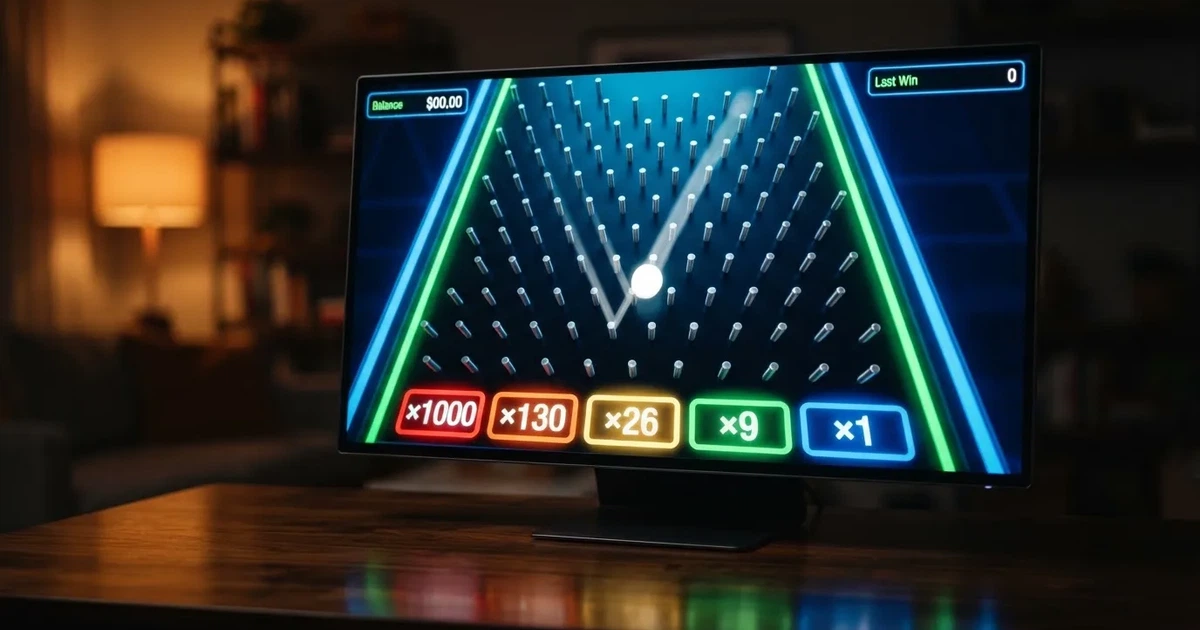
The casino product Australians meet in 2026 search results is overwhelmingly BGaming’s Plinko. The studio’s own product page advertises a 99% return-to-player and a maximum multiplier of x1,000, with balls dropping through a fixed pyramid of pegs into the row of multiplier slots at the bottom. Before each ball the player sets two things: the risk level — low, normal or high — and the number of lines, anywhere from eight to sixteen. From there it is manual ball-by-ball or auto-bet, and the rest is watching where the ball settles.
That pitch is the version offshore brands pass through to their marketing. It is not the only one on the market — Spribe, Turbo Games and a handful of smaller studios have their own Plinko titles — but the BGaming build is the one that shows up consistently on the offshore brands the ACMA has acted against, and it is the one this page takes as the reference point for everything that follows.
The pegboard itself is older than the casino product by forty years. Plinko premiered as a pricing game on the American television show The Price Is Right on 3 January 1983, with nine bottom slots carrying values of $100, $500, $1,000 and $0 from the outside in and a centre slot worth $10,000 — a maximum possible win of $50,000 per chip. The centre slot was worth $5,000 before 1998, capping the maximum at $25,000 at the time. The casino version keeps the pegboard, swaps the dollar values for multipliers, and adds the player’s two pre-drop choices. Nothing else in the mechanic changes.
What the 99% RTP actually means
The 99% RTP is the long-run average return across many millions of balls — not a forecast for any single session. A round of a few hundred balls can land anywhere inside that 99% envelope, and most sessions land well below it. The figure is the casino’s programmed expectation, set by the studio, and the same number holds whether a player is betting in fiat or in Bitcoin.
The x1,000 top multiplier is also a tail event. It sits at the far edge of the multiplier row and the ball reaches it on a small share of drops. The headline figure is the upper bound of what the round can return on any single ball, not the average outcome a player should expect to see. A ball-by-ball session of fifty or a hundred drops is far too short a sample for the long-run average to settle in.
The 99% RTP also applies to the specific combination of risk level and line count the player has set. Different combinations return slightly different long-run figures, and BGaming publishes the breakdown by combination on its product page. A reader who treats 99% as a flat number is reading past the table the studio published.
What the two dials actually change
The two pre-drop choices shift the variance of the round, not its house edge. The risk level changes the spread of the multipliers — high risk compresses the small slots and stretches the big ones, normal risk puts most of the row near the centre, and low risk pulls the row inward so most balls land in middling slots. The line count changes how many slots are open at the bottom: more lines mean more slots, more small wins, fewer big ones.
The pair of dials together is the variance dial. The math of the round does not change with them; the distribution of outcomes does. A player who wants long quiet stretches of small returns chooses one combination; a player who wants long dry patches between occasional big returns chooses another. Neither is closer to 99% on a short sample than the other.
Why the same game wears three marketing labels
In Australian-facing marketing, the BGaming title often appears under variations such as “plinko casino,” “plinko online casino,” and “plinko casino game real money.” These are not three products. They are the same offshore casino site, dressed up for different search terms. The “free spins” and “no deposit bonus” labels that sit beside the game are operator-level promotions rather than properties of the Plinko code — they describe what the casino offers the player around the game, and they are not always available to Australian accounts.
A “plinko casino app” is similarly an app shell for the same offshore site, not a separate Plinko product. Some sites push a downloadable Android APK, others push a progressive web app, and a few run a wrapper inside a real iOS or Android app store. The Plinko inside the app is the same BGaming title as the in-browser version, with the same 99% RTP and the same x1,000 top multiplier. The marketing wrapper is the only thing that changes.
The eleven brands the ACMA has acted against
Every operator in the table below has been the subject of a formal warning from the ACMA under the Interactive Gambling Act 2001 for offering prohibited online casino games — Plinko-style multiplier games included — to customers in Australia. The list is not a ranking and not a recommendation. It is the regulator’s own record of who has been warned, in the order research carried it from the ACMA’s published register.
| Brand | ACMA action and date | Operator named by the ACMA | Plinko support |
|---|---|---|---|
| RocketPlay | Formal warning, March 2026 (Pulsup Ltd); earlier May 2022 (Dama N.V.) | Pulsup Ltd | — |
| Level Up Casino | Formal warning, May 2022 | Dama N.V. | listed |
| Woo Casino | Formal warning, March 2025 | Dama N.V. | — |
| Spirit Casino | Formal warning, May 2025 | Dama N.V. | — |
| National Casino | Formal warning, July 2025 | Consolutetish S.R.L. | listed |
| Bizzo Casino | Formal warnings, July 2025 and 2022 | Consolutetish S.R.L. / TechSolutions | — |
| Ignition Casino | Formal warning, July 2025 | Bamboo Media | — |
| Instant Casino | Formal warning, February 2025 | EOD Code SRL | — |
| Jackbit | Formal warning, April 2026 | Ryker B.V. | — |
| Casino Intense | Formal warning, April 2025 | Sterplay Holding Ltd | listed |
| Sky Crown | Formal warning, September 2022 | Hollycorn N.V. | — |
The “Plinko support” column follows what research actually carries. “listed” means an aggregator or studio page names the brand alongside Plinko; an em dash means no listing in the consulted set covers the brand and Plinko together. That distinction matters. A “no listing found” entry is not the same claim as “Plinko is not offered” — a brand can carry the BGaming Plinko on a lobby page the aggregator does not index, and an em dash only reflects the consulted set.
RocketPlay — two ACMA warnings under different operators
RocketPlay sits on the ACMA’s register twice. The first warning came under Dama N.V. in May 2022, alongside five other Dama brands in the same round. The second came under Pulsup Ltd in March 2026, four years later. Two warnings on the same brand, under two different corporate operators, is the regulator’s own record of repetition on this name — and the only brand in this table where the operator entity itself changed between warnings.
Level Up Casino — Dama N.V. warning of May 2022
Level Up Casino was one of the six brands the ACMA warned Dama N.V. about in May 2022, alongside Bambet, Dazard, Rocketplay, Wild Tornado and Cobra Casinos. The round was the first published Dama N.V. warning on the regulator’s register, and Level Up was one of the names that came in with it. The brand sits among the earliest Dama warnings the ACMA has on file.
Woo Casino — Dama N.V. warning of March 2025
Dama N.V. picked up a second warning on the ACMA’s register in March 2025, with Woo Casino named as the operator on this round. The warning sits three years after the first Dama batch in May 2022, and the regulator’s record on this operator name now spans two formal warnings across that period. An aggregator listing does not place Woo Casino alongside the BGaming Plinko in the consulted set, so the table records an em dash there.
Spirit Casino — Dama N.V. warning of May 2025
Spirit Casino was the second Dama N.V. brand warned in 2025, two months after Woo Casino. The May 2025 warning came in a separate round from the Woo Casino one, but under the same corporate operator. Dama N.V. is now the operator name on four of the eleven brands in this table — the most repeated corporate entry across the register.
National Casino — Consolutetish S.R.L. warning of July 2025
Consolutetish S.R.L. did not appear on the ACMA’s warning register before July 2025. The July 2025 warning covered National Casino and Bizzo Casino together, both first-time entries under this corporate operator. An aggregator listing names National Casino alongside the BGaming Plinko, which is the source for the “listed” entry in the Plinko support column.
Bizzo Casino — two ACMA warnings under different operators
Bizzo sits on the ACMA’s register twice. The first warning came under TechSolutions (CY) Group Limited and TechSolutions Group N.V. in 2022; the second came under Consolutetish S.R.L. in July 2025, alongside National Casino in the same round. Two operators and two warnings on the same brand is the regulator’s own record of repetition on this name, and Bizzo is the second brand in the table where the operator entity changed between warnings.
Ignition Casino — Bamboo Media warning of July 2025
Bamboo Media’s only published ACMA warning covers Ignition Casino, issued in July 2025. The operator name does not appear elsewhere on the regulator’s register. An em dash in the Plinko support column reflects the consulted set rather than any claim about the brand’s actual lobby — Bamboo Media sits on the register with one entry, and that entry is this one.
Instant Casino — EOD Code SRL warning of February 2025
EOD Code SRL’s only published ACMA warning names Instant Casino in February 2025. The operator name is not on the regulator’s register elsewhere, and Instant Casino’s only published ACMA action is this single warning. The February 2025 date places it on the earlier side of the 2025 enforcement round.
Jackbit — Ryker B.V. warning of April 2026
Ryker B.V.’s April 2026 warning was the first on the operator’s register, covering Jackbit and CasinOK in the same round. The brand’s ACMA record is the shortest in this table — one warning, issued in the same enforcement year as the Rocketplay warning under Pulsup Ltd and the National Casino and Bizzo follow-ups under Consolutetish S.R.L.
Casino Intense — Sterplay Holding Ltd warning of April 2025
Sterplay Holding Ltd appears once on the ACMA’s register, with Casino Intense in April 2025. The brand is also among the listings that an aggregator page names alongside the BGaming Plinko, which is the source for the “listed” entry in the Plinko support column. The corporate operator name does not recur on the register elsewhere.
Sky Crown — Hollycorn N.V. warning of September 2022
Hollycorn N.V.’s September 2022 warning covered Sky Crown and Blue Leo together. The pair has been on the ACMA’s register since then, making this the longest-standing warning in the table above. Hollycorn N.V. is the only corporate operator named on the register for these two brands, and neither name appears elsewhere in the consulted set.
What a plinko casino fundamentally means offshore
“Plinko casino” is a shorthand for an offshore casino site that carries the BGaming Plinko title, alongside the rest of a usual casino lobby. The term bundles several distinct offers that sites often present as separate columns:

- A Plinko lobby entry, with the risk-level and line-count dials. This is the game itself.
- A “plinko casino bonus” or “plinko casino free spins” tag, which is a casino-level promotion rather than a property of the Plinko code. The BGaming Plinko does not have built-in free spins; the label describes what the casino offers the player around the game.
- A “plinko casino no deposit bonus” tag, which is the same kind of casino-level promotion, with no deposit required. The terms attached — wagering multiples, maximum cashout, game restrictions — sit in the casino’s bonus terms page, not in the Plinko code.
- A “plinko casino app” label, which is an app shell for the same offshore casino. The Plinko game inside the app is the same BGaming title as the in-browser version.
Each of those labels is a marketing wrapper for one of two things: the Plinko game itself, or a casino promotion around it. Treating them as four different products is the misread the marketing pages rely on. They are one product and a series of offers stacked on top.
The bonus layer is the part most worth reading closely. A “no deposit bonus” with a high wagering multiple and a tight cashout cap is a different offer from one with no wagering and no cap, and the difference is what the bonus terms page says — not what the front-of-house banner says. The marketing pages that rank for “plinko casino no deposit bonus” link through to terms pages that often carry the conditions in smaller type than the headline. That is the standard shape of the offer, and it is what a reader should look at before claiming anything.
The terms layer also carries the maximum-cashout rule. A “no deposit” offer with a maximum withdrawal of two or three times the bonus amount is a different product from one with no cap at all. The headline reads the same in both cases; the terms tell the reader which one they are looking at. The “instant withdrawal” line on the cashier page sits in the same terms document, and runs only as fast as the verification step the operator triggers at its discretion.
The Australian prohibition
Online casino games, including Plinko-style multiplier games, are prohibited in Australia. The Interactive Gambling Act 2001 — strengthened by the Interactive Gambling Amendment Act 2017 — makes it an offence to provide them to a person physically in Australia. The penalties sit at up to A$220,000 per day for individuals and up to A$1.1 million per day for corporations. No state or territory licenses the activity, and no licence is available to apply for.
What is licensable in Australia is wagering on races and sport placed before the event, lotteries and keno. In practice the bulk of that licensing sits with the Northern Territory Racing and Wagering Commission, which regulates 52 of Australia’s online bookmakers — Sportsbet, Bet365 and Ladbrokes among them — for tax reasons. The commission runs with no full-time staff and meets once a month in Darwin. The same body does not license casino games; the question does not arise.
How the ACMA enforces the prohibition
The ACMA — the Australian Communications and Media Authority — is the body charged with investigating complaints, issuing formal warnings and directing Australian internet service providers to block illegal sites. The agency can ask an ISP to geo-block a domain or to take it off the Australian routing entirely; either way, an Australian customer trying to reach the site from a standard residential connection hits a wall. The site itself can stay live in every other jurisdiction it serves.
As of June 2026 the ACMA reported that 1,751 illegal gambling and affiliate marketing websites had been blocked since the first blocking request in November 2019, and that more than 230 unlicensed gambling services had left the Australian market since enforcement was strengthened in 2017. In a single round reported on 26 June 2026 the regulator asked ISPs to block twelve more: 7Signs, ChromaBet, Donbet, Duospin, Freshbet, Slots Gem, Jacks Club, Lucky Start, Pointsbetz.com, Spinrise, Vinyl Casino and Wildsino. The list is long because the supply of offshore brands willing to accept Australian customers is long.
A formal warning does not itself block the site. It is the step before blocking. A brand can be warned, change its marketing to Australians, and continue operating. A brand that keeps accepting Australian customers after the warning is the one the ACMA moves on to a blocking request. The 1,751-blocked count and the 230-services-left count are the cumulative totals across this two-step ladder.
What the law targets — and what it does not
The Interactive Gambling Act 2001 targets the provider, not the player. An individual Australian who places a real-money bet on an offshore casino is not prosecuted; the regulator’s enforcement sits against the operator offering the service. That asymmetry matters because it leaves the player without a parallel set of protections. The same offshore site gives no Australian consumer protection, no Australian complaints body and no recourse if a withdrawal is refused. A block can land with a balance still on the account, and there is no Australian court to take the complaint to.
The Interactive Gambling Amendment (Gambling Reform) Bill 2026 passed Parliament on 19 August 2026, with advertising and inducement measures commencing on 1 January 2027. On a 2026 page that is law with a start date, not yet in force. The change closes some of the marketing gaps around offshore brands, but the underlying prohibition is unchanged. An Australian in 2026 is still looking at a market where the offshore Plinko casino is operating outside the law at every minute it accepts an Australian deposit.
Responsible gaming: what applies, what does not
Minimum age is 18 across every state and territory. The rest of the responsible-gaming frame splits cleanly: protections that apply because they sit in Australian law and bind any Australian-facing operation, and protections that bind only Australian-licensed wagering services and therefore do not reach an offshore casino.
BetStop, the National Self-Exclusion Register, has been live since August 2023. It binds every Australian-licensed online and phone wagering service, and an Australian who has registered with BetStop cannot open a new account with any of them. An offshore casino is not connected to BetStop, and a self-excluded Australian is not stopped from opening an offshore account. The register’s reach ends at the Australian licence.
The National Gambling Helpline, on 1800 858 858, is free, 24/7 and reachable from anywhere in Australia. Online chat is available through Gambling Help Online. Both are funded independently of any operator and are the right first call for someone whose gambling has stopped being the entertainment it was supposed to be. They sit outside the offshore casino frame in the same way BetStop does, which is the point: the support exists whether or not the casino is.
What does not exist on the offshore side is a complaints body. A player who is refused a withdrawal by an Australian-licensed operator can take the matter to the state regulator; a player who is refused a withdrawal by an offshore operator has the operator’s own dispute process, and nothing else. The Australian regulator cannot compel an offshore operator to pay a disputed balance, and an offshore operator’s terms page can sit between the player and any withdrawal without recourse.
Crypto and anonymity: what the offshore pitch offers
The “plinko crypto casino” label markets a Plinko lobby alongside deposits in Bitcoin, Ethereum, USDT and a handful of other coins. The pitch has two parts: faster settlement than a bank transfer, and a degree of pseudonymity the same operator’s bank-mediated deposit does not offer. Neither part changes the Australian legal frame.
A crypto deposit from an Australian wallet to an offshore casino is still a deposit with a prohibited interactive gambling service under the Interactive Gambling Act 2001. The provider-side offence is the same regardless of the rail the money travels on. The enforcement arms — formal warning, blocking request, ISP-level geo-block — sit against the operator, not against the payment method, and they land whether the deposit was a bank transfer or an on-chain transaction.
The crypto-specific Australian rule sits one layer up. Since 11 June 2024 digital currency has been a banned payment method for Australian-licensed online wagering, alongside credit cards and credit-related products; the operator-side penalty for accepting either is up to A$247,500. That rule applies only to Australian-licensed wagering services, and it closes the legal channels for crypto deposits with them. It does not change the status of an offshore casino, which is not a legal channel at all.
The anonymity the pitch sells is also narrower than it looks. A Bitcoin transaction is pseudonymous, not anonymous: the on-chain record is permanent and the wallet address can be linked to a person through any of the standard chain-analytics routes. The withdrawal side of the round is the same on-chain record in reverse, and the same tools apply. What the pitch sells as anonymity is, in practice, a permanent public-ledger record that an Australian law-enforcement request can read. A mixer or a tumbling service adds friction but does not erase the chain.
For a player in Australia comparing options, the relevant question is not whether a crypto deposit feels lighter or faster than a bank transfer. It is whether the offshore casino at the other end of the transaction has any Australian-facing accountability. The answer for every brand in the table above is no — the ACMA has warned each one, and the warnings do not require the operator to recognise Australian consumer law on withdrawals, complaints or dispute resolution.
Payments and payout speed: what “instant” actually costs
The “plinko casino payout” and “plinko casino game real money withdrawal” labels are marketing hooks for the offshore cashier. They do not name a regulated payout timeline, because the operator is not under an Australian timeline. The advertised “instant withdrawal” against an Australian bank account is the operator’s word against its own terms page, and the terms page is the document that runs in any dispute.
What the legal wagering side in Australia accepts is narrower. Since 11 June 2024, credit cards, credit-related products and digital currency have been banned as payment for Australian-licensed online wagering; the legal deposit routes for licensed wagering are debit card, bank transfer, PayID/Osko and BPAY. An offshore casino asking an Australian for a credit card or a crypto deposit is operating outside the Australian rules, regardless of what licence the site displays on its footer.
The advertised payout speed on an offshore cashier page usually carries three conditions in smaller type: a maximum amount per transaction, a verification step the operator triggers at its discretion, and a list of bonus-related holds that apply until wagering requirements are met. A “no deposit bonus” with a high wagering multiple and a maximum cashout cap will hold the player’s withdrawal until the wagering is cleared and the cashout limit is calculated; the “instant payout” claim does not survive those terms.
The Australian-facing reality is that the operator’s word is the only mechanism. A withdrawal refused by an offshore casino cannot be escalated to an Australian regulator, and an Australian court order has no direct reach into a payment processor in another jurisdiction. The cost of “instant payout” on an offshore cashier is the absence of the slow, regulated payout path that a licensed wagering operator offers — and the slow path is exactly what gives the player the recourse the offshore cashier cannot.
The blocking arithmetic
The ACMA’s blocking record makes a rate calculation straightforward. The first blocking request went out in November 2019. As of June 2026, 1,751 illegal gambling and affiliate marketing websites had been blocked across the period in between. That works out to a long-run rate of somewhere between five and twelve sites per week, depending on how the period is read.
The lower end is the long-run average. 1,751 sites over roughly eighty months between November 2019 and June 2026 works out to about twenty-two sites per month, or just over five sites per week. That is the rate if the ACMA’s enforcement had been evenly distributed across the entire period. It was not. The agency’s annual reports show long stretches with little activity and shorter stretches with concentrated blocking rounds, and the average is a smoothed-over number that hides both.
The upper end is the recent rate. In the single round reported on 26 June 2026 alone, the ACMA asked ISPs to block twelve sites. That is more than twice the long-run weekly average in one enforcement action. The single-round rate is the rate any reader who has just watched a blocking round will recognise, and the gap between the long-run and the recent rate is the gap between the regulator’s average tempo and its enforcement ceiling.
Stated as a band, then: the ACMA’s blocking activity has run at somewhere between roughly five sites per week on the long-run average since November 2019 and roughly twelve sites per single enforcement round on the recent peak. The band reflects the shape of the enforcement record, not a single average. A reader who sees “around five a week” and reads it as the regulator’s steady tempo is missing the spikes; a reader who sees “twelve in one round” and reads it as the weekly pace is missing the long quiet stretches. Both ends of the band are in the data.
The supply the ACMA is blocking is not yet thinning. New offshore brands replace blocked ones on a similar timeline to the blocking rate, and the agency’s published list of warned operators continues to grow. The 230-plus services that have left the Australian market since 2017 are a slower-moving count than the blocked-sites count, but both are pointed in the same direction: the regulator is gaining on the supply faster than the supply can replace itself, and the band above is the arithmetic of that catching-up.
Frequently asked questions
What is the Plinko casino game, and how does the ball-drop mechanic actually determine a payout?
BGaming’s Plinko drops balls through a peg pyramid into a row of multiplier slots; the slot the ball lands in sets the multiplier on the bet. Before each ball the player sets the risk level (low, normal or high) and the line count, from 8 to 16. The 99% RTP is a long-run average across millions of balls, not a per-session forecast.
Does a crypto version of Plinko pay out any differently to a standard real-money version?
No. The Plinko code runs on the casino’s server and the return-to-player is fixed by the game’s design, regardless of whether the deposit is in fiat or in Bitcoin, Ethereum or USDT. The crypto route changes the payment rail and the speed the cashier marks the deposit, but it does not change the math of the round.
Is playing Plinko for real money at an offshore casino something Australians are legally allowed to do?
No. The Interactive Gambling Act 2001, strengthened in 2017, makes it an offence to provide online casino games — Plinko included — to a person in Australia. Penalties reach A$220,000 per day for individuals and A$1.1 million per day for corporations. The law targets the provider, and the offshore casino gives no Australian complaints body.
What return-to-player rate do offshore sites typically advertise for their Plinko game?
BGaming’s Plinko carries a 99% RTP on the studio’s own product page, and that is the figure offshore brands pass through to their marketing. The 99% is a long-run average across many millions of balls, not a per-session forecast. The x1,000 top multiplier sits at the edge of the row, so the share of balls reaching it is small.
Why do Plinko casino apps get advertised separately from ordinary Plinko casino websites?
A “plinko casino app” is an app shell for the same offshore casino site, not a different version of the game. The Plinko inside the app is the same BGaming title as the browser version. The separate marketing exists because app-store and APK-distribution searches are a different landscape from web search.