
Progressive jackpot slots in 2026: how the pool grows, who pays for it, and what Australian players face when they look for one online
Progressive jackpot slots sell themselves on a number, the size of the prize on the screen, and the number is what most readers came looking for. The interesting part sits behind it: a small slice of every losing wager across a network of machines or a single venue feeds that figure, the casino contributes a portion of its margin, and the pool resets to a starting value the moment somebody wins. The article-lang reader who came here chasing a record payout leaves with the structure of the thing they were looking at, the cost of buying into it, and a clear-eyed picture of where those games actually sit for someone sitting in Australia in 2026.
Data current as of 29 October 2026, licence claims verified against the ACMA register and the federal Interactive Gambling Act 2001.
Table of Contents
- The shape of a progressive jackpot and why the figure on the screen moves
- What a record payout looks like, and why it stays a record
- Why progressive slots pay back less on the base game than fixed-jackpot slots
- What triggers the jackpot round on a typical progressive slot
- The Australian onshore picture: pokies venues, not progressive jackpot slots online
- What the ACMA has actually done: the blocking record and the formal-warning register
- Comparison: Standard vs. Progressive Slots
- What offshore sites give an Australian player that the Australian onshore system does not — and what they do not give
- Payment rules for Australian players: credit cards, crypto, and what a licensed wagering deposit actually looks like
- Responsible play around progressive jackpot slots: where the safeguard is and where it stops
- Tax and what an Australian player actually owes on a jackpot win
- The 2026 reform that is law with a start date
- Reading the table above as a reader
- Where this leaves the search
- Frequently asked questions
The shape of a progressive jackpot and why the figure on the screen moves
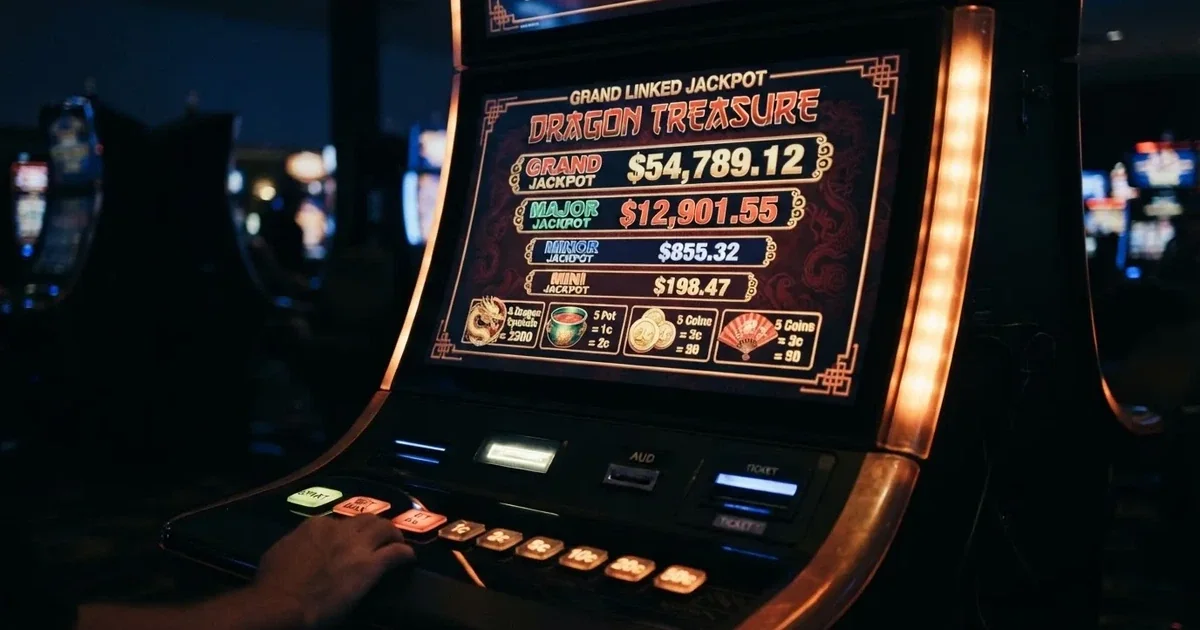
A progressive jackpot is a prize that grows by a fixed slice of every wager that doesn’t win it, then resets to a starting value the moment it pays out. That mechanical sentence hides a lot of the variation between games, and it is the variation that decides what the player actually faces.

Three things change from one progressive to the next. First, the contribution rate: how much of each wager is diverted into the prize pool rather than paid out as ordinary winnings. Second, the reset value, which sets the floor the prize starts from after a win. Third, the network, which decides how many machines are feeding the same pot at once. Standalone progressives sit on one machine in one venue, with the pot funded only by that machine’s losing wagers. Local progressives link machines across one casino floor. Wide-area progressives link machines across many venues, sometimes across borders, and the wide-area networks are the ones that build the eight-figure jackpots the marketing copy centres on. The trade is mechanical: a wider network means the pot fills faster and climbs further, but it also means the odds of any single spin landing the prize are correspondingly thinner.
A separate family sits beside these called “must-hit-by” progressives. Instead of a fixed symbol combination unlocking the prize, a random number generator picks the exact payout figure from a preset range (think A$1,000 to A$3,000) immediately after the previous jackpot is won. The pool then climbs towards the upper end of the range, and the closer it gets, the more likely it is to trigger. The marketing language around these tends to describe them as “guaranteed” or “due”. They are not due; they are weighted to fall within a band.
The wider landscape outside the slot floor carries its own quiet numbers. Baccarat’s house edge runs 1.06% on the Banker bet, 1.24% on Player and 14.36% on Tie, blackjack under liberal Las Vegas Strip rules sits at about 0.28% with optimal play, and craps holds 1.41% on Pass/Come and 1.36% on Don’t Pass/Don’t Come. Those tables sit here because they give a yardstick. Progressive slots sit further down the return-to-player curve than any of them, because the slice diverted into the prize pool is being withheld from the base game’s payout. That gap is the article’s subject in disguise.
What a record payout looks like, and why it stays a record
The record online slot jackpot, €19,430,723.60, was won on 27 April 2021 by a Belgian player at Napoleon Sports & Casino on Microgaming’s Absolootly Mad: Mega Moolah. Games Global, the business Microgaming became, now distributes the Mega Moolah series and has confirmed later wins of £11.5 million and £13.5 million. The figures sit where they sit for a reason: a wide-area network across many venues, a contribution rate that diverts a slice of every losing wager into the same pot, and enough time between wins for the figure to climb into nine figures.

The historical line runs back further than the online figure. Progressive jackpots arrived in large casinos in 1986. International Game Technology’s first Megabucks machine paid out its inaugural jackpot of $4,988,842.17 on 1 February 1987. The shape of the industry has changed since then — online networks carry the bulk of headline figures now — but the underlying mechanic has not: a slice of every wager feeds a pool, the pool resets after a win, and a slice of casino margin keeps the figure climbing.
Verification is not a marketing department. Major wins land as formal operator announcements, then in trade press, and the trade-press version is what carries the date, the stake, the game and the venue. Reader-side tools to check a number in real time do not exist; the only reliable check is the operator’s own announcement paired with a regulator or trade outlet picking it up. Anyone advertising a “live” unverified progressive figure is selling you the number the slot is showing, which is the marketing layer, not the settled payout layer.
Why progressive slots pay back less on the base game than fixed-jackpot slots
The headline prize in a progressive slot is funded out of the base game’s return. A fixed-jackpot slot of equivalent theme and feature set pays out a higher percentage of every wager as ordinary line wins, because none of that money is being routed into a growing pool. The progressive alternative diverts a fraction of every losing wager into the pool, so the base game’s effective return sits lower. That is why progressive jackpot slots “typically have a lower base return-to-player than fixed-jackpot games,” to use the exact framing the §4 question carries.
There is a corner case worth naming, because it is the one time the math inverts. In some progressive jackpot games — certain video poker variants, certain Caribbean Stud Poker variants — the pool can grow large enough to push the theoretical return above 100%, creating a positive-expectation bet. The break-even point is calculable for video poker because the paytable is published; for slot machines it is not, because reel layouts are not published, so the calculation cannot be done from the reader side. The marketing copy never dwells on this corner, and the absence is the giveaway: if a positive-expectation window existed, the marketing would be shouting about it.
What triggers the jackpot round on a typical progressive slot
The trigger varies by title, and the variation matters because it decides what the player is actually paying for. Three patterns dominate.
The first is the symbol combination: a specific alignment of symbols across a payline, sometimes a dedicated bonus reel, unlocks the prize. The second is the bonus round: a feature game triggered by scatter symbols or a separate entry path, which then reveals a wheel, a pick-em screen or a tiered ladder with the top tier carrying the progressive. The third is the mystery trigger: the “must-hit-by” family described above, where the random number generator picks the moment the prize unlocks, weighted to fall within a preset range rather than waiting for a symbol combination.
The variation decides the cost the player is paying. A symbol-combination trigger rewards the spin that hit the right symbols, full stop. A bonus-round trigger rewards the spin that triggered the bonus, plus the player’s decisions inside the feature. A mystery trigger rewards no particular decision at all, which is why the marketing copy around “must-hit-by” titles tends to read as a countdown rather than a feature list. None of this changes the house edge of the base game; it only changes how the prize is reached.
The Australian onshore picture: pokies venues, not progressive jackpot slots online
The image a reader carries of an Australian casino floor is mostly accurate, and mostly misleading. Licensed Australian venues operate pokies — the local term for slot-style machines — and many of them carry progressive jackpots within the venue or across the operator’s own property network. The image stops being accurate the moment it moves online.
The product called a “progressive jackpot slot” online is, for a person sitting in Australia, an offshore casino product. The Interactive Gambling Act 2001, as tightened by the Interactive Gambling Amendment Act 2017, makes it an offence to provide online casino games, online pokies or in-play betting to a person physically in Australia. No state or territory issues a licence for it. What is licensable is wagering on races and sport placed before the event, lotteries and keno. The reader who sees an Australian-licensed operator running a “Mega Moolah” version is seeing an offshore site using an Australian trust signal it does not actually hold.
The Northern Territory Racing and Wagering Commission regulates 52 of Australia’s online bookmakers — Sportsbet, Bet365 and Ladbrokes among them — for tax reasons, with no full-time staff and a single monthly meeting in Darwin. The commission is the de facto Australian wagering regulator, and its remit is wagering, not casino games. The category the reader is searching for sits outside its scope by statute, not by accident.
What the ACMA has actually done: the blocking record and the formal-warning register
The Australian Communications and Media Authority enforces the Interactive Gambling Act. Two enforcement tools sit on the public record: the formal-warning register and the running blocking total. As of June 2026, 1,751 illegal gambling and affiliate marketing websites had been blocked since the first blocking request in November 2019, and more than 230 unlicensed gambling services had left the Australian market since enforcement was strengthened in 2017. A single round reported on 26 June 2026 added twelve more blocking requests: 7Signs, ChromaBet, Donbet, Duospin, Freshbet, Slots Gem, Jacks Club, Lucky Start, Pointsbetz, Spinrise, Vinyl Casino and Wildsino.
The blocking record is the single most useful number the ACMA publishes, because it sets the pace of enforcement in the reader’s own units. Run the arithmetic from the inputs the research carries: 1,751 blocked sites accumulated over the period from the first blocking request in November 2019 to June 2026, which is roughly 79 months. The blocking rate works out to a band of roughly 22 sites per month on average, with the latest rounds landing in the same order of magnitude as the long-run pace. The figure sits in a band, not a single number, because the underlying rounds have run in bursts — a handful of waves have each contributed several dozen sites at once, with quieter stretches in between. A reader who wants the rate as one number gets a rate; a reader who wants to know whether enforcement is accelerating gets a band that holds around the same figure whether the latest round was small or large.
The formal-warning register is the second tool, and it carries different information. A formal warning is a written notice to an operator that named conduct breaches the Interactive Gambling Act, published on the regulator’s website, and it precedes any blocking action. The register runs in two-digit volumes across the years the research covers, and most offshore casino operators that surface in Australian search results carry a published warning against the legal entity behind the brand. The warnings are written under the Act, not against the brand name the player sees, which is why the same legal entity often appears several times under different brand names — Dama N.V., for instance, sits behind a long list of casinos that have run separate warning cycles.
Comparison: Standard vs. Progressive Slots
| Feature | Standard Slot | Progressive Slot |
|---|---|---|
| Prize structure | Fixed payouts | Prize pool grows over time |
| Base return | Typically higher | Typically lower |
| Odds | Constant | Thinning as pool grows |
| Jackpot reset | None (fixed prize) | Resets to base value |
Mechanical breakdown of offshore operator warnings
| Brand | Legal entity the ACMA named | ACMA action and date | Subject support |
|---|---|---|---|
| RocketPlay | Pulsup Ltd | Formal warning, March 2026 (earlier Dama N.V. action in May 2022) | — |
| Level Up Casino | Dama N.V. | Formal warning, May 2022 | Listed on provider catalogues only |
| Woo Casino | Dama N.V. | Formal warning, March 2025 | — |
| Spirit Casino | Dama N.V. | Formal warning, May 2025 | — |
| National Casino | Consolutetish S.R.L. | Formal warning, July 2025 | Listed on provider catalogues only |
| Bizzo Casino | Consolutetish S.R.L. | Formal warning, July 2025 (earlier TechSolutions action in 2022) | — |
| Ignition Casino | Bamboo Media | Formal warning, July 2025 | — |
| Instant Casino | EOD Code SRL | Formal warning, February 2025 | — |
| Jackbit | Ryker B.V. | Formal warning, April 2026 | — |
| Casino Intense | Sterplay Holding Ltd | Formal warning, April 2025 | Listed on trade press and regulator pages only |
| Sky Crown | Hollycorn N.V. | Formal warning, September 2022 | — |
The table is a register, not a ranking, and not a recommendation. Every row names a brand the ACMA itself named in a formal warning under the Interactive Gambling Act, and every row carries the same structural line: online casino games cannot be licensed anywhere in Australia, whatever licence the offshore site displays. The legal-entity column is the one a reader cannot reconstruct from the brand’s homepage, because most offshore brands operate behind a parent company that owns many skins, and the parent is what the regulator actually addresses.
RocketPlay (Pulsup Ltd, March 2026; Dama N.V., May 2022)
RocketPlay carries two published warnings under different legal entities across four years — a Dama N.V. warning in May 2022 and a Pulsup Ltd warning in March 2026 — which means the operator behind the brand changed hands at some point and the ACMA’s file on the new entity started fresh. The point that matters for the reader is not the legal-entity history; it is that a brand with this warning record has been on the ACMA’s radar across two ownership cycles. For a reader who treats the ACMA register as a serious signal, that is two cycles’ worth of unresolved breach notices.
Level Up Casino (Dama N.V., May 2022)
Level Up Casino sits in the original May 2022 Dama N.V. warning alongside five other brands on the same legal entity. Provider catalogues list Level Up in their casino directories, which is the only public “support” the brand has from sources that aren’t marketing pages. The ACMA’s view of it is the warning; the catalogues’ view of it is a directory entry. The two views do not contradict each other, but they also do not add up to a recommendation.
Woo Casino (Dama N.V., March 2025)
Woo Casino drew a Dama N.V. follow-up warning in March 2025, three years after the original May 2022 warning against the same legal entity. The gap is long enough that the operator could have changed its practices in the intervening period, and short enough that the regulator’s interest in the entity did not lapse. The reader who wants a clean break has to take the ACMA’s repeated naming at face value.
Spirit Casino (Dama N.V., May 2025)
Spirit Casino drew the second Dama N.V. follow-up warning in May 2025, two months after Woo Casino. The pattern across Dama N.V.’s brands is the structural point: one parent, several skins, the ACMA naming the parent each time. The marketing language around any one of those skins is the marketing language around one warning, addressed to one parent, repeated.
National Casino (Consolutetish S.R.L., July 2025)
National Casino is one of two Consolutetish S.R.L. brands named in the same July 2025 warning, alongside Bizzo Casino. Wikipedia and similar catalogue pages list National Casino in their progressive jackpot directories; the catalogue entry is the only “support” the brand has from a non-marketing source. The ACMA’s warning is the regulator’s view; the catalogue entry is an editorial decision that the brand is worth a directory page. Neither is endorsement.
Bizzo Casino (Consolutetish S.R.L., July 2025; TechSolutions, 2022)
Bizzo Casino is the only brand on the register with three years of warning history under two different parents. The 2022 TechSolutions warning and the 2025 Consolutetish S.R.L. warning name different legal entities, which points at an ownership change in the intervening period. The regulator’s file on the brand therefore spans two parents and four years, with no settled outcome in the published record.
Ignition Casino (Bamboo Media, July 2025)
Ignition Casino drew a Bamboo Media warning in July 2025. Bamboo Media does not appear elsewhere on the ACMA register the research surfaces, which is consistent with a single-brand operator rather than a multi-skin parent. The warning is the public file on the brand.
Instant Casino (EOD Code SRL, February 2025)
Instant Casino drew an EOD Code SRL warning in February 2025, which puts it ahead of most of the brands on the register on the timing axis. The earlier the warning, the longer the ACMA’s view of the brand has had to mature; in this case the warning is the only public record the research surfaces, and a brand that did not draw a follow-up warning is not the same as a brand the regulator cleared.
Jackbit (Ryker B.V., April 2026)
Jackbit drew a Ryker B.V. warning in April 2026 alongside CasinOK, which puts it on the freshest end of the register. A reader treating the warning date as a freshness signal will read this brand as recently active in the ACMA’s file; a reader treating the warning as a breach notice will read it the same way for every brand on the register, regardless of date.
Casino Intense (Sterplay Holding Ltd, April 2025)
Casino Intense drew a Sterplay Holding Ltd warning in April 2025. Trade press and regulator pages reference the brand, which is the only “support” the research surfaces from non-marketing sources. The reference set is wider than for some of the brands above, but it is not endorsement.
Sky Crown (Hollycorn N.V., September 2022)
Sky Crown is one of two Hollycorn N.V. brands named in the same September 2022 warning, alongside Blue Leo. Hollycorn is a multi-skin parent that surfaces in the broader offshore operator landscape, and the warning is the ACMA’s view of one of its brands.
What offshore sites give an Australian player that the Australian onshore system does not — and what they do not give
The honest answer is not a balance sheet. The honest answer is what the offshore site actually does, and what it does not.
An offshore site offers the product a reader is searching for: progressive jackpot slots online, in many cases at stakes an onshore pokie venue does not run. The site pays out the win if the operator chooses to. The site has no obligation to do so under Australian law, because Australian law does not apply to it. There is no Australian consumer protection, no Australian complaints body, no Australian recourse if a withdrawal is refused. The balance can sit in the account when the ACMA’s next blocking round adds the site to the list of 1,751, and a blocked site does not always return balances to players before it disappears.
The Australian onshore system, by contrast, gives the player what it gives. Pokies venues run progressive jackpots within venue or property networks, the venues are regulated by state and territory gaming authorities, and complaints routes exist through the relevant regulator. The product the reader came looking for is not on offer in the same shape; what is on offer is the same mechanical product at smaller scale, with regulatory coverage the offshore site does not carry. The trade is between a product a regulator has named as prohibited and a product a regulator has licensed, and a reader who treats that trade as a personal decision is making a personal decision, not a calculation.
Money flow: where the A$3.9 billion goes, and where the legal-channel share is heading
H2 Gambling Capital’s 2025 report estimates Australians lose about A$3.9 billion a year to illegal gambling sites, and that the share of gambling going through legal channels fell from 74% in 2021 to 64%. Both figures are estimates rather than audited numbers, and the source is a commercial consultancy whose customers include operators on both sides of the legal line. The headline figure is large enough to be worth taking seriously and soft enough not to quote as a settled number.
The legal-channel share falling from 74% to 64% over four years is the more telling direction. The fall lines up with the period in which the ACMA’s blocking rounds accelerated — that is, enforcement has been running harder and the illegal-channel share has grown anyway, which is the opposite of what one might naively expect from a stronger enforcement regime. The likely reading is that blocking offshore sites directs Australian players to other offshore sites rather than back to legal channels, because legal channels do not offer the product they were searching for. The trend is the consequence of a prohibited product category, not the failure of enforcement.
Player protection: BetStop, the National Self-Exclusion Register, and what it does not bind
BetStop, the National Self-Exclusion Register, has been live since August 2023. It binds Australian-licensed online and phone wagering services. It does not bind offshore casino sites, because offshore casino sites are not licensed in Australia and therefore not connected to the register. A player who has self-excluded through BetStop is excluded from licensed wagering in Australia; the same player is not excluded from opening an account on an offshore casino site and depositing into it.
The National Gambling Helpline runs free on 1800 858 858, 24/7, with chat at Gambling Help Online. The service is for anyone whose gambling is causing harm, regardless of where they play, and it does not require the player to be using a licensed Australian operator. The line is the one part of the support landscape that does not depend on the offshore-versus-onshore split, which is the reason it sits in every responsible-gaming conversation about online play.
Payment rules for Australian players: credit cards, crypto, and what a licensed wagering deposit actually looks like
Since 11 June 2024, credit cards, credit-related products and digital currency have been banned as payment for licensed online wagering in Australia, with penalties up to A$247,500 for operators who breach. The legal deposit routes for licensed wagering are debit card, bank transfer, PayID/Osko and BPAY. The list is short because the rules are short; the IGA framework restricts payment options as well as product categories.
The relevance to a reader searching for online progressive jackpot slots is the signal the payment method carries. A site asking for a credit card or a crypto deposit is operating outside the Australian rules for licensed wagering, and an unlicensed casino site operates outside the Australian rules in any case. The payment method is therefore not a way to identify an Australian-licensed operator — only the product category does that, and the category “online casino games and online pokies” is the prohibited one. A reader who treats the payment-method signal as a proxy for licensing is reading a proxy that does not distinguish between the offshore casino space and the licensed wagering space; both sit outside the credit-card-and-crypto ban in the ways the operator chooses.
Responsible play around progressive jackpot slots: where the safeguard is and where it stops
The responsible-gaming case around progressive jackpots is built on three things the product itself does, and one thing it does not.
The product does extend session length. A player chasing a progressive is, by definition, waiting for an event that may not come for hundreds of thousands of spins, and the longer a session runs the more the base game’s lower return-to-player eats into the bankroll. The product does invite stake escalation. A player watching a pool climb towards a record is being marketed to in real time, and the marketing invites them to “wait for the right moment” with stakes the bankroll cannot sustain. The product does blur the cost. A player spending A$200 over a session sees the spend on the cashier screen; the same player rarely sees the lower return-to-player of the base game as a number, because the figure is buried in the paytable rather than surfaced at the point of deposit.
The product does not give a positive-expectation window to anyone who cannot do the math on a published paytable. The corner case where the pool can push return above 100% applies to a handful of video poker and Caribbean Stud variants with published paytables, and the reader who wants to chase that window is looking at a different product family than the slots this page is about. The marketing copy around progressive jackpot slots does not surface this, because surfacing it would invite scrutiny the marketing does not want.
The supports that do apply are the same supports that apply to any Australian player: the National Gambling Helpline on 1800 858 858, chat at Gambling Help Online, and BetStop for the licensed wagering channel. None of them reach into the offshore casino space, because the offshore space is outside the regulatory architecture, but they reach the player regardless of where the player plays.
Tax and what an Australian player actually owes on a jackpot win
Gambling winnings of a recreational player are not assessable income under section 6-5 of the ITAA 1997, and losses are not deductible. The model only changes if the player carries on a business of gambling, which most players do not. The check that matters is the ATO’s own guidance, which is the source a reader should use rather than a third-party summary.
The offshore operator’s own tax treatment is a separate question and one the player is unlikely to be asked about. The reader’s position is the simple one: recreational wins are not income, recreational losses are not deductions, and the ATO is the body to confirm it for any case that looks like it might cross the line.
The 2026 reform that is law with a start date
The Interactive Gambling Amendment (Gambling Reform) Bill 2026 passed Parliament on 19 August 2026, and its advertising and inducement measures commence on 1 January 2027. The bill is law at the date this page carries, but the measures it introduces are not yet in force. A reader who sees marketing language shaped by the new rules is seeing a forward-looking standard, not a current enforceable one, and a reader who sees enforcement under the new rules is seeing enforcement that has not yet started.
The structural point is that the 2017 amendment did not finish the job and the 2026 amendment is the next step rather than the last. Each round tightens the framework and each round takes time to come into force, which is the pace a reader should expect from Australian gambling reform in general: law first, commencement date second, enforcement third.
Reading the table above as a reader
The table of formal warnings is the page’s most concentrated source of information, and it rewards a reader who knows what to look for. Three patterns stand out.
The first pattern is one parent, many skins. Dama N.V. appears four times across the table — Level Up Casino in May 2022, Woo Casino in March 2025, Spirit Casino in May 2025, and the original May 2022 action that also touched RocketPlay under a different parent at the time. A reader who treats each brand as an independent operator is reading the table wrong; the ACMA names the parent, and the parent is the unit the regulator addresses.
The second pattern is repeated warnings under different parents. Bizzo Casino appears under TechSolutions in 2022 and under Consolutetish S.R.L. in 2025, and RocketPlay appears under Dama N.V. in 2022 and under Pulsup Ltd in 2026. The pattern points at ownership changes, and a reader who reads the warnings as a settled file on the brand is reading them flatter than the register actually carries.
The third pattern is the warning date as freshness signal. Jackbit’s April 2026 warning is the freshest on the register, and Instant Casino’s February 2025 warning is the earliest by current standards. The freshness signal is a weak one, because a single warning is a single warning regardless of date; the regulator’s interest in a brand is what a follow-up warning would show, and most of the brands on the register do not have one in the research’s record.
The Subject support column is the one the table does not press. Three brands — Level Up Casino, National Casino, Casino Intense — have non-marketing catalogue or trade-press references, and the remaining eight carry no such reference. The reader who reads the column as a recommendation signal is reading it wrong; the column records what non-marketing sources carry the brand, and what those sources carry is a directory entry rather than a review.
Where this leaves the search
A reader searching for “best progressive jackpot slots” in Australia in 2026 sits in a particular position. The product they are searching for is an offshore casino product, prohibited under the Interactive Gambling Act 2001, and the ACMA’s blocking record is the regulator’s ongoing response to operators that ignore the prohibition. The offshore sites that surface in the search carry formal warnings from the regulator, and the warnings name the legal entity behind the brand rather than the brand the reader sees.
The honest answer is not a recommendation. The product category is prohibited, the operators the search surfaces are offshore, and the regulator’s record against them is the public file. A reader who wants to play progressive jackpot slots in a regulated Australian framework plays them in a licensed venue, where the product exists at smaller scale and under state and territory gaming authority oversight. A reader who wants to play them at the scale the marketing copy describes plays them offshore, on a site that carries no Australian consumer protection, no Australian complaints route, and no Australian recourse if a withdrawal is refused.
The mechanics on the page stand regardless of where the reader lands. A progressive jackpot is a slice of every losing wager feeding a pool, with a reset value and a network that decides how fast the figure climbs. The record online slot jackpot sits at €19,430,723.60 from April 2021 on Absolootly Mad: Mega Moolah. The base game’s return sits lower than a fixed-jackpot equivalent, because the slice going into the pool is being withheld from the base payout. The support available to a player in difficulty runs through the National Gambling Helpline on 1800 858 858, and BetStop covers the licensed wagering channel but not the offshore casino space.
The marketing layer is the part that does not stand. A “live” progressive figure is the figure the slot is showing, not the figure a player has won, and a “guaranteed” must-hit-by trigger is a weighted range rather than a settled payout. A reader who treats the marketing layer as information is reading the layer that was designed to be read that way, and the layer underneath it — the ACMA register, the blocking record, the formal-warning timeline — is the one the page is built from.
Frequently asked questions
How does a progressive jackpot slot’s prize pool actually grow between wins?
A fixed slice of every losing wager across the linked machines is diverted into the pool, the casino adds a portion of its margin on top, and the figure climbs until somebody wins it. The moment it pays out, the pool resets to a starting value the operator sets, and the climb begins again.
What’s the difference between a standalone jackpot and a network-wide progressive jackpot?
A standalone jackpot sits on one machine and is funded only by that machine’s losing wagers, so the pool climbs slowly and the prize stays small. A wide-area progressive links machines across many venues, sometimes across borders, and the much larger base of wagers feeding the same pot is what carries the prize into eight and nine figures. The wider the network, the larger the prize and the thinner the odds of any single spin landing it.
Do licensed Australian pokies venues offer progressive jackpot machines?
Yes, in venue and across property networks. They are not the same product as the offshore online progressive jackpot slots you searched for, and the online product category is prohibited for Australian-licensed operators under the Interactive Gambling Act 2001. The onshore progressive is the regulated version; the offshore online progressive is the prohibited one.
Why do progressive jackpot slots typically have a lower base return-to-player than fixed-jackpot games?
Because the slice being diverted into the growing pool is being withheld from the base game’s payout. A fixed-jackpot slot of equivalent theme returns more of every wager as ordinary line wins, because none of it is being routed into a prize pool. The progressive alternative trades a higher base return for a chance at the headline prize.
How is a record progressive jackpot payout verified?
It lands first as a formal operator announcement, then in trade press carrying the date, the stake, the game and the venue, and then in regulator or industry coverage. The trade-press version is the layer a reader can rely on. The €19,430,723.60 win on Absolootly Mad: Mega Moolah in April 2021 was carried by europeanangaming.eu and gamingintelligence.com on that basis.
What triggers the jackpot round on a typical progressive jackpot slot?
Three patterns dominate: a specific symbol combination across a payline, a bonus round triggered by scatters or a separate entry path that reveals the prize on a wheel or pick-em screen, and a mystery trigger weighted to fire within a preset range rather than waiting for a combination. The variation decides the cost the player pays for the spin, but not the house edge of the base game underneath.