
Pay by phone bill casinos in Australia: how carrier billing meets a market that doesn’t license it
The promise is tidy enough: tap a button, confirm by SMS, see the deposit land before the spin loads. The reality behind it, for an Australian, is messier. No state or territory issues a licence for an online casino. Carrier billing — Boku, Fortumo, the rest of that roster — is a payment rail, not a regulatory one. It does not launder an offshore operator into the Australian market, and the Australian Communications and Media Authority has spent several years saying so out loud.

Data current as of 29 October 2026, cross-checked against the ACMA’s formal-warning register and its June 2026 blocking round.
Table of Contents
- How “pay by phone” actually moves money to a casino
- Pay-by-phone casinos in Australia — what the broader landscape actually looks like
- Australian law on online casinos: what’s allowed, what isn’t
- Responsible gaming: where the safety net actually sits
- Pay by phone bill casinos and payout speed: what the marketing claims and what the rails allow
- Mobile, apps and the “pay by mobile phone” rail on an Australian phone
- Slots and games: the titles the pay-by-phone casino pages tend to spotlight
- The 11 brands the ACMA has warned — what’s on the record
- The blocking-rate calculation: what 1,751 blocked sites since 2019 actually looks like
- Other payment rails an Australian player meets at an offshore casino
- What the picture looks like from the player’s side
- What an Australian needs to know
- Frequently asked questions
How “pay by phone” actually moves money to a casino
Carrier billing is one rail in a wider mobile-payments stack. It charges a purchase to a mobile phone bill — or, for prepaid, deducts it from airtime credit — instead of routing through a card or a bank account. The phone is the payment instrument; the carrier is the collector. Boku, founded in 2009 in London and listed on the London Stock Exchange’s AIM market on 20 November 2017 under the ticker BOKU, is the most-cited processor in this space. It describes its network as more than 200 local payment methods across 40-plus markets, with payment licences in those same 40-plus countries, and says it operates in over 90 countries in total. Other processors in the same lane — Fonix, Bango, Fortumo and Google Pay — sit alongside it.

The mechanics of a casino deposit through that rail are simple to describe and slow to settle. A player enters a deposit amount on the casino site, confirms through the carrier’s billing page, and either approves or rejects the charge by SMS. Most processors cap a single transaction well below what an offshore casino would consider a normal first deposit; a second transaction is usually needed to clear the cap, and only when that second transaction settles does the casino credit both halves to the balance. The promise of “instant” is therefore about the credit-to-balance half. The bill-side of it — the cash settlement between the carrier, the processor and the casino — runs on its own rails and its own clock, and that clock is the part an Australian player never sees.
Three things make the rail distinctive at a casino, and all three cut against the player rather than for them.
The first is the carrier cap. A single carrier-billed deposit is bounded; what looks like one transaction on screen is often two on the back end, and the second one only triggers once the first clears. The second is that withdrawals almost never travel back along the same rail. A carrier can collect a charge; it does not pay out winnings. The casino has to send the money somewhere else — a bank transfer, a card refund, sometimes a wallet — and that “somewhere else” is where the slowness the marketing copy sidesteps actually lives. The third is reversibility. A chargeback on a phone bill is harder to pursue than one on a card, because the dispute has to climb from the player through the casino to the processor to the carrier, with the IGA sitting underneath the whole dispute as an uncomfortable backdrop. None of this is novel; it is how carrier billing has worked since well before the casino industry adopted it.
Pay-by-phone casinos in Australia — what the broader landscape actually looks like
The wider shelf of “pay by phone” casinos is a marketing category more than a regulated one. Sites that slot into it are offshore-licensed, sit outside the Interactive Gambling Act 2001’s permitted-licence perimeter, and accept Australian traffic on the implicit understanding that the regulator cannot easily stop them. The ACMA’s blocking tool — directing Australian ISPs to refuse to resolve the site’s domain — is the regulator’s bluntest instrument. By June 2026, 1,751 illegal gambling and affiliate marketing websites had been blocked since the first request in November 2019, and more than 230 unlicensed gambling services had left the Australian market since enforcement was strengthened in 2017.
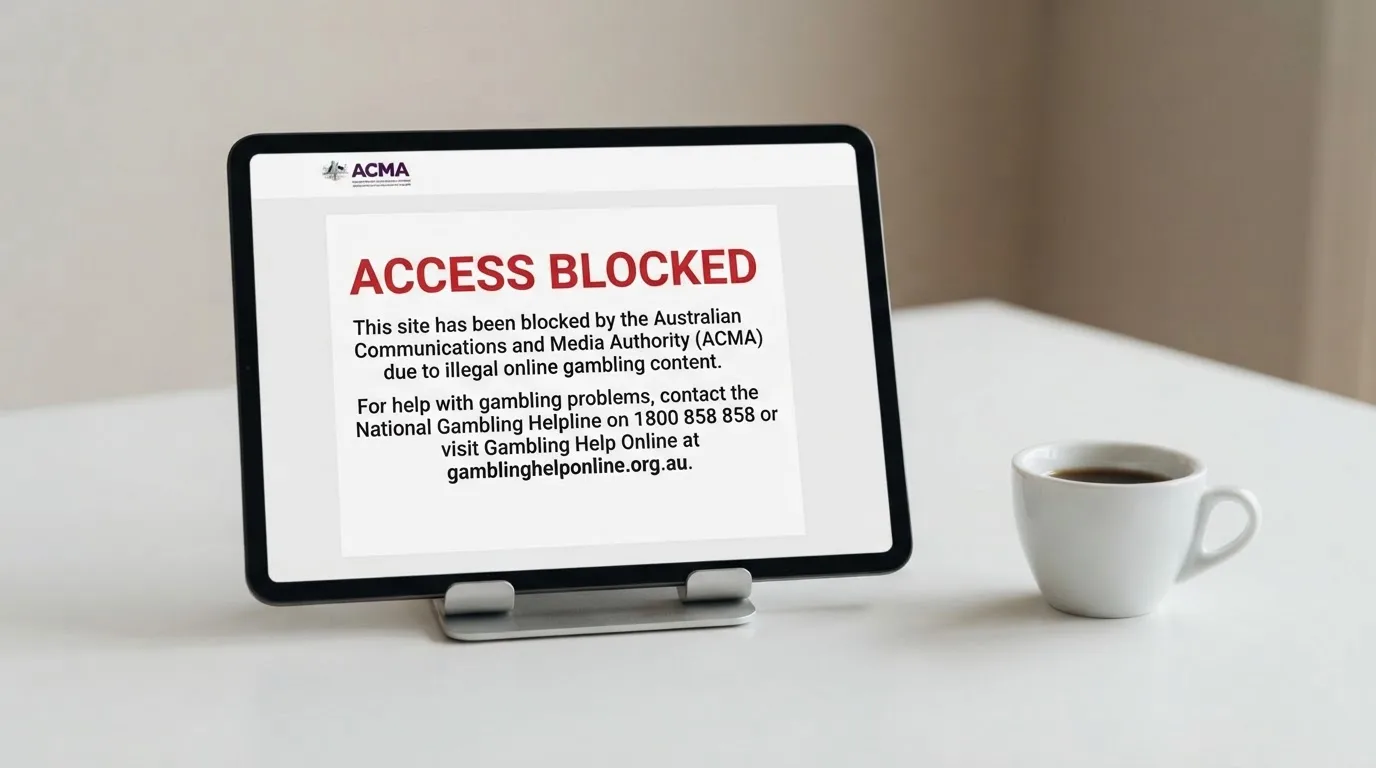
What an Australian sees, scanning that landscape, is a fairly stable cluster of brands and a thin turnover at the top. Many of the names have rotated over the last few years — Dama N.V. is the most-cited operator, with formal warnings in May 2022, March 2025 and May 2025 covering six of its brands; Hollycorn N.V. surfaces in 2022 over Sky Crown and Blue Leo; Consolutetish S.R.L. takes a 2025 warning over National Casino and Bizzo Casino. The shape of the cluster is the regulator’s record, not a recommendation; a brand on the list is a brand the ACMA has already named. A player reading that list as a buyer’s guide has mistaken the document.
Two things change the picture even before the IGA is read. First, the ACMA’s enforcement moved from warning to blocking in late 2019, and the cadence has accelerated since: a single June 2026 round added 12 domains to the block list, including 7Signs, ChromaBet, Donbet, Duospin, Freshbet, Slots Gem, Jacks Club, Lucky Start, Pointsbetz, Spinrise, Vinyl Casino and Wildsino. Second, the operators most often named run dozens of brands apiece, so a single corporate enforcement action can name a player’s actual casino under a parent they may never have heard of. Rocketplay’s March 2026 warning was issued to Pulsup Ltd; Jackbit and CasinOK’s April 2026 warning to Ryker B.V.; Casino Intense’s April 2025 warning to Sterplay Holding Ltd. The brand and the operator are different things, and only the ACMA’s register keeps them straight.
Australian law on online casinos: what’s allowed, what isn’t
The Interactive Gambling Act 2001, as tightened by the Interactive Gambling Amendment Act 2017, makes it an offence to provide online casino games, online pokies or in-play betting to a person in Australia. No state or territory issues a licence for any of those products. What is licensable — wagering on races and on sport before the event, lotteries and keno — sits, in practice, under the Northern Territory Racing and Wagering Commission, which regulates 52 online bookmakers including Sportsbet, Bet365 and Ladbrokes. The Northern Territory commission is a peculiar body: it has no full-time staff, meets once a month in Darwin, and operates on a tax-driven licence model that has produced repeated calls for reform in 2026.
The IGA targets the provider, not the individual player. An Australian depositing into an offshore casino commits no offence under the Act. What the player gives up is the protection that a domestic licence would have provided — dispute resolution, segregation of player funds, responsible-gaming enforcement, an Australian complaints body. An offshore casino can be blocked with a balance still in the account, with no recourse, because the regulator cannot help a player recover funds from an entity it has just told ISPs to cut off.
Three payments restrictions sharpen that picture for Australian players specifically:
- Credit cards and credit-related products cannot be used at Australian-licensed online wagering services since the 2023 amendment to the IGA, with the rule in force from 11 June 2024 and penalties for breaching operators up to A$247,500.
- Digital currencies are also outside the accepted-payment perimeter for licensed wagering, on the same 2024 footing.
- The legal deposit routes that remain — debit card, bank transfer, PayID and Osko instant transfers, and BPAY — are the ones an Australian-licensed bookmaker accepts.
A pay-by-phone rail sits beside these rather than inside them. Carrier billing is a real Australian payment method; it is simply not a permitted one for gambling on a licensed site. That is why the brands offering it sit offshore. They have no reason to accept an Australian payment method the Australian framework would have to whitelist, and no interest in being paid in a way that an Australian bank would refuse to clear.
Responsible gaming: where the safety net actually sits
The support infrastructure for an Australian gambler who decides to stop is real, well-funded and tightly constrained to the licensed market. BetStop — the National Self-Exclusion Register — has been live since August 2023 and binds every Australian-licensed online and phone wagering service. The minimum exclusion period is three months; the maximum is permanent; registration is free and online; and an exclusion stops at the operator end, with no attempt to claw back money already on an unlicensed account. The National Gambling Helpline is 1800 858 858, free, open 24 hours a day, with chat at Gambling Help Online.
None of this is connected to an offshore casino. BetStop covers Australian-licensed operators. The helpline covers anyone who calls. Beyond those two, the responsible-gaming environment for an Australian using an offshore casino is whatever the offshore casino chooses to publish — usually a deposit-limit field, sometimes a self-exclusion toggle, almost always written in copy that the ACMA would not accept on a licensed site.
A practical second line sits on the bank side. ANZ’s gambling transaction block, activated through the ANZ app, blocks gambling transactions on an eligible card — including transactions made through a linked digital wallet such as Apple Pay. Once activated, removing the block again carries a 48-hour cooling-off period, and ANZ warns that not all gambling transactions will be blocked and that some non-gambling transactions might be blocked in error. Westpac’s gambling block operates at card level too, refusing authorisation under the merchant category code Betting/Casino Gambling on eligible personal credit and debit cards. Both are blunt instruments — they block legitimate gambling as well as illegal gambling — and they cut off an offshore casino more cleanly than the ACMA ever could, because the bank simply declines the transaction.
A third route is carrier-level: an Australian mobile account can ask the carrier to disable premium-SMS billing, which kills the carrier-billed-deposit rail by interrupting the SMS-confirmation step before it reaches the processor. That step, on its own, does nothing for a player who has already signed up with a card or a PayID. Its place in the stack is preventive: it closes a door before someone walks through it.
Pay by phone bill casinos and payout speed: what the marketing claims and what the rails allow
Claims around payout speed at pay-by-phone casinos are an exercise in selective quotation. The deposit rail settles in seconds, because that is how carrier billing works — the SMS round-trip is fast, the credit-to-balance half is fast, and the screen says “deposit successful” almost immediately. The withdrawal rail, on the other hand, is whatever rail the casino has decided to use for outgoing payments. A carrier does not pay out winnings.
In practice the rails an offshore casino names are bank transfer, debit card refund and, on some sites, an e-wallet. None of them is instant. Bank transfers inside Australia settle in under a minute on Osko when paid to a BSB and account number or to a PayID, and PayID itself is available at over 100 Australian financial institutions, with more than 25 million PayID identifiers registered on the New Payments Platform by April 2025. None of that Osko speed reaches a player depositing from Australia into an offshore casino, because Osko is a domestic Australian rail and the money has to cross borders before it gets to the casino — and cross back before the payout reaches the player.
Three figures are worth keeping in mind when comparing payout claims on these sites:
- Osko inter-bank transfers in Australia settle in under a minute, 24/7, including weekends.
- PayID-based instant transfers are available at over 100 Australian institutions.
- An A$10,000-or-more transfer does not, on its own, trigger an AUSTRAC threshold-transaction report, because that reporting rule applies only to physical cash, not to electronic transfers.
None of these is a payout promise from any offshore casino. They describe the rails an Australian player is reading about when scanning a casino’s “fast payouts” page. A deposit speed of seconds and a payout speed of minutes is the common claim; the rails described here say the deposit half is real and the payout half is at the mercy of a non-domestic settlement window.
Mobile, apps and the “pay by mobile phone” rail on an Australian phone
The phrase “pay by mobile phone” covers a wider set of rails than carrier billing alone, and the marketing around it is loose enough that the phrase can mean three different things on three different sites. The most common reading is that the phone is the payment device — Apple Pay, Google Pay, Samsung Pay — rather than the bill itself. By the end of 2025 those three collectively accounted for around 45% of all card payments in Australia by number, on the Reserve Bank of Australia’s reading. They do not, in themselves, charge the phone bill; they charge the underlying card. The second reading is the carrier-billing rail described above. The third is a wallet top-up funded by another method — a debit card, a PayID transfer — that the phone then presents as a payment token.
The practical consequence for an Australian player is that “pay by mobile” usually means a card is in the loop somewhere, and a card is the rail the bank-side gambling blocks sit on. ANZ blocks a gambling transaction made through Apple Pay on an eligible card; Westpac refuses authorisation under the gambling merchant category code. The 11 June 2024 credit-card ban for licensed wagering does the same thing on a regulatory level: a card payment to a licensed bookmaker is not allowed for credit, and the same merchant category is what the bank blocks use.
The third reading — wallet top-up funded from a domestic Australian source — is the path of least resistance, and is the one an offshore casino rarely advertises as such. An Apple Pay or Google Pay wallet funded from a debit card or a PayID transfer moves money to a casino site in seconds, sits inside the bank’s view of the transaction as a card payment, and triggers the bank’s gambling block if the bank has one switched on. A player who has activated ANZ’s block, or who has Westpac’s gambling block in place, finds the transaction declined. A player who has not finds the transaction processed, with no record on the phone bill and no way to tell, from the bill alone, that the deposit was a gambling deposit.
Slots and games: the titles the pay-by-phone casino pages tend to spotlight
The titles pay-by-phone casino pages tend to name in their slot sections are not, in themselves, a pay-by-phone product. They are mainstream video slots with a public RTP and a volatility class, hosted on offshore casino sites that happen to accept carrier-billed deposits. The deposit rail and the slot are independent choices — a slot is a slot irrespective of how the deposit got there — and pages that frame a slot as “pay-by-phone-friendly” are describing how a player can fund a session, not how the slot works.
The recurring titles in this corner of the market are familiar ones: Sweet Bonanza, Gates of Olympus, Big Bass Bonanza, Sugar Rush, The Dog House, Money Train 3, Wanted Dead or a Wild, Razor Shark, Mental, San Quentin xWays, Book of Dead, Starburst, Gonzo’s Quest, Legacy of Dead, Jammin’ Jars, Fire Joker. The deposit rail that funds them, on a pay-by-phone casino, is Boku or one of its peers; the slot itself is the same slot on every site that hosts it, and the RTP and volatility figures are title-level rather than casino-level.
The question worth carrying forward from this shelf is whether the slot makes any difference to the carrier-billing route. It does not. A deposit via Boku at one casino and a deposit via Boku at another settle on the same rails, with the same caps, at the same speed. The slot changes the session cost; the rail does not.
The 11 brands the ACMA has warned — what’s on the record
Every brand below is on the ACMA’s formal-warning register. The register is the regulator’s record of operators it considers to be offering prohibited interactive gambling services to Australians. It is not a buyer’s guide, not a ranking, and not a recommendation. A brand’s appearance on it is a statement of the regulator’s view; a brand’s absence from it is not a statement of any view at all.
Each write-up below keeps the same shape: the ACMA warning as published, the corporate operator named on that warning, any earlier warnings to the same operator or to a brand’s previous corporate parent, and the page’s own verdict on what the warning record means for a player who is reading it. Verdict is not endorsement; it is the page’s reading of the regulator’s record.
RocketPlay
The ACMA’s March 2026 formal warning to Pulsup Ltd covers RocketPlay; the same brand was earlier the subject of a May 2022 warning to Dama N.V. alongside five other Dama brands. Two operators, two dates, the same brand — that is what a player sees when they read the register, and it is what the register shows. The brand’s subject-key support is currently unlisted. The picture the warning record paints is of a casino whose operator changes its corporate parent without changing the brand on the front door.
Level Up Casino
Level Up was named in the May 2022 Dama N.V. warning alongside Bambet, Dazard, Rocketplay, Wild Tornado and Cobra Casinos. The brand’s subject-key support shows up only on Westpac’s gambling block page, which is a payments-rail reading rather than a casino endorsement. The verdict is the regulator’s: a Dama brand, named in 2022, on a list that has not been retracted.
Woo Casino
Woo Casino received a Dama N.V. warning in March 2025, freshening a record that was already on the file. No specific subject-key support is currently associated with the brand, and the warning is the page’s only relevant datum. A 2025 warning on a brand whose corporate parent already had a 2022 warning is the kind of pattern the ACMA’s enforcement cadence has produced across several operators.
Spirit Casino
Spirit Casino received a Dama N.V. warning in May 2025 — two months after Woo Casino’s, both at the same operator. The pairing is informative: a regulator that names the same operator twice in two months is not signalling satisfaction. The brand’s subject-key support is unknown on this page’s data.
National Casino
National Casino’s July 2025 warning to Consolutetish S.R.L. sits alongside the same operator’s Bizzo Casino warning on the same date. The brand’s subject-key support shows up only on AUSTRAC’s threshold-transaction page and on a Wikipedia entry — neither is a casino endorsement, and neither is a regulator’s view of the casino. The corporate name Consolutetish S.R.L. is one a player is unlikely to see on the casino’s own footer, and a player checking the brand’s regulator record is the only one who will dig it out.
Bizzo Casino
Bizzo Casino is the brand with the longest warning record in this set: Consolutetish S.R.L. in July 2025, and an earlier 2022 warning to TechSolutions (CY) Group Limited and TechSolutions Group N.V. Two operators, two warnings, the same brand on the front. The brand’s subject-key support is unknown on this page’s data. A player reading the register sees a brand whose operator has rotated, and a regulator that has followed the rotation.
Ignition Casino
Ignition Casino’s July 2025 warning to Bamboo Media is the ACMA’s only published action against this brand. The brand’s subject-key support is unknown. A single warning on a brand is the smallest entry in the register, and it is the one that says least about what the brand is doing now — and the most about what the regulator thinks it was doing then.
Instant Casino
Instant Casino was named in the ACMA’s February 2025 warning to EOD Code SRL. The brand’s subject-key support shows up on listings pages at ecoPayz and PayID — payments-rail readings rather than casino endorsements, and ones that simply say the brand has been seen on those rails. The warning record is the regulator’s view; the rail listings are infrastructure.
Jackbit
Jackbit and CasinOK were named together in the ACMA’s April 2026 warning to Ryker B.V. Two brands, one operator, one warning. The brand’s subject-key support is unknown. The pairing is the kind of action the ACMA has taken repeatedly in 2024-2026 — a single enforcement event naming every brand the corporate parent runs.
Casino Intense
Casino Intense’s April 2025 warning to Sterplay Holding Ltd is the ACMA’s only published action against this brand. The brand’s subject-key support shows up on listings pages at AUSTRAC, ITNews and NAB — three Australian-institution readings of the brand, none of them an endorsement. A player who has landed on the brand from one of those listings has not been recommended there; they have been seen there.
Sky Crown
Sky Crown’s warning sits in Hollycorn N.V.’s September 2022 entry on the ACMA’s register, alongside Blue Leo. The brand’s subject-key support is unknown. Hollycorn is the third largest operator on this page’s warning list by brand count, and Sky Crown is one of two Hollycorn brands named in 2022.
Reading the register
A player reading the ACMA’s warning list as a buyer’s guide has misread the document. The register is a regulator’s record of action, not a comparison of brands. The columns below set the record out for the eleven brands this page covers; nothing in them is a recommendation, and the absence of a column value is the column saying the page has nothing to put in it.
| Brand | ACMA action and date | Operator named by the ACMA | Subject support |
|---|---|---|---|
| RocketPlay | Formal warning, March 2026 | Pulsup Ltd (Rocketplay.com.au) | — |
| Level Up Casino | Formal warning, May 2022 | Dama N.V. | listings-only (Westpac gambling block) |
| Woo Casino | Formal warning, March 2025 | Dama N.V. | — |
| Spirit Casino | Formal warning, May 2025 | Dama N.V. | — |
| National Casino | Formal warning, July 2025 | Consolutetish S.R.L. | listings-only (AUSTRAC, Wikipedia) |
| Bizzo Casino | Formal warning, July 2025 | Consolutetish S.R.L. | — |
| Ignition Casino | Formal warning, July 2025 | Bamboo Media | — |
| Instant Casino | Formal warning, February 2025 | EOD Code SRL | listings-only (ecoPayz, PayID) |
| Jackbit | Formal warning, April 2026 | Ryker B.V. | — |
| Casino Intense | Formal warning, April 2025 | Sterplay Holding Ltd | listings-only (AUSTRAC, ITNews, NAB) |
| Sky Crown | Formal warning, September 2022 | Hollycorn N.V. | — |
Three things stand out from the table. The first is that every row carries the regulator’s action, and the only column where the regulator is absent is the subject-support column — because that column is about what the payments rail says, not what the regulator says. The second is the operator clustering: Dama N.V. appears four times, Consolutetish S.R.L. twice, and several single-brand rows around them. A player who has visited two of these brands has very probably visited the same operator. The third is the cadence — six of the eleven warnings are dated 2025 or later, which is the ACMA’s enforcement pacing, not the page’s.
The blocking-rate calculation: what 1,751 blocked sites since 2019 actually looks like
The arithmetic here belongs to the page, and the inputs come straight from the regulator’s record. The first blocking request to an Australian ISP was made in November 2019. By June 2026 the ACMA’s running total sat at 1,751 blocked illegal gambling and affiliate marketing websites.
Two ways of reading that number, both honest. Divided across roughly 80 months between November 2019 and June 2026, the average is about 22 blocked domains a month — a pace that has clearly accelerated in the most recent reporting rounds, with the single 26 June 2026 round alone adding 12 domains. Divided across the most recent twelve-month window, the figure is closer to one to two blocking requests per week. Both readings are valid; neither is a forecast.
The arithmetic has two honest framings:
| Framing | Figure |
|---|---|
| Long-run average | ~22 domains/month |
| Recent pace | ~12–15 domains/month |
Neither is a forecast of next month’s blocklist, and neither says how many of those blocked domains are casino brands, sports brands or affiliate marketing pages — the ACMA’s running total covers all three. A reader who wants a forward-looking pace is reading the wrong document; the ACMA’s report is a record of what has been blocked, not a projection.
The market context behind that blocklist is its own figure. H2 Gambling Capital’s 2025 report estimates that Australians lose about A$3.9 billion a year to illegal gambling sites, and that the share of gambling going through legal channels has fallen from 74% in 2021 to 64%. A market that has lost ten percentage points of legal-channel share in four years is a market where offshore operators are doing the gaining. The blocklist is the regulator’s response, not the cause.
Other payment rails an Australian player meets at an offshore casino
An Australian player who lands on an offshore casino’s banking page will see, alongside carrier billing, a fairly stable stack of alternative rails. Their names and how they sit beside pay-by-phone are worth knowing, because each one tells the player something about the casino’s payment architecture.
American Express is the rail an Australian player is least likely to use for gambling. The Reserve Bank of Australia’s July 2025 review proposes removing surcharges only on eftpos, Mastercard and Visa card transactions, leaving American Express explicitly outside the proposed surcharge ban. Amex itself, founded in 1850 as a freight-forwarding company and a charge-card issuer since 1 October 1958, runs as a three-party network rather than Visa and Mastercard’s four-party one, which is part of why it costs merchants more. A casino naming Amex as a deposit method is naming the most expensive card in an Australian wallet.
PayID and Osko are domestic-Australian rails and are described above under payout speed. Both settle in seconds inside Australia; neither is a payout rail from an offshore casino. PayID’s value, as the Australian Payments Plus warning puts it, is that a PayID transfer shows the name of the account holder before the money is sent, and being asked to send money to a PayID on an illegal gambling site is almost certainly a scam signal. That warning is the rail’s verdict on the casino side.
BPAY is the third domestic rail an Australian player meets, and the slowest. The payer enters the Biller Code and the Customer Reference Number printed on the bill in their online banking session; the bill is paid; the casino credits the balance when the BPAY message reaches it. The mechanism is honest and slow, and the slowness is part of why licensed Australian wagering uses it for deposits where instant rails are not required.
AUSTRAC’s threshold-transaction-report rule, which requires reporting of transfers of A$10,000 or more, applies only to physical cash. An ordinary electronic bank transfer — a PayID transfer, an Osko transfer, a BPAY payment — is not subject to that per-transaction reporting requirement, regardless of the amount. A player who has been told otherwise has been told something the regulator’s own page contradicts.
What the picture looks like from the player’s side
The whole shelf collapses to a short list when a player tries to use it. An Australian depositing via carrier billing to an offshore casino commits no offence; the IGA targets the provider. The provider, on the ACMA’s register, is one of a relatively small number of operators running many of the brands the player meets. The deposit rail settles in seconds. The withdrawal rail is whatever the casino has chosen to publish, and the publication is usually optimistic. The casino can be blocked at any time, with a balance still on the account, with no Australian complaints body to appeal to. The bank’s gambling block can decline the deposit before it leaves the account. BetStop does not cover the casino. The support helpline covers anyone who calls.
Three choices sit underneath that picture. A player can pick an Australian-licensed wagering service, where debit cards, PayID, Osko and BPAY are the rails the law permits. A player can pick an offshore casino, accepting the loss of every protection the IGA would otherwise provide. A player can pick nothing at all, and that is the choice BetStop and the 1800 858 858 helpline are set up to support.
The pages of this guide describe the offshore option. They do not recommend it.
What an Australian needs to know
- Pay by phone is a payment rail, not a regulatory one. It charges a phone bill; it does not license a casino.
- No Australian licence covers an online casino offering pay-by-phone deposits. The Interactive Gambling Act 2001 says so and the ACMA’s enforcement record shows it.
- Credit cards are not permitted for licensed Australian wagering since 11 June 2024; digital currencies are not permitted on the same footing; debit cards, bank transfer, PayID/Osko and BPAY are.
- The ACMA’s blocking tool has been in use since November 2019; by June 2026 it had 1,751 blocked sites on the running total.
- Australian bank gambling blocks (ANZ, Westpac) cut the deposit off at the rail rather than at the casino, and they cover wallet payments too.
- BetStop binds Australian-licensed operators. Offshore casinos are not connected to it.
- The gambling helpline, 1800 858 858, is free, 24/7, and reachable by chat at Gambling Help Online.
Frequently asked questions
How does paying by phone bill actually work as a deposit method at a casino?
The player confirms a deposit amount through the carrier’s billing page and either approves or declines the charge by SMS. Carrier billing processes like Boku, Fonix, Bango, Fortumo or Google Pay collect the money from the phone bill — or from prepaid airtime — and credit the casino balance. Most processors cap a single transaction well below a typical first deposit, so a second transaction usually has to clear before the full balance appears.
Does carrier billing make a casino any more legitimate for Australian players?
No. Carrier billing is a payment rail, not a regulator. It is licensed to collect payments in 40-plus countries on Boku’s reading, and it does not make any statement about whether the merchant accepting the payment is licensed where the customer is sitting. The ACMA’s view of offshore casinos is unaffected by which rail they accept.
Is depositing via a mobile phone bill to an offshore casino something an Australian resident can lawfully do?
The Interactive Gambling Act 2001, as amended in 2017, makes it an offence to provide prohibited interactive gambling services to a person in Australia. The player is not the target of that offence. The casino is, and the casino can be blocked at any time. The legal status of the deposit is therefore not the question a player should be asking; the question is what protection they have if the casino disappears.
What’s the difference between “pay by phone bill” and “pay by mobile phone” at a casino?
“Pay by phone bill” means carrier billing — the deposit is charged to the mobile account. “Pay by mobile phone” usually means a card payment through Apple Pay, Google Pay or Samsung Pay, or a wallet funded from a card or PayID. By the end of 2025, Apple Pay, Google Pay and Samsung Pay together accounted for around 45% of all card payments in Australia by number. They are different rails, and they are read differently by bank-side gambling blocks.
Why would a landline phone bill payment option be offered for online slots?
Some pay-by-phone sites preserve a landline-billed option, alongside the mobile-billed option, for users who prefer not to identify their mobile number to the processor. The mechanism is the same — the bill is the payment instrument — and the difference is the account the charge lands on. A landline-billed deposit is unusual enough that it is more likely a marketing label than a real product for most Australian players.
What happens if a phone-bill casino charge shows up on someone else’s mobile account?
Carrier billing charges go to the account that owns the SIM. A charge on someone else’s account is a billing dispute between the account holder and the carrier, and the carrier is the first port of call. The casino is downstream of that dispute; it has already been paid. A chargeback route exists but is slower and harder to pursue than a card chargeback, and the IGA sits underneath the dispute as an uncomfortable backdrop.