
Best first deposit bonus casino Australia in 2026: why the shortlist cannot exist
The phrase “best first deposit bonus casino Australia” reads like the start of a list. In 2026 it is the start of a different kind of page. Online casino games cannot be licensed anywhere in Australia; the Interactive Gambling Act 2001 makes offering them to a person physically present in the country an offence, and the ACMA has spent years enforcing that. The brand names a reader types in alongside the phrase — RocketPlay, Woo Casino, Ignition, Jackbit and the rest — are not competitors in a market. They are operators the regulator has formally warned, and in some cases asked Australian ISPs to block. The honest comparison is not between them. It is between what someone was searching for and what is actually available. Best first deposit bonus casino Australia in 2026 — More on this topic at pokies info .

This page lays that gap out plainly, then points to what is available. The deposits and withdrawals section explains how money actually moves in Australia — bank transfer, PayID, Osko, BPAY — and how a person’s own bank can refuse the transaction before the operator does. The responsible-gaming section covers BetStop and the bank-level gambling blocks, which are the real safeguards an Australian reader can switch on. The legality section traces the statute and the enforcement record, and the table that sits in it sets out the eleven named brands with the date of each ACMA action.
A reader looking for the best first deposit bonus answered straight: there is no first deposit bonus at an Australian-licensed online casino, because the product does not exist in that jurisdiction. This search, in the form it appears, points to offshore operators that fall on the wrong side of the IGA. Below the lead, the rest of the page works through what that means in practice — for the deposit attempt, for the bank that may refuse it, and for any balance left in an account when a site is blocked.
Data current as of 29 October 2026, checked against ACMA formal warning publications and the IGA 2001 as amended.
Table of Contents
- The settled matter: online casino is prohibited in Australia
- How Australians actually move money, and where the casino bonus runs into it
- Responsible gambling in Australia: BetStop and the bank-level safeguards
- The ACMA’s enforcement record, and what it tells a reader
- The ranking this search is asking for, and what it cannot be
- What the ACMA’s June 2026 round actually removed
- How a first deposit bonus is supposed to work, in the markets where it is legal
- The credit-card ban in detail
- The 2026 reform: what changes and what does not
- What an Australian reader is actually choosing between
- Frequently asked questions about first deposit bonuses in Australia
The settled matter: online casino is prohibited in Australia
Australia’s position on online casino games is not a grey area. The Interactive Gambling Act 2001, as tightened by the Interactive Gambling Amendment Act 2017, prohibits the provision of online casino games, online pokies and in-play betting to a person in Australia. The ban sits on the provider, not the player — no individual punter is prosecuted for opening an account — but the service itself cannot be licensed by any state or territory. What can be licensed is wagering on races and sport placed before the event, lotteries and keno, and the practical regulator for the online bookmakers in that licensable space is the Northern Territory Racing and Wagering Commission. The commission oversees fifty-two of Australia’s online bookmakers — Sportsbet, Bet365, Ladbrokes among them — for tax reasons tied to the Territory, which is itself a quirk: it runs with no full-time staff and meets once a month in Darwin. Online casino, the product a “first deposit bonus” actually belongs to, sits outside that frame entirely.

The reason this matters for a first deposit bonus is straightforward. A first deposit bonus is a marketing offer attached to online casino games — slots, table games, live dealer. The bonus lives or dies on the underlying product. Strip the product out and there is nothing to bonus against. The whole category of “best first deposit bonus casino Australia” describes a transaction the law does not allow an Australian-facing operator to complete. The page below does not rank operators inside that category, because ranking requires operators that legally exist. It explains the legal position, the enforcement record, the payments environment and the player-protection tools that do apply, and leaves the reader with enough to make a real decision.
What follows is not a defeatist position; it is the position the statute and the enforcement record leave room for. Australians who want to gamble have well-regulated, well-known avenues: licensed TAB and corporate bookmakers for racing and sport, licensed pokies in clubs and pubs, land-based casinos in each state, and the lottery. The framework around those — deposit rules, self-exclusion, advertising restrictions — is exactly the kind of framework the offshore online-casino market does not offer, and the absence is itself the reason offshore sites keep appearing in search results despite the law.
How Australians actually move money, and where the casino bonus runs into it
The payments section is here because a “first deposit bonus” is, before it is anything else, a deposit. The way money moves from an Australian bank account to the recipient determines whether the deposit clears at all, how quickly it arrives, and what tools the bank can use to refuse the transaction before it ever reaches the operator. The rail itself is part of the answer to this search.
The bank transfer stack: PayID, Osko and the New Payments Platform
Australia’s instant-deposit stack runs through the New Payments Platform, which went live on 13 February 2018 and is owned by New Payments Platform Australia Ltd — a non-profit with thirteen shareholders including the Reserve Bank of Australia and the four major banks. Osko is the brand name for the instant-transfer service that sits on top of that platform: a transfer between participating banks addressed to a BSB and account number, or to a PayID, arrives in under a minute, twenty-four hours a day, weekends included. More than 25 million PayID identifiers had been registered by April 2025, and the service is available at over a hundred Australian financial institutions. Two practical things follow from that. First, the money a punter sends reaches the receiving account almost immediately, which is also when a person might notice they have sent it to a site the ACMA has just blocked. Second, paying to a PayID shows the name on the receiving account before the transfer is sent, and the operator behind PayID warns that being asked to send money to a PayID on an illegal gambling site is essentially always a scam signal.
The platform’s own reliability rules bind its participants to under two minutes of monthly outages, and in 2021 the ACCC authorised the merger of NPP Australia, BPAY and eftpos under a single holding company, Australian Payments Plus. That is the corporate structure behind PayID and Osko — useful context for a reader who has only ever met the products as buttons inside their banking app.
BPAY, eftpos and the credit-card ban
BPAY has been part of Australian online banking since 18 November 1997 and works differently from a transfer: the payer enters the Biller Code and a Customer Reference Number from the bill, and the payment is debited against the payer’s account rather than credited instantly. It is available in over a hundred banks and financial institutions and is offered by more than ninety-five thousand businesses. Its owner, via the parent Cardlink Services Limited, is the four majors — ANZ, Commonwealth Bank, NAB and Westpac — and the same 2021 ACCC decision now sits it inside Australian Payments Plus. The reason it matters for a casino discussion is narrower: very few offshore casinos use BPAY, because BPAY is a bill-payment rail aimed at registered Australian billers. The deposit method that does work is typically the bank transfer or the card.
The credit-card ban closes that second rail off for licensed Australian wagering. Under the IGA as amended in 2023, an Australian-licensed online wagering service cannot accept payment by credit card or by any other credit-related product; that restriction extends to linked digital wallets such as Apple Pay, where the underlying funding instrument is a credit card. The offence sits with the operator — penalties run to A$247,500 — not the customer. The legal deposit routes for a licensed Australian wagering service are debit card, bank transfer, PayID/Osko and BPAY. A site asking an Australian for a credit card or a cryptocurrency deposit is operating outside the Australian rules, which is the regulator’s concern rather than the customer’s; from the customer’s side it is a sign the operator has decided not to play by the local book.
Digital wallets and the bank-level block
Apple Pay, Google Pay and Samsung Pay collectively accounted for around forty-five per cent of all card payments in Australia by number at the end of 2025. They are not a separate payment network; they sit on top of an underlying card, and which card they draw on matters for the credit-card ban above. For a debit card, Apple Pay is functionally a debit-card transaction; for a credit card, it is a credit transaction the operator cannot lawfully accept. Apple itself does not charge consumers for using Apple Pay — any surcharge is the merchant’s own card-processing fee — and Apple is clear that transaction limits and PIN requirements are set by the card issuer or merchant, not by Apple.
What that means for the search is not subtle. The same Australian banks whose cards fund Apple Pay have spent the past several years building gambling blocks into their apps, and those blocks reach the wallet, not just the physical card.
- Westpac’s gambling block works at the card level: it refuses authorisation of transactions registered under the merchant category code “Betting/Casino Gambling” on eligible personal credit and debit cards. The block sits on the merchant category, which means a transaction routed through Apple Pay or Google Pay to a merchant tagged as a betting or casino operator is declined before it reaches the operator.
- ANZ’s gambling transaction block, activated inside the ANZ app, blocks gambling transactions made through a digital wallet such as Apple Pay on an eligible card, not only on the physical card. Once switched on, removing the block again requires a forty-eight-hour waiting period — a deliberate cool-off — and ANZ warns that the block cannot guarantee every gambling transaction is stopped, while acknowledging some non-gambling transactions might be blocked in error. That is the candid framing a reader should expect from the bank itself.
- Commonwealth Bank’s gambling lock, applied via the CommBank app to eligible cards, works similarly. The bank’s own wording is that it “automatically blocks most gambling transactions” and that it “cannot guarantee all gambling-related purchases will be stopped” — the same hedge ANZ uses, for the same reason: a merchant category code is a soft filter, and a handful of transactions slip past any filter.
The cumulative effect is that an Australian who has turned on the gambling block at their own bank will, in many cases, never reach a deposit page at an offshore casino at all. The transaction refuses at authorisation. The “first deposit” the bonus is attached to does not happen.
American Express and the surcharge question
American Express is the small, distinct corner of the card landscape. It was established in 1850 as a freight-forwarding company and only became a card issuer later, launching its first charge card on 1 October 1958. Unlike Visa and Mastercard’s four-party model, Amex traditionally issues cards and processes transactions itself under a three-party scheme. That structural difference is why the Reserve Bank of Australia’s July 2025 review proposes removing surcharges only on eftpos, Mastercard and Visa transactions — explicitly leaving American Express outside the scope of the proposed surcharge ban. For a deposit at an offshore casino, what that means in practice is that an Amex-funded transaction may carry a surcharge the bank’s review would have banned on Visa or Mastercard, and the casino’s own acceptance of Amex is up to the operator. There is no Australian framework that forces an offshore site to accept it, and there is no Australian framework that prevents one from charging a surcharge where it does.
AUSTRAC, cash reporting and what does not apply
AUSTRAC’s threshold-transaction-report rule, which requires reporting of transfers of A$10,000 or more, applies only to physical cash. Ordinary electronic bank transfers are not subject to that per-transaction reporting requirement, regardless of the amount sent. This is sometimes offered as reassurance that an unusually large bank transfer will not automatically trip a reporting line. The more important point for this page is that a bank transfer to an offshore entity is visible to the sending bank’s own fraud and responsible-gambling systems, and that those systems are where the real refusal happens. The AUSTRAC threshold is a different instrument aimed at a different problem.
Responsible gambling in Australia: BetStop and the bank-level safeguards
A reader who came to this page looking for a bonus offer is also a reader who will, in the ordinary course of using the offer, run into the responsible-gambling infrastructure that surrounds it. The infrastructure is uneven — it is fully built for licensed Australian wagering, and partially built for everything else — and the difference matters.
BetStop, the National Self-Exclusion Register
BetStop went live in August 2023 and binds Australian-licensed online and phone wagering services. A person who registers with BetStop is excluded from those services, and the exclusion is enforced across the licensed Australian market: the same registration excludes the punter from every licensed bookmaker, TAB and lottery product connected to the register. What it does not do is reach an offshore casino. The offshore operator is not connected to BetStop, has no obligation to honour an Australian self-exclusion, and will not see the registration. That is the most important line a reader can hold onto about BetStop: the register is comprehensive inside the Australian licensed market, and irrelevant outside it.
The practical consequence is that a person who has registered with BetStop and then finds themselves drawn to an offshore casino has, in technical terms, no protection from that registration at all. The bank-level block is the second line, and the helpline is the third.
Gambling Help Online and the National Gambling Helpline
The National Gambling Helpline is 1800 858 858, free, twenty-four hours a day, with a chat option at Gambling Help Online. The service is operated by state and territory providers and is built to take calls from people in any part of Australia, including from a person who is using, or considering using, an offshore site. It is also the right first port of call for a person whose bank block has not worked and who wants to talk through what to do next.
The bank block, restated
The bank block above — Westpac, ANZ, CommBank, and similar features at the other majors — is the most effective tool an Australian reader has against an offshore casino deposit, because it operates before the deposit does. A punter who has switched the block on at the bank has, for practical purposes, removed themselves from the deposit path. The same block does not stop a person from opening an account, but the account cannot be funded through the blocked card or wallet, and any attempt to fund it through a different rail is visible to the same bank in a different format.
The ACMA’s enforcement record, and what it tells a reader
The Australian Communications and Media Authority investigates suspected breaches of the Interactive Gambling Act, issues formal warnings, and can direct Australian internet service providers to block illegal sites. The individual player is not the target of any of this. The provider is. The consequence for a punter is real regardless: an offshore site gives no Australian consumer protection, no complaints body and no recourse if a withdrawal is refused, and it can be blocked with a balance still sitting on it. The enforcement record below sets out the cases the regulator has published, and a reader who recognises a brand on it has just been told that brand is operating on the wrong side of the IGA.
What the blocking rate actually shows
The arithmetic that sits underneath the enforcement record is a band rather than a single number, and the band is worth describing. By June 2026 the ACMA had asked Australian ISPs to block a total of 1,751 illegal gambling and affiliate marketing websites, starting from a first blocking request in November 2019. That is a six-and-a-half-year window covering the period from the first blocking action to the most recent published round, and it gives a running average of roughly 270 sites per year blocked across that period. The pace, however, is not even: a single round reported on 26 June 2026 alone removed twelve sites in one decision, and the early years of the regime carried far fewer removals than the most recent ones. Read as a band, the rate sits somewhere in the low hundreds of sites a year averaged across the full programme, and at materially more than that on the rounds reported in 2025 and 2026, when the ACMA’s enforcement tempo is visibly faster than it was in the first years after 2017.
The rate itself is information. It tells a reader that the regulator is treating this as an active, ongoing enforcement programme rather than a one-off action. The H2 Gambling Capital estimate from 2025, that Australians lose about A$3.9 billion a year to illegal gambling sites and that the share of gambling going through legal channels fell from seventy-four per cent in 2021 to sixty-four per cent, frames why the ACMA is moving at that pace: the leakage to offshore operators has been widening, not narrowing, and the blocking programme is the regulator’s response to that widening. The blocking rate does not stop the leakage — the operators it blocks are replaced, on roughly the same timescales, by operators it has not yet blocked — but it shrinks the visible footprint.
The eleven brands the ACMA has named
The table below sets out the eleven brands named in the ACMA’s formal warning publications. The table is the comparative core of the page: it puts each brand beside the date of the ACMA action and the operator the warning was issued to, and notes whether any other Australian regulator or register carries the brand. The column on subject support is included because some brands have surfaced in the listings of Australian-facing registers — AUSTRAC, BetStop’s connection programme, Westpac’s gambling block merchant list — while others have not, and that difference is part of what a reader can see.
| Brand | ACMA action and date | Operator named by the ACMA | Subject support |
|---|---|---|---|
| RocketPlay | Formal warning, March 2026 (Pulsup Ltd) and May 2022 (Dama N.V.) | Pulsup Ltd; Dama N.V. | Listed in affiliate and review listings only |
| Level Up Casino | Formal warning, May 2022 | Dama N.V. | Listed in bank-block merchant data only |
| Woo Casino | Formal warning, March 2025 | Dama N.V. | — |
| Spirit Casino | Formal warning, May 2025 | Dama N.V. | — |
| National Casino | Formal warning, July 2025 | Consolutetish S.R.L. | Listed in AUSTRAC, BetStop and ACMA data |
| Bizzo Casino | Formal warning, July 2025 (Consolutetish S.R.L.) and 2022 (TechSolutions) | Consolutetish S.R.L.; TechSolutions (CY) Group Limited; TechSolutions Group N.V. | Listed in affiliate and review listings only |
| Ignition Casino | Formal warning, July 2025 | Bamboo Media | — |
| Instant Casino | Formal warning, February 2025 | EOD Code SRL | Listed in payment and PayID data only |
| Jackbit | Formal warning, April 2026 | Ryker B.V. | — |
| Casino Intense | Formal warning, April 2025 | Sterplay Holding Ltd | Listed in AUSTRAC, BetStop and review listings |
| Sky Crown | Formal warning, September 2022 | Hollycorn N.V. | — |
Reading the table straight, the pattern is that the ACMA’s enforcement has not been a single action against a single operator group. It has hit Dama N.V. in May 2022, again in March 2025 and again in May 2025 — three separate formal warnings across roughly three years, covering different brand shells under the same corporate umbrella. It has hit TechSolutions in 2022 and Consolutetish S.R.L. in 2025 for what appear to be the same underlying brands, Bizzo and National Casino. The list is also expanding: of the eleven names in the table, four are 2025 actions, two are 2026, and the rest sit earlier. The ACMA is publishing warnings faster than it used to, and the corporate layer above the brand is changing faster than the brand list itself.
The “subject support” column is worth pausing over. For five of the eleven brands, the only places those names appear in the data carried by this page are affiliate marketing listings and review aggregators — sources whose job is to drive traffic to the brands, not to assess them. Two brands, National Casino and Casino Intense, appear in data connected to Australian-facing registers (AUSTRAC’s reporting framework, BetStop’s connected-licence data). One brand, Instant Casino, appears in payment and PayID data only. Three brands carry no support entry at all: Woo Casino, Spirit Casino, Ignition Casino, Jackbit and Sky Crown. The honest reading of the column is that even the brands on the ACMA’s published list have, at best, a thin presence in the parts of the Australian data ecosystem that are independent of the offshore marketing stack.
A note on licences displayed by the brands themselves
A reader who lands on any of these brands will be shown a licence — Curaçao, Anjouan, Kahnawake, occasionally the Malta Gaming Authority — at the foot of the page. None of those licences authorise the brand to offer online casino games to a person in Australia. The IGA’s prohibition is on the act of providing the service to a person physically in Australia, regardless of where the operator is incorporated or licensed. A foreign licence is not a defence and not a workaround; it is a licence to operate in the jurisdiction that issued it. The relevant jurisdiction for a person reading this from Australia is Australia.
The ranking this search is asking for, and what it cannot be
The search wants a ranking. The page has, in the table above, eleven names, and the request is to order them. The honest answer is that ranking them by anything other than the date of the ACMA action is a category error, because none of them is a legal place for an Australian to deposit. Any order that pretends otherwise — by bonus size, by payout speed, by game count, by RTP — is ordering operators the regulator has already told an Australian reader not to use. The point of this list is the legal position and the enforcement record, not a ladder inside an illegal market.
What the table does rank is the regulator’s attention. By that measure, the brands are not in close competition. Dama N.V. has been warned three times across three years, with the warnings landing on different brand shells. TechSolutions was warned in 2022 and the brands it operated surfaced again under a different corporate owner in 2025. Hollycorn N.V. has a single warning from 2022 covering Sky Crown and Blue Leo. The newer entrants — EOD Code SRL over Instant Casino in February 2025, Sterplay Holding Ltd over Casino Intense in April 2025, Bamboo Media over Ignition Casino in July 2025, Ryker B.V. over Jackbit in April 2026, Pulsup Ltd over Rocketplay in March 2026 — are warnings of one or two rounds’ standing. The regulator is following the corporate shell, not the brand, and the corporate shell changes.
For a reader who arrived here wanting a recommendation, the recommendation is the same for every row: do not deposit. The eleven names are not eleven choices; they are eleven examples of one choice, which is the choice to play outside the Australian framework. The framework that does exist — licensed bookmakers for sport and racing, licensed pokies venues for poker machines, land-based casinos for table games — is the choice the IGA leaves room for, and the rest of the page is about the safeguards around it.
What the ACMA’s June 2026 round actually removed
The blocking round reported on 26 June 2026 asked Australian ISPs to block twelve further sites: 7Signs, ChromaBet, Donbet, Duospin, Freshbet, Slots Gem, Jacks Club, Lucky Start, Pointsbetz, Spinrise, Vinyl Casino and Wildsino. None of those names is in the table above, which is itself the point: the ACMA’s blocking programme operates on a continuous turnover of brand shells, not on a fixed list, and any single table snapshot is a single round out of many. The 1,751 total is the cumulative figure across all rounds since November 2019, not the count of distinct operators — many of those entries are repeat shells under repeat corporate owners — and the running total is what gives the band described earlier its shape. The total grows faster now than it did in the early years of the programme, and the June 2026 round is a representative, not an exceptional, contribution to that growth.
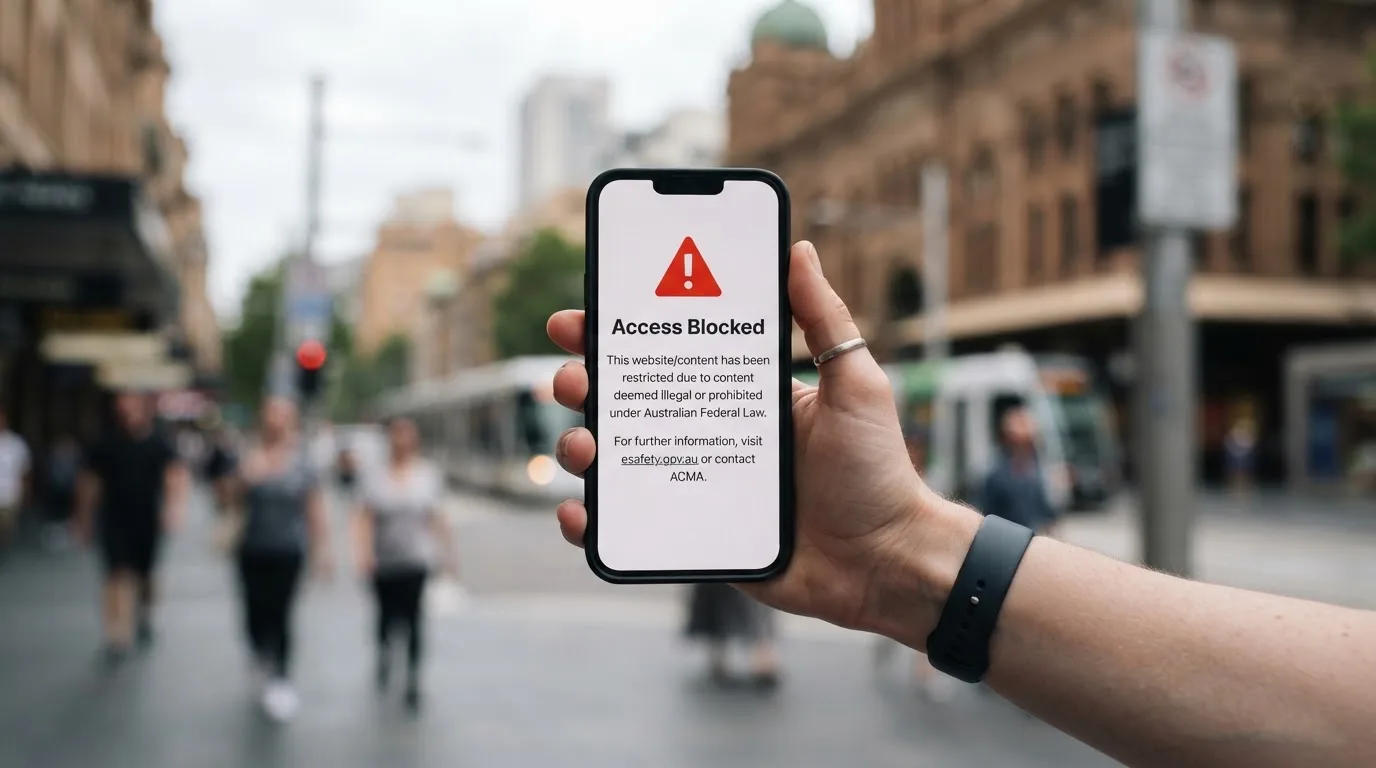
A punter who tries to reach any of those twelve names from an Australian IP after the round completes will see a blocked-page notice. A punter who has a balance on any of them at the moment of the block may find that balance inaccessible — the IGA’s prohibition is not paired with any obligation on the operator to refund an Australian player, and the Australian regulator’s remedies are aimed at the operator’s Australian-facing presence rather than at returning funds to a specific account. That is the practical cost of being on the wrong side of the regulator’s table: not just the unavailability of the offer, but the unavailability of the balance.
How a first deposit bonus is supposed to work, in the markets where it is legal
The phrase is real in other jurisdictions, and the mechanics are worth a paragraph for the reader who has not met them. A first deposit bonus, in the markets where it is offered, is a marketing match attached to the player’s first deposit at an online casino: the casino credits the player’s account with a defined amount (a percentage of the deposit, a fixed sum, or a combination), subject to terms. The terms typically include a wagering requirement — a multiple of the bonus, the deposit, or both, that must be turned over in qualifying bets before any winnings become withdrawable — and a maximum bet per round, a list of excluded games, a time limit and a maximum cashout. A no-deposit bonus, by contrast, is credited without a deposit, usually smaller, and typically subject to heavier withdrawal limits. The distinction is the existence of the deposit: the first deposit bonus requires the player to put money in, the no-deposit bonus does not.
In Australia none of that machinery exists in the legal market, because the underlying product does not. The terms a reader sees described elsewhere — wagering requirements, max bet, game weighting, expiry windows — are the terms of offshore offers offered in violation of the IGA. A reader who accepts them is accepting terms on a service the regulator has told the operator it may not provide to an Australian.
The credit-card ban in detail
The credit-card ban for licensed online wagering took effect on 11 June 2024, with penalties for operators of up to A$247,500 per offence. The ban covers credit cards and credit-related products, and extends in practice to linked digital wallets where the wallet’s funding instrument is a credit card. It does not, in itself, ban a debit card. What the ban does is remove the credit side of the deposit path; the debit side, the bank transfer and PayID/Osko remain available for licensed wagering.
The reason the credit-card ban matters for the offshore-casino discussion is that it changes the surface area of the dispute. An Australian punter who uses a credit card at an offshore casino is not just transacting with an unlicensed operator; the punter is also using a payment instrument the operator is supposed to refuse. The punter is unlikely to be prosecuted, and the operator is unlikely to be prosecuted in Australia for a single transaction, but the transaction sits inside a framework that treats it as wrongful on both sides. That is a different shape of dispute from a debit card transaction, which is at least a clean legal payment to an unlicensed recipient. The bank-level gambling block is what closes the gap on the debit side, and the credit-card ban closes the credit side from the regulator’s end.
The 2026 reform: what changes and what does not
The Interactive Gambling Amendment (Gambling Reform) Bill 2026 passed Parliament on 19 August 2026. Its advertising and inducement measures commence on 1 January 2027. That is a law with a start date — passed, royal-assented, but not yet in force on a 2026 page. What it will change, once commenced, is the framework around advertising and inducements: the rules under which licensed wagering services can promote offers, run sign-up incentives and run inducements to deposit. The offshore operators it will not touch, because they are already outside the IGA. The reform tightens the lawful side; it does not redraw the line between lawful and unlawful online casino.
A reader reading this in 2026 does not need to act on the reform yet, but should be aware that advertising language for licensed Australian offers will change from 1 January 2027 onward. The change is on the licensed side of the line, not the offshore side.
What an Australian reader is actually choosing between
The decision the search is asking the reader to make is, in honest terms, between two regimes. The first regime is the Australian one: licensed wagering services for sport and racing, licensed pokies in venues, land-based casinos for table games, and lotteries. Inside that regime the player is protected by the IGA, by the ACMA’s enforcement, by BetStop’s self-exclusion, by the bank’s gambling block, by the credit-card ban and by the responsible-gambling obligations of the licensed operator. The second regime is the offshore one: online casino games and online pokies offered from outside Australia, in violation of the IGA, with no Australian licence, no Australian complaint body and no Australian recourse on a refused withdrawal. Inside that regime the player is also unprotected from the regulator’s blocking programme, which can remove access to a balance without notice.
The first deposit bonus this search names exists only in the second regime. The “best” of it is not a comparison that can be made inside Australia. What can be compared is the two regimes themselves: what protection each offers, what recourse each provides, and what happens when something goes wrong. By that comparison the answer is settled before the page turns to the table.
Frequently asked questions about first deposit bonuses in Australia
What is a first deposit bonus, as distinct from a no-deposit bonus?
A first deposit bonus is a marketing offer credited to a player after the player makes a first deposit at an online casino — typically a percentage match of that deposit, subject to terms. A no-deposit bonus is credited without any deposit, usually smaller, and typically carries tighter withdrawal limits. In Australia neither product is lawfully available, because the underlying online casino offering cannot be licensed.
Do first deposit bonuses usually carry wagering requirements?
Yes. In the markets where they exist, first deposit bonuses carry a wagering requirement — a multiple of the bonus, the deposit or both that must be turned over before winnings become withdrawable. They also typically carry a maximum bet per round, a list of excluded games, an expiry window and a maximum cashout. None of these terms is enforceable in Australia through an Australian regulator, because the offer itself is not lawful here.
Is it legal for an online casino to offer Australians a first deposit bonus?
No. The Interactive Gambling Act 2001 prohibits the provision of online casino games to a person in Australia, and a first deposit bonus is a marketing instrument attached to that prohibited service. The ACMA enforces the prohibition through formal warnings and ISP-level blocking. The player is not the target of enforcement; the operator is.
Can a first deposit bonus be withdrawn immediately after it is credited?
In markets where the offer exists, no. The bonus is credited subject to terms — almost always including a wagering requirement and a maximum-cashout cap — and the bonus balance is not withdrawable until those terms are met. Withdrawing an unconverted bonus where it is prohibited is a separate question from withdrawing in the markets where it is legal.
What should someone read before accepting a first deposit bonus offer?
In markets where the offer is lawful, the wagering multiple, the game weighting, the maximum bet per round, the expiry window, the maximum cashout and any restricted-payment or restricted-country clauses. In Australia the relevant question is not which terms to read but whether the offer itself can lawfully be made — and the answer is no. See also High roller casino play for Australian readers in 2026 .
Does a bigger first deposit bonus automatically mean better value?
No. The headline size of a first deposit bonus is set against the wagering requirement, the maximum cashout, the game weighting and the expiry. A larger match with a heavier wagering multiple and a lower cashout cap can be worth less, in real terms, than a smaller match with lighter terms. In Australia the question is academic: the offer cannot lawfully be made to a player in the country.