
Casino sites that accept Trustly in Australia in 2026: offshore only, and the ACMA has a file on most of them
Trustly is a Stockholm-built bank-to-bank rail that lets a casino take money from — and pay it back to — a player’s bank account without a card. Offshore casino sites list it. Australian-licensed services cannot. That single fact reshapes the market for these services, because a Trustly-friendly casino operating for Australian players is by definition one the ACMA does not authorise, and the regulator has spent the last several years publishing formal warnings on exactly the brands listed below.
This page works through what Trustly deposits and withdrawals look like in practice, what an Australian player can and cannot lawfully use it for, and what the ACMA’s public file on the offshore brands that take Trustly actually contains. The ranking below lists eleven brands the regulator has acted against; it is not a recommendation, because no offshore casino is licensed to provide online casino games or online pokies to a person in Australia under the Interactive Gambling Act 2001. The only Trustly-style options inside Australian law are not casinos at all — they are land-based venues, registered clubs and pub pokies, plus state lotteries and keno.
Currency stamp: current as of 29 October 2026, licence claims verified against the ACMA’s published Register of Licensed Interactive Gambling Services and its public formal-warning index.
Table of Contents
- Responsible gaming: what an Australian player is actually walking into
- Payments and payout speed: how a Trustly flow actually behaves
- Registered operators and ACMA enforcement: eleven Trustly-accepting brands the regulator has acted against
- Overview: what the Trustly casino market actually looks like in 2026
- Legality: what the Interactive Gambling Act 2001 actually does
- Frequently asked questions
Responsible gaming: what an Australian player is actually walking into
Trustly has a marketing word for the product — “Pay N Play”, launched in 2016, which folds the deposit and the account-opening step into a single bank authentication. The pitch is convenience: no card, no upload, no e-wallet. For a player inside the EU/EEA that simplification is genuinely useful, because it sits on top of a regulated national identity layer. For an Australian player walking onto an offshore casino through the same rail, the simplification does the opposite of what its name suggests — it skips exactly the verification step the ACMA’s framework expects, while the offshore operator still has no Australian licence behind it.
Anyone weighing one of these sites should read the regulator’s public warnings before trusting any of the site’s own safety claims. The ACMA publishes them as formal records, each tied to a named operator company and a named brand, and each one is dated and traceable. They are not marketing collateral. They are the closest thing to an Australian consumer-protection file this market has for offshore brands, and the body of them runs from 2022 through to 2026.
The interactive gambling ban is enforced on the provider, not on the player — a person who signs up at one of these offshore sites does not commit an offence under the IGA 2001. What they give up is the Australian-licensed layer of protection that comes with a Sportsbet-style wagering account: a registered complaints route through the operator’s home regulator, the binding force of BetStop when a self-exclusion is needed, and the Australian bank’s own gambling-block tooling where it can reach the transaction. An offshore site can be blocked by an ISP mid-week with a balance still sitting on it, and there is no Australian body the player complains to.
Player protection tools that do and do not apply
BetStop, the National Self-Exclusion Register, has been live since August 2023 and covers every Australian-licensed online and phone wagering service. Offshore casino brands are not connected to it. A self-exclusion request lodged with an offshore operator has whatever force that operator chooses to give it, which is to say, none that an Australian body can enforce. The National Gambling Helpline at 1800 858 858 runs free 24/7, with chat at Gambling Help Online, and the helpline is the right number to call regardless of where the wagering account sits.
On the bank side, the major Australian banks run gambling blocks at the card level. Westpac’s block refuses authorisation of transactions tagged with the merchant category code “Betting/Casino Gambling” on eligible cards. ANZ’s block, set up in the ANZ app, also catches Gambling Transactions routed through a digital wallet such as Apple Pay on an eligible card. The catch — and this is the part that matters for a Trustly deposit — is that these blocks are merchant-code based. They screen card rails. Trustly, as a direct account-to-account credit transfer, does not run through that merchant code, and the bank’s block does not necessarily intercept it. A player who has set up a gambling block and then funds an offshore casino with Trustly has, in practice, sidestepped the very tool they installed.
Removing ANZ’s gambling block requires a 48-hour waiting period once a request is lodged, and ANZ itself warns that not every gambling transaction will be blocked and that some non-gambling transactions may be blocked in error. The bank-side tool is approximate. It is not a fence.
Payments and payout speed: how a Trustly flow actually behaves
A Trustly deposit at an offshore casino looks like a normal bank transfer from the player’s side, with the casino’s payment screen acting as a redirect into the bank’s own authentication step. The player picks their bank, authenticates with whatever the bank requires, and the casino receives the funds as a credit. No card details pass through the casino; no e-wallet sits between the bank and the site. That is the engineering reason Trustly ended up on so many gambling sites — it removes the card-rail intermediaries that were historically the choke point for compliance.
The minimum deposit at most Trustly-accepting offshore casinos sits at A$10 or the euro/dollar equivalent. That is roughly where the floor sits across the segment; it is not the case that every Trustly site asks for A$10, and it is not the case that every one asks for less. What is consistent is that the floor is low enough that a player can probe a site with a single small transfer before deciding whether to leave a larger balance there. Whether the casino accepts A$10 in Australian dollars is a separate question: many offshore operators settle in euros or US dollars and apply their own conversion at the deposit step.
What a withdrawal looks like on the same rail
A Trustly withdrawal is the same rail in reverse, in principle. The casino queues the payout, and the funds arrive back in the player’s nominated bank account once the casino’s own checks are complete. “Once the casino’s own checks are complete” is doing more work in that sentence than the words suggest. The ACMA’s published enforcement record on offshore brands repeatedly returns to the same finding: manual approval queues, “pending verification” holds, and source-of-funds re-checks applied selectively. A withdrawal request that a regulated operator would clear in hours can sit for days at an offshore site, and the player’s only recourse is the casino’s own complaints address, which is not an Australian body.
The Australian equivalent of an instant bank-to-bank credit is PayID through Osko, and the comparison is worth making directly. An Osko transfer between participating Australian banks arrives in under a minute, 24/7, addressed to either a BSB and account number or a PayID identifier. More than 25 million PayID identifiers had been registered on Australia’s New Payments Platform as of April 2025, with PayID-based instant transfers available at over 100 Australian financial institutions. The platform’s participants are bound to keep its monthly outages to no more than two minutes, and the system is owned by New Payments Platform Australia Ltd, with the Reserve Bank of Australia and the country’s major banks among its 13 shareholders. Trustly does not connect to PayID. The two systems are siblings, not the same system.
The Australian Payments Plus warning on its own PayID page is the line that matters here: paying to a PayID displays the name of the account holder before the transfer is sent, and AP+ warns that being asked to transfer money to a PayID on an illegal gambling site almost certainly means a scam site. That warning does not extend to Trustly — Trustly sits one step removed from that named-payee protection — but the principle carries across. A direct bank-to-bank credit into an account that does not carry an Australian business name attached to it is a weaker check, not a stronger one.
Where Trustly sits on the global stage
Trustly was founded in 2008 in Stockholm under the original name Glue Finance, by Carl Wilson, Joel Jakobsson and Lukas Gratte. It holds authorisation as a payment institution from Sweden’s Financial Supervisory Authority (Finansinspektionen) for the EU/EEA and from the UK Financial Conduct Authority. The company reports that its network supports 12,000 banks and connects with around 650 million consumers globally, with more than 9,000 companies using it, including PayPal, DraftKings and eBay. Trustly reported 2023 revenue of US$265 million (2.68 billion SEK) on US$58 billion of transaction volume, with about 1,000 employees.
Nordic Capital acquired a 70% stake in Trustly for about US$800 million in 2018, and the planned Nasdaq Stockholm listing that followed valued the company at around US$11 billion in 2021. By 2022 more than 200 gaming brands had adopted the Pay N Play product. The scale is real. None of it changes the legal frame an Australian player sits inside.
The geography Trustly serves is the line that decides whether an Australian player should treat a Trustly deposit as anything more than a bank transfer to an unknown recipient. Wizard of Odds counts Trustly as available in more than 20 European countries — including the UK, Norway, Spain, Austria, Finland, the Netherlands, Ireland, Croatia, Germany and Malta. Trustly’s own gaming page addresses the US market, branding the product “Pay by Bank for Gaming”. Australian bank-to-bank instant payments run on PayID and Osko instead, at over 100 Australian institutions. An Australian player using Trustly at an offshore casino is being routed through a European or US product rail to settle a transaction with an offshore merchant — the geography of the rail does not match the geography of either the player’s bank or the regulator.
The fees question
Trustly deposits are, in the brand’s own positioning, free to the consumer. Whether a casino passes a fee through on top is a casino-by-casino decision, and the only honest answer is that it depends on the operator. The pattern is that offshore casinos that list Trustly alongside cards and e-wallets do not advertise a Trustly surcharge, because the rail does not impose one — the casino is not paying interchange. What a casino may charge is a conversion fee when it accepts Australian dollars and settles in another currency, or a minimum withdrawal fee on small payouts. The operator’s own cashier page is the source for the actual number, not the deposit method’s marketing page.
Apple Pay, which sits alongside Trustly on most cashier pages, gives a useful comparison. Apple does not charge consumers for using Apple Pay in stores, online, or in apps — any surcharge comes from the merchant’s own card-processing fees, not from Apple. By the end of 2025 Apple Pay, Google Pay and Samsung Pay transactions collectively accounted for around 45% of all card payments in Australia by number. The Reserve Bank of Australia’s July 2025 review proposes removing surcharges on eftpos, Mastercard and Visa transactions, leaving American Express outside the scope of the proposed surcharge ban. None of this changes the offshore question, because none of these wallets are the legal deposit route for an Australian-licensed wagering service either. Credit cards, credit-related products and digital currency are banned as payment for licensed online wagering in Australia since 11 June 2024, and that restriction extends in practice to linked digital wallets like Apple Pay. The legal deposit routes for a licensed wagering account are debit card, bank transfer, PayID/Osko and BPAY.
Registered operators and ACMA enforcement: eleven Trustly-accepting brands the regulator has acted against
The list below is not a ranking by quality. The brands are the ones the ACMA has published formal warnings against for offering prohibited interactive gambling services to Australians. They are the offshore casino sites that show up most reliably on Australian-facing search results for “Trustly casino”. Reading them as a ranking — “this brand is better than that brand” — is the wrong use of the table. The right use is to see which operator names keep recurring in the ACMA’s enforcement record, and which companies have been warned more than once.
| Brand | ACMA action and date | Operator named by the ACMA | Trustly support |
|---|---|---|---|
| RocketPlay | Formal warning under the IGA 2001, March 2026; earlier Dama N.V. warning, May 2022 | Pulsup Ltd | — |
| Level Up Casino | Formal warning under the IGA 2001, May 2022 | Dama N.V. | Westpac lists Dama N.V. brands under its gambling-block scope |
| Woo Casino | Formal warning under the IGA 2001, March 2025 | Dama N.V. | — |
| Spirit Casino | Formal warning under the IGA 2001, May 2025 | Dama N.V. | — |
| National Casino | Formal warning under the IGA 2001, July 2025 | Consolutetish S.R.L. | AUSTRAC and Wikipedia listings identify National Casino |
| Bizzo Casino | Formal warning under the IGA 2001, July 2025; earlier warning, 2022 | Consolutetish S.R.L.; earlier TechSolutions (CY) Group Limited and TechSolutions Group N.V. | — |
| Ignition Casino | Formal warning under the IGA 2001, July 2025 | Bamboo Media | — |
| Instant Casino | Formal warning under the IGA 2001, February 2025 | EOD Code SRL | EcoPayz and PayID listings reference the brand |
| Jackbit | Formal warning under the IGA 2001, April 2026 | Ryker B.V. | — |
| Casino Intense | Formal warning under the IGA 2001, April 2025 | Sterplay Holding Ltd | AUSTRAC, iTnews and NAB listings identify the brand |
| Sky Crown | Formal warning under the IGA 2001, September 2022 | Hollycorn N.V. | — |
What the table is actually showing
The same operator names keep appearing under different brand names. Dama N.V. has been warned under the IGA 2001 in May 2022 over six brands including Level Up, then again in March 2025 over Woo Casino and in May 2025 over Spirit Casino — and again, via Pulsup Ltd, in March 2026 over RocketPlay. Consolutetish S.R.L. has been warned twice over Bizzo Casino alone, once in 2022 (under TechSolutions) and again in July 2025. The ACMA’s enforcement record is not a list of unrelated brands: it is a small number of operator companies cycling through brand skins. The Trustly cashier at any one of them is, in practice, the Trustly cashier at the rest of the same group’s portfolio, and the ACMA file sits behind all of them.
The “Trustly support” column is the spot where the audit on a feature like this gets hardest to write honestly. Research carries direct confirmation of Trustly at the cashier for a handful of brands across this set. For the rest, the picture comes from listings rather than from the operator — Westpac’s gambling-block page identifies Dama N.V. brands, AUSTRAC and Wikipedia listings identify National Casino, iTnews and NAB listings identify Casino Intense, and EcoPayz and PayID references pick up Instant Casino. The empty cells in the column above are the brands where the research record carries no specific Trustly signal in either direction. They are not a denial. They are also not a confirmation. The reader should treat the column as “what we could verify from the cited listings”, not as “every brand here supports Trustly”.
RocketPlay
RocketPlay sits at the top of the ACMA’s enforcement record for the period this page covers. The regulator issued a formal warning under the Interactive Gambling Act 2001 to Pulsup Ltd over Rocketplay.com.au in March 2026, with a separate earlier Dama N.V. warning covering the brand in May 2022. The operator has cycled through two named companies in four years. That is the picture worth sitting with: a brand that surfaces on the ACMA’s formal-warning index in two separate actions, under two separate operating companies, has not been unwarned, and the ACMA does not publish a formal warning unless it has investigated and concluded that the service is a prohibited one being supplied to Australians. The right reading is that this brand is a name the ACMA keeps returning to.
Level Up Casino
Level Up Casino was caught up in the May 2022 Dama N.V. warning that covered six brands. Westpac’s gambling-block page identifies Dama N.V. brands within its block scope — that is the only signal research carries for this brand’s Trustly position, and it is a listings-only entry rather than a cashier-level confirmation. The takeaway is the same as for RocketPlay: Dama N.V. is a repeatedly-named operator on the ACMA’s file, and the brands underneath its name move together in enforcement actions.
Woo Casino
Woo Casino drew a fresh Dama N.V. formal warning in March 2025 — a separate action from the 2022 batch. The ACMA’s pattern is to escalate when the same operator company is warned and then continues to offer prohibited services to Australians; a second formal warning to the same operating company is itself a piece of information. The brand is on the ACMA’s record, the operator company has been warned twice over different brands, and no research evidence places Trustly specifically at this brand’s cashier.
Spirit Casino
Spirit Casino was the third Dama N.V. brand to draw a fresh warning, in May 2025. The Dama N.V. cluster is now three separate warnings across three separate brands, on top of the 2022 batch. The ACMA file is becoming a case study in how a single operating company can run multiple brand skins while the underlying enforcement record accumulates.
National Casino
National Casino was caught up in Consolutetish S.R.L.’s July 2025 warning, with AUSTRAC and Wikipedia listings identifying the brand. The 2022 warning that touched Bizzo Casino, under TechSolutions, did not name National Casino — these are separate brands, separate actions, but they share an operator company and they share a 2025 warning. The right read is that National Casino sits inside the Consolutetish cluster.
Bizzo Casino
Bizzo Casino carries the longest paper trail of any brand in this set: a 2022 formal warning under TechSolutions (CY) Group Limited and TechSolutions Group N.V., followed by a July 2025 formal warning under Consolutetish S.R.L. Two formal warnings to two different operating companies over the same brand is the ACMA’s strongest available signal that the underlying service has continued despite enforcement. The brand has not been unwarned.
Ignition Casino
Ignition Casino sits under Bamboo Media, warned in July 2025. It is the only brand in this set tied to that operating company, so it does not bring the “same company, multiple brands” pattern. It is, however, on the ACMA’s record as a site supplying illegal games to Australians, and that is the defining fact for the brand.
Instant Casino
Instant Casino was warned in February 2025 under EOD Code SRL. The Trustly signal here is the listings-only entry: EcoPayz and PayID references pick up the brand, and that is the evidence the research record carries for whether Instant Casino’s cashier is Trustly-enabled. It is not a cashier confirmation. It is a hint that the brand sits inside listings aggregators that also carry Trustly.
Jackbit
Jackbit was warned in April 2026 under Ryker B.V., alongside CasinOK, in a single action. Research carries no Trustly-specific signal for either brand. Ryker B.V. is a newer name on the ACMA’s record than Dama N.V. or Hollycorn N.V., but the pattern is the same: a single operating company, two brand skins, one warning.
Casino Intense
Casino Intense was warned in April 2025 under Sterplay Holding Ltd. AUSTRAC, iTnews and NAB listings all identify the brand — that is the cross-reference network research turned up, and it is the best evidence the record carries on whether Casino Intense is a Trustly-accepting brand in practice. The brand is on the ACMA’s record. The operator has not been warned more than once on this brand.
Sky Crown
Sky Crown sits under Hollycorn N.V., which the ACMA warned in a formal publication dated September 2022 covering both Sky Crown and Blue Leo. Hollycorn N.V. is one of the older entries on the ACMA’s file for this segment. The brand has not been unwarned, and the ACMA’s record on Hollycorn remains the regulator’s stated position.
Overview: what the Trustly casino market actually looks like in 2026
Strip the offshore branding off and the Trustly-accepting casino segment is a small number of operating companies cycling through dozens of brand skins. The ACMA’s enforcement record is the best publicly available index of that cycle, because each formal warning names the operating company, the brand and the date, and a reader can search across the regulator’s publications to see how often a single name shows up. Dama N.V. is on the file three times. Consolutetish S.R.L. is on it twice. TechSolutions has been on it twice across two different operating company names for the same underlying brand.
The Trustly angle does not change that picture. The cashier at any of these brands is the same product rail — Trustly’s account-to-account credit transfer — sitting on top of the same offshore operator stack. Trustly’s own engineering solves the deposit step. It does not solve the regulatory question, because the regulatory question sits above the payment layer: an offshore operator is prohibited from providing illegal online games to a person in Australia, and the payment rail used to deposit the funds is legally irrelevant.
The minimum-deposit pattern
The single piece of practical information a player looks for in this segment is the minimum deposit floor. Across the Trustly-accepting offshore segment the floor sits at A$10 or the euro/dollar equivalent, but the floor is set by the operator, not by Trustly. Some sites ask for A$20. A handful ask for A$30. A small number lower the floor for Trustly specifically, on the theory that the rail’s lower fraud profile lets the casino accept smaller deposits without eating the same chargeback risk a card rail carries. None of that is regulation; all of it is commercial positioning. The Trustly floor and the card floor on the same site are often different numbers, and the cashier page is the source.
Settlement currency and conversion
Most offshore casinos that list Trustly settle in euros or US dollars. An Australian player depositing in AUD takes the operator’s conversion rate on the deposit step, and the same rate (or a worse one) on the withdrawal step. The casino’s own cashier page carries the conversion margin, which is typically embedded in the exchange rate rather than listed as a separate fee. The honest framing is that the deposit may be free in Trustly’s marketing, but the conversion is not free, and the conversion is where the casino takes its margin on an Australian deposit.
Legality: what the Interactive Gambling Act 2001 actually does
The Interactive Gambling Act 2001, as strengthened by the Interactive Gambling Amendment Act 2017, makes it an offence to provide online casino games, online pokies or in-play betting to a person physically in Australia. The offence sits on the provider — the offshore casino, not the Australian player who signs up. The legal routes inside Australia are wagering on races and sport placed before the event, lotteries and keno — in practice licensed by the Northern Territory Racing and Wagering Commission (NTRWC). The NTRWC regulates 52 of Australia’s online bookmakers, including Sportsbet, Bet365 and Ladbrokes, licensed in the Territory for tax reasons; the commission has no full-time staff and meets once a month in Darwin. The point of that detail is not the staffing level. It is that the only Australian-licensed online wagering market is sports and racing, not casino games.
Enforcement reach
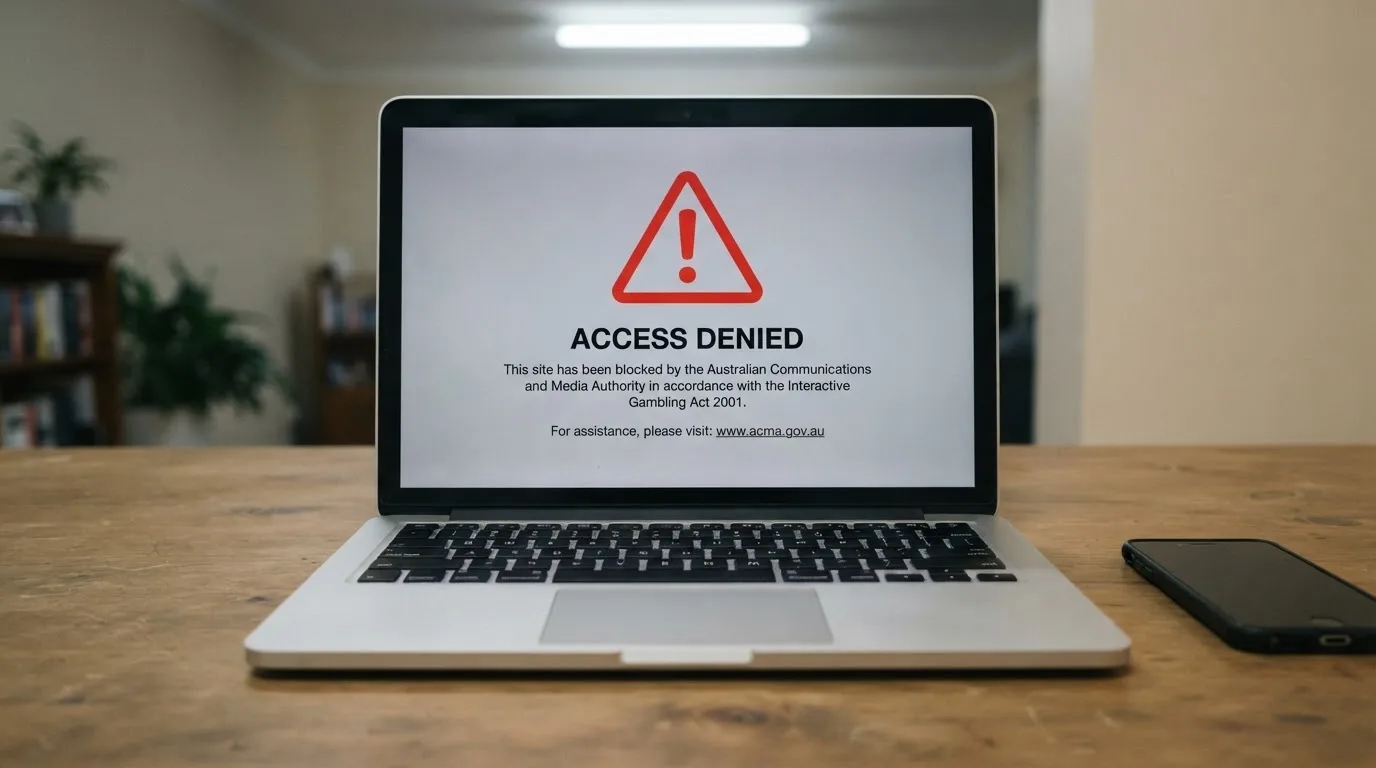
The ACMA investigates, issues formal warnings, and directs Australian internet service providers to block illegal sites. By the end of the round reported on 26 June 2026, a cumulative 1,751 illegal gambling and affiliate marketing websites had been blocked since the first blocking request in November 2019. More than 230 unlicensed gambling services had left the Australian market since enforcement was strengthened in 2017. The most recent round reported on 26 June 2026 alone asked ISPs to block 12 more illegal gambling websites — 7Signs, ChromaBet, Donbet, Duospin, Freshbet, Slots Gem, Jacks Club, Lucky Start, Pointsbetz.com, Spinrise, Vinyl Casino and Wildsino. The blocking rate is the prescribed calculation for this page: roughly 1,751 sites blocked over a period running from November 2019 to the end of the snapshot reported in June 2026 — between about 200 and 280 sites per year on a straight-line rate, depending on which end of the date range is used, and with the actual annual figure varying because the ACMA’s blocking requests come in waves rather than on a steady schedule. The arithmetic belongs to the ACMA’s enforcement tempo, and the band — not a single figure — is the honest statement.
A blocking request does not require the operator to comply with any Australian law going forward. It only removes the site from Australian ISP routing. The offshore operator continues to operate from wherever it is incorporated; the Australian player loses access, and any balance still on the site sits with the operator.
H2 Gambling Capital’s loss estimate
H2 Gambling Capital’s 2025 report estimates that Australians lose about A$3.9 billion a year to illegal gambling sites. The share of gambling going through legal channels fell from 74% in 2021 to 64%. The A$3.9 billion figure is an estimate, not a measured total — illegal sites do not publish Australian revenue splits — but it is the closest publicly cited estimate available, and the direction of travel is the part that matters: legal channels are losing share to illegal ones, not the other way around. The 2026 reform package, the Interactive Gambling Amendment (Gambling Reform) Bill 2026, passed Parliament on 19 August 2026, with its advertising and inducement measures commencing on 1 January 2027. That is law with a future start date, not law in force on a 2026 page.
Tax position
Gambling winnings of a recreational Australian player are not assessable income under section 6-5 of the ITAA 1997, and losses are not deductible. A player who carries on a business of gambling — a professional punter in the ATO’s sense — sits in a different tax frame, and the right advice for that case is to check with the ATO or a tax adviser, not to take it from a page like this one. The tax framing does not change the legality framing. These services are unlawful, regardless of the tax status of any winnings.
Credit-card ban on licensed wagering
Since 11 June 2024, Australian-licensed online wagering services cannot accept payment by credit card or other credit-related products, with penalties up to A$247,500 for operators who breach the rule. The restriction also constrains gambling use of linked digital wallets such as Apple Pay, because the underlying credit line is what the ban targets. The legal deposit routes for a licensed wagering account are debit card, bank transfer, PayID/Osko and BPAY. An offshore site that asks an Australian for a credit card or a crypto deposit is operating outside the Australian rules in two directions at once: it is offering a prohibited service, and it is offering to take payment through a rail the licensed market is not allowed to use.
What the law does not do
The IGA does not prosecute individual players. An Australian who signs up at an offshore casino does not commit an offence. The offence sits on the provider. That is the legal answer, and it is also the answer that explains why offshore casinos continue to operate for an Australian audience despite the ACMA’s enforcement tempo: the operator is the one taking the legal risk, and many of them operate from jurisdictions where Australian enforcement is not the binding constraint. The player’s loss is the protection layer they would otherwise have, not a criminal record.
Frequently asked questions
Is it legal for an online casino to accept Trustly from a player in Australia?
No. Under the Interactive Gambling Act 2001, no operator may lawfully provide online casino games or online pokies to a person in Australia, regardless of which payment method the cashier lists. Trustly, cards, crypto and e-wallets are all the same under the law. The legal wagering routes inside Australia are pre-event sports and racing, lotteries and keno.
What is the smallest deposit a Trustly casino site usually asks for?
Most Trustly-accepting offshore casinos set the floor at A$10 or the euro/dollar equivalent, but the floor is set by the operator, not by Trustly, and varies by brand. Some sites ask for A$20 or more. The cashier page is the source for the exact number at any specific brand, and the conversion rate from AUD is applied at the deposit step.
Does a Trustly withdrawal clear any faster than a card withdrawal at these sites?
In principle yes — Trustly is a direct account-to-account credit, with no card scheme intermediary. In practice the casino’s own manual approval queue is the binding step, and that queue is the part the ACMA’s enforcement record repeatedly flags as the place where offshore operators hold withdrawals. The rail is fast; the operator’s checks are the constraint.
Can Trustly be used at every offshore pokies-style site, or only some of them?
Only some of them. Trustly is a product the casino chooses to integrate, and integration depends on the operator’s banking stack and the jurisdictions it wants to serve. Wizard of Odds counts Trustly as available in more than 20 European countries, including the UK, Norway, Spain, Austria, Finland, the Netherlands, Ireland, Croatia, Germany and Malta. Australian-facing offshore sites that list Trustly are a subset of the broader Trustly casino segment, not the whole of it.
Does depositing with Trustly add an extra fee at these casino sites?
Trustly itself does not charge consumers a fee, and most offshore casinos do not advertise a Trustly surcharge. The casino may apply a conversion margin when settling in a non-AUD currency, and that margin is embedded in the exchange rate rather than listed separately. The cashier page is the source for the actual numbers, because the rail’s fee position and the operator’s fee position are different things.
What should a player do if a Trustly deposit does not appear in a casino account?
Check the bank statement first — Trustly payments are real bank transfers and show up with the casino’s processor as the beneficiary name. If the funds have left the bank account and not arrived in the casino, the casino’s support is the only address. An offshore casino’s support is not an Australian-licensed complaints body, and there is no Australian recourse if the operator declines to credit the account. The National Gambling Helpline at 1800 858 858 is the right number to call regardless.