Best Keno Online Casino Australia: The Legal Picture, the ACMA Record, and Where Keno Is Played for Real
 Available in US
The Interactive Gambling Act 2001 makes it an offence for any operator to provide online casino games to a person physically in Australia. Keno is one of those games when it is offered online. No Australian state or territory issues a licence for it, so the question “best keno online casino australia” has no shortlist behind it — the cabinet the page imagines does not legally exist. What does exist is a long list of offshore brands the ACMA has told ISPs to block or formally warned, a parallel lawful channel in pubs, clubs and land-based casinos, and a self-exclusion register that an offshore site is not connected to. That is what this page lays out.
Current as of 23 September 2026 and cross-checked against the Australian Communications and Media Authority’s published list of formal warnings and the igamingbusiness.com blocking round report from 26 June 2026.
Table of Contents
- The shape of online keno for an Australian reader
- What the Interactive Gambling Act 2001 actually says
- What the ACMA enforcement record looks like
- Where online keno’s specific catalogue sits
- Crypto deposits and the offshore casino
- Player protection: BetStop, the Helpline, and what they reach
- The eleven ACMA-warned brands and what they tell the reader
- What the offshore gap costs a reader
- What a reader comparing this page to others should know
- Frequently asked questions
The shape of online keno for an Australian reader
A player who searches for “keno casino online” or “casino keno online” is usually looking for a place to deposit, pick numbers and let a draw settle the ticket. Modern keno is straightforward on that front: pick up to 20 numbers from a field of 1 to 80, the house draws 20 by ball machine or random number generator, and the payout depends on how many picks land. The big number on the ticket is the one that matters — a 20-spot card that hits every number sits at odds of about 1 in 3.5 quintillion, which is the kind of figure a paytable uses to justify capping the top prize.

What separates keno from the rest of the casino floor is the house edge. Wizard of Odds puts it at 25% to 29% in standard play, well above baccarat’s 1.06% on the Banker bet or blackjack’s roughly 0.28% under liberal Las Vegas Strip rules. Wikipedia’s broader survey of online keno puts the figure anywhere from under 4% to over 35% and in-person play at 20% to 40%. A reader comparing games reads those numbers and finds that keno is the highest-edge game in the standard casino catalogue by a wide margin.
Live keno at a US venue returns 65% to 80% to the player, which is the same point made another way: roughly a quarter to a third of every dollar staked goes back to the house before the player sits down. That ratio is the reason a bonus offer attached to keno clearing needs to be read carefully — a 35x wagering multiple on a deposit that is being ground through a 25%-edge game is a different cost from the same multiple on a 1% game, even before considering how long the clearing takes.
The shape of an offer on a casino site is recognisable regardless of jurisdiction: a deposit match, free keno tickets, a “keno casino bonus” that pays extra credit against the house’s draw. What changes for an Australian reader is that the bonus itself sits on top of a service the operator is not licensed to provide. A wagering requirement is a contract clause; the service underneath it is unlawful in this country.
What the Interactive Gambling Act 2001 actually says
The Interactive Gambling Act 2001, strengthened by the Interactive Gambling Amendment Act 2017, prohibits the supply of online casino games, online pokies and in-play betting to a person physically in Australia. Keno offered online falls inside that prohibition. The IGA targets the provider, not the individual player — placing a bet from Australia is not the offence — but the page is built around where someone can play, and where someone can play is constrained by what an operator is willing to provide legally.
What is licensable is wagering on racing and sport placed before the event, lotteries, and keno delivered through state and territory frameworks. Keno sits in that list because it has a long-standing licensed channel: pubs, clubs, casinos and TABs run by state-licensed operators under instruments such as the Keno Act 1996 in Queensland, a 28-year extension to 1 April 2050 in NSW worth more than A$230 million to the state, and 20-year Victorian licences from 15 April 2022 issued to Keno (VIC) Pty Ltd and Lottoland Australia Pty Ltd, the latter since renamed KenoGo Pty Ltd on 9 September 2025. Keno (QLD) Pty Ltd is the exclusive licensee in Queensland, regulated by the Office of Liquor and Gaming Regulation under the Keno Act 1996, the Keno Regulation 2007 and the Keno Rule 2010.
The Northern Territory Racing and Wagering Commission regulates 52 of Australia’s online bookmakers — Sportsbet, Bet365 and Ladbrokes included — under Territory licences that exist for tax reasons. The commission has no full-time staff and meets once a month in Darwin, which is a structural detail that matters when the question is who actually supervises an Australian-facing wagering service.
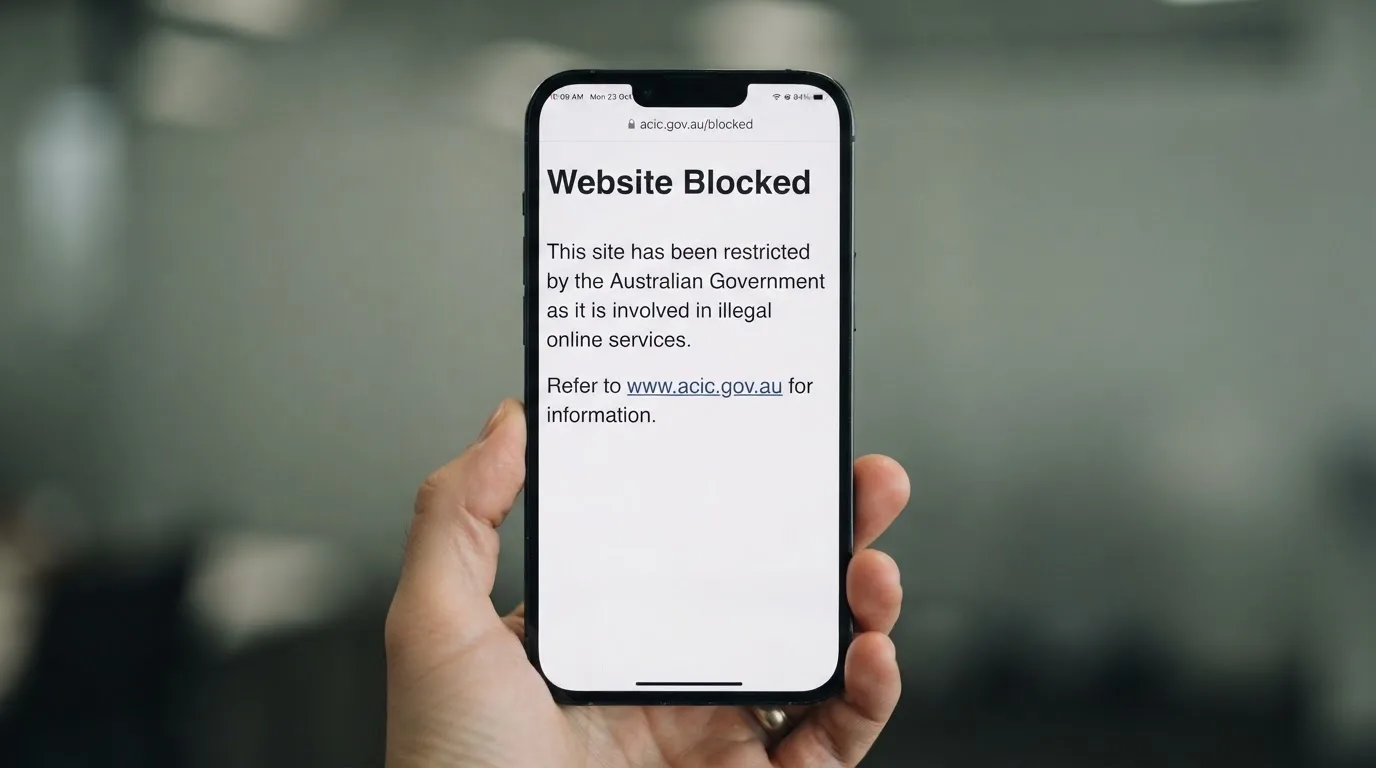
The Australian Communications and Media Authority is the body that enforces the IGA. It investigates complaints, issues formal warnings, and directs Australian internet service providers to block offending sites. The provider-facing nature of the regime is what the offshore gap looks like from the regulator’s desk: a Curacao-registered brand, an operator in another jurisdiction, the same offering that would be unlawful for an Australian licensee.
The Interactive Gambling Amendment (Gambling Reform) Bill 2026 passed Parliament on 19 August 2026. Its advertising and inducement measures commence 1 January 2027. The law is enacted and dated, not in force on a page read in the year of passage; any reference to “current as of” treats it that way.
What the ACMA enforcement record looks like
The ACMA’s enforcement is the most concrete evidence of how the prohibition is applied. As of June 2026, 1,751 illegal gambling and affiliate marketing websites have been blocked since the first blocking request in November 2019, and more than 230 unlicensed gambling services have left the Australian market since enforcement was strengthened in 2017. A blocking round reported on 26 June 2026 added another 12 sites to the block list: 7Signs, ChromaBet, Donbet, Duospin, Freshbet, Slots Gem, Jacks Club, Lucky Start, Pointsbetz.com, Spinrise, Vinyl Casino and Wildsino.
The pattern under the headline figure is a series of formal warnings, one operator at a time, which is the ACMA’s preferred step before a block request. In March 2026 it warned Pulsup Ltd over Rocketplay.com.au. In April 2026 it warned Ryker B.V. over Jackbit and CasinOK. In April 2025 it warned Sterplay Holding Ltd over Casino Intense. The same Dama N.V. group has collected several warnings: one in May 2022 covering Bambet, Dazard, Level Up, Rocketplay, Wild Tornado and Cobra Casinos, then a separate warning in March 2025 over Woo Casino and a further one in May 2025 over Spirit Casino.
In July 2025 the ACMA warned Bamboo Media over Ignition Casino and Consolutetish S.R.L. over National Casino and Bizzo Casino. Bizzo had already been on the ACMA’s list — TechSolutions (CY) Group Limited and TechSolutions Group N.V. were warned over it back in 2022, so the 2025 warning is the second time the same brand has come up under a different corporate wrapper. In February 2025 the ACMA warned EOD Code SRL over Instant Casino. Hollycorn N.V. was warned over Sky Crown and Blue Leo under a 2022 formal warning still on the ACMA’s register.
What the record shows is that the ACMA moves against operators, not against players, and that it moves repeatedly against the same groups under successive corporate names. The blocking-rate calculation that sits in the next section uses the running totals and the November 2019 starting point to put a pace on that pattern.
The arithmetic: what blocking-rate yields from the ACMA totals
Across the 1,751 sites blocked by the ACMA between November 2019 and the snapshot reported on 26 June 2026 — a span of roughly 79 months — the average works out at somewhere around 22 blocked sites per month, or just over one site every 36 hours. That is a steady drumbeat rather than a campaign: most months the regulator adds a small number of sites, with occasional larger rounds like the 12 added in the June 2026 batch.
The figure carries one condition. It is a simple average across the full window, which smooths over quieter months at the start of the enforcement period and busier months around particular operators. The 230-odd services that have left the Australian market since 2017 are not all the same as a blocked site — some withdraw voluntarily after a warning, some after a block, and a small number rebrand and continue to operate from a new domain. Reading “1,751 blocked” as “1,751 distinct operations shut down” overstates the disruption. Reading it as “the regulator maintains a running block list of 1,751 domains” is the closer fit.
The number to carry forward from the arithmetic is the order of magnitude, not the precise count. Between 20 and 25 sites per month is the band, and it has held across several years of ACMA action. That pace is why an offshore brand a reader sees advertised this month may not be reachable from an Australian IP next month, even before any individual operator profile shifts.
Where online keno’s specific catalogue sits
The §3 cluster on specific games covers the catalogue side of online keno: paytables, draw mechanics, live keno versus the automated version, and the surrounding catalogue of similar games a venue carries. Keno itself is the draw — players choose up to 20 numbers from 1 to 80, the house draws 20, and payouts depend on the count of matches. That is the universal mechanic; the differences are in the paytable and in how the draw is presented.
An automated keno draw uses a random number generator. A live keno draw uses a ball machine, sometimes broadcast from a studio, sometimes from a land-based casino floor. The difference is not in the odds but in the cadence and the perceived fairness — a ball draw happens every few minutes, a software draw can be on demand. Wizard of Odds’ Las Vegas survey found live keno returns of 65% to 80%, which sits in the same band as the standard 25%-to-29% house edge figure quoted in reverse.
The wider catalogue on a casino site that offers keno typically includes baccarat and blackjack alongside it. Baccarat’s edge on the Banker bet is 1.06%, on the Player bet 1.24% and on the Tie 14.36%. Blackjack under liberal Las Vegas Strip rules sits at about 0.28% with optimal play, and around 0.43% under Atlantic City rules. The point of putting these numbers next to keno’s is to show what the house keeps across the standard games: roughly a fifth to a quarter on the average keno ticket, against a fraction of a percent on a well-played blackjack hand. Two games on the same floor, same venue, radically different cost.
Baccarat has its own regulatory notes in Australia. Crown Melbourne offers Traditional Baccarat, Crown Baccarat and 2 to 1 Baccarat as approved table games under the Victorian Gambling and Casino Control Commission, which replaced the VCGLR as Victoria’s casino regulator on 1 July 2022. NSW’s position is in section 66 of the Casino Control Act 1992, which requires a casino operator not to permit a game such as baccarat unless the game and its rules are approved by the regulator, and a copy of the approved rules must be available on request. The pattern is the same in Victoria under the Casino Control Act 1991, which requires the VGCCC to approve any rules for table games, including blackjack, before they are introduced at the Melbourne casino.
Variants matter for the read. Punto banco is the baccarat most players meet today — the casino banks the game and both hands play out under fixed drawing rules, from a shoe of 6 or 8 decks. Chemin de fer is the two-player variant, named “railway” for its pace relative to the older game. Blackjack has Spanish 21 (no 10s, liberal player rules), Double Exposure (both dealer cards up), Blackjack Switch (swap cards between two hands) and Super Fun 21 (up to four splits). These are the variants that show up on a casino’s table-game page; the regulation runs in the same direction regardless of which is on the felt.
Crypto deposits and the offshore casino
The §3 cluster on crypto and anonymity covers the cryptocurrency side of online keno. A reader searching “bitcoin keno casino” or “bitcoin casino with keno” is asking whether a Bitcoin deposit changes anything about where they can play. In Australia it does not. The Interactive Gambling Act 2001 prohibits the supply of the game, not the payment method, and a crypto deposit does not relocate the operator outside the prohibition. A Bitcoin or other cryptocurrency deposit at an offshore site is the same illegal service paid for in a different unit.
What crypto does change is the payment channel. From 11 June 2024, credit cards, credit-related products and digital currency are banned as payment for licensed online wagering in Australia, with penalties up to A$247,500 for operators. Legal deposit routes for a licensed Australian wagering service are debit card, bank transfer, PayID/Osko and BPAY. A site asking an Australian for a credit card or for crypto is operating outside the Australian rules. That is the read of the deposit screen rather than of the game screen, and it points to the same conclusion: an offshore brand.
A licensed Australian wagering service cannot take a Bitcoin deposit. A licensed Australian wagering service also cannot offer online keno. The two restrictions line up: the lawful Australian keno channel is in the venue, not online, and is paid for in cash or via eftpos at the counter. Crypto deposits belong to the offshore side of the catalogue, where the prohibition is on the service rather than on the payment method.
A practical note for a reader who already has Bitcoin and wants to play keno: the lawful answer is the licensed venue, paid for in Australian dollars. The crypto route lands them at an offshore brand the ACMA has acted against, on a service that the regulator’s enforcement record shows gets blocked and warned over time.
Player protection: BetStop, the Helpline, and what they reach
The §3 cluster on responsible gaming covers what an Australian reader can use to limit harm from online wagering. BetStop, the National Self-Exclusion Register, has been live since August 2023. It binds Australian-licensed online and phone wagering services — a person can register once and have every licensed operator refuse their account. An offshore casino is not connected to it, which is the relevant point for a page about online keno: the offshore service is outside the register’s reach.
The National Gambling Helpline on 1800 858 858 is free and operates 24/7. Chat counselling is available at Gambling Help Online. Both are reachable from Australia regardless of where the gambling is happening, and both are the right first call for someone whose play has moved beyond what they intended — whether the play is at a licensed TAB or at an offshore casino the ACMA has not yet blocked.
The other side of player protection is the absence of it offshore. An offshore casino gives no Australian consumer protection, no complaints body and no recourse if a withdrawal is refused. If the ACMA blocks the site, the player can find themselves holding a balance at a domain that no longer resolves from an Australian IP. None of that is a remote risk; the blocking-rate arithmetic above shows it is the routine operating environment for offshore-facing Australian players.
H2 Gambling Capital’s 2025 report estimates that Australians lose about A$3.9 billion a year to illegal gambling sites, and that the share of gambling going through legal channels fell from 74% in 2021 to 64%. The shift in the legal-share figure is the downstream effect of the offshore gap: more money is going through channels the regulator cannot reach, which is precisely why the 2026 reform bill passed Parliament on 19 August 2026 with advertising and inducement measures to commence 1 January 2027.
A self-exclusion or a complaints body is a structural feature of the licensed side. On the offshore side the player has what the operator decides to give them, which is the most important reason the page exists at all: there is no Australian-licensed shortlist of “best keno online casino australia” because there is no Australian-licensed list at all.
The eleven ACMA-warned brands and what they tell the reader
What follows is not a ranking. Each of the eleven operators below is on the list because the ACMA itself issued a formal warning over it for offering prohibited services to Australians. The only sources for bonus terms were affiliate marketing pages, which is why no bonus figures appear. The list is in research’s §6 order and that order is the one this section keeps.
The table that follows names the brand, the ACMA action and date, the operator entity the ACMA named in its warning, and the support for the keno subject — which is, for most of these brands, no-data, meaning that what listings say about keno on these sites has not been confirmed and the brand is not attached to the subject on confirmed evidence.
| Brand | ACMA action and date | Operator named by the ACMA | Keno subject support |
|---|---|---|---|
| RocketPlay | Formal warning, March 2026; earlier Dama N.V. warning, May 2022 | Pulsup Ltd (Rocketplay.com.au) | — |
| Level Up Casino | Formal warning, May 2022 | Dama N.V. | listings only (Bgaming.com) |
| Woo Casino | Formal warning, March 2025 | Dama N.V. | — |
| Spirit Casino | Formal warning, May 2025 | Dama N.V. | — |
| National Casino | Formal warning, July 2025 | Consolutetish S.R.L. | listings only (en.wikipedia.org) |
| Bizzo Casino | Formal warning, July 2025; earlier TechSolutions warning, 2022 | Consolutetish S.R.L. | — |
| Ignition Casino | Formal warning, July 2025 | Bamboo Media | — |
| Instant Casino | Formal warning, February 2025 | EOD Code SRL | — |
| Jackbit | Formal warning, April 2026 | Ryker B.V. | — |
| Casino Intense | Formal warning, April 2025 | Sterplay Holding Ltd | listings only (Abc.net.au, acma.gov.au, Crownmelbourne.com.au) |
| Sky Crown | Formal warning, September 2022 | Hollycorn N.V. | — |
The table is the ACMA’s own record, transcribed: action, date, operator. The “keno subject support” column is what listings report, not what the operator has confirmed. Most entries in that column are dashes because the input did not carry a confirmed keno subject match; three entries are marked listings-only because the only sources for those particular keno references were listings the page treats as third-party rather than operator-confirmed. The same point holds across the rows: the service is prohibited under the IGA, the licence the site displays is from another jurisdiction, and the ACMA has named the operator in a formal warning on a stated date.
RocketPlay
RocketPlay was warned by the ACMA in March 2026, with Pulsup Ltd named as the operator behind Rocketplay.com.au. The same brand had come up earlier under a Dama N.V. warning in May 2022. The brand’s own marketing presents it as an Australian-facing casino; the ACMA’s record is the regulator’s view of the same offer. The keno subject on the brand is no-data, meaning the page does not attach the brand to a confirmed keno offering.
For a reader comparing options, RocketPlay is the brand with two ACMA touchpoints across different corporate vehicles, which is the kind of recurrence the regulator’s enforcement pattern produces.
Level Up Casino
Level Up Casino was named in the Dama N.V. warning of May 2022, alongside Bambet, Dazard, Rocketplay, Wild Tornado and Cobra Casinos. The keno subject support comes from listings only (Bgaming.com), which is the kind of source the page reads as a third-party reference rather than a brand-confirmed offer. No bonus terms are stated; the only sources for them were affiliate marketing pages.
The takeaway for the reader is the date and the operator, not the catalogue. Level Up is on the ACMA’s record from a 2022 warning, and the brand has not been the subject of a fresh ACMA action since then.
Woo Casino
Woo Casino was warned in March 2025 under the same Dama N.V. umbrella that produced the 2022 batch and the May 2025 Spirit Casino warning. No keno subject support is recorded for the brand. The relevant fact for the reader is the date and the operator: a fresh warning in 2025, on a Dama N.V. corporate wrapper.
Spirit Casino
Spirit Casino was warned in May 2025, also under Dama N.V. The brand’s keno subject support is no-data. The warning is part of the same 2025 cluster of Dama N.V. actions as Woo Casino, three months apart.
National Casino
National Casino was warned in July 2025, with Consolutetish S.R.L. named as the operator. The keno subject support is listings only (en.wikipedia.org), again a third-party reference. National Casino is one of two Consolutetish S.R.L. brands the ACMA acted against in the same July 2025 batch.
Bizzo Casino
Bizzo Casino was also warned in July 2025 under Consolutetish S.R.L., in the same batch as National Casino. Bizzo had already been on the ACMA’s record — TechSolutions (CY) Group Limited and TechSolutions Group N.V. were warned over it in 2022, so the 2025 warning is the second time the brand has come up under a different corporate wrapper. The keno subject support is no-data.
A reader who watches the corporate names will see the same brand attached to two different operators in three years. That is the structural form the offshore gap takes under the IGA: an operator exits, the brand re-emerges under a new corporate wrapper, and the regulator has to start again.
Ignition Casino
Ignition Casino was warned in July 2025, with Bamboo Media named as the operator. No keno subject support is recorded for the brand. The warning is the ACMA’s view that the service is being offered to Australians in breach of the IGA.
Instant Casino
Instant Casino was warned in February 2025, with EOD Code SRL named as the operator. The keno subject support is no-data. Instant Casino is one of the earliest warnings in the 2025 cluster on the ACMA’s list.
Jackbit
Jackbit was warned in April 2026, with Ryker B.V. named as the operator, alongside CasinOK in the same batch. No keno subject support is recorded for the brand. The 2026 date puts Jackbit among the most recent warnings on the ACMA’s register.
Casino Intense
Casino Intense was warned in April 2025, with Sterplay Holding Ltd named as the operator. The keno subject support is listings only (Abc.net.au, acma.gov.au, Crownmelbourne.com.au) — three third-party references rather than a brand-confirmed offering. The warning is part of the April 2025 cluster.
Sky Crown
Sky Crown was the subject of a 2022 formal warning under Hollycorn N.V., alongside Blue Leo, which is the same warning on the ACMA’s register. The keno subject support is no-data. Sky Crown is the oldest warning in this list by date, and the brand has not been the subject of a fresh ACMA action since 2022.
What the offshore gap costs a reader
The arithmetic on what an offshore keno play costs the reader is the same arithmetic that sits behind the headline A$3.9 billion a year figure in H2 Gambling Capital’s 2025 report. The 25%-to-29% house edge on standard keno means roughly a quarter of every staked dollar goes back to the house before any bonus clearing. A bonus that requires a 35x turnover of the deposit plus bonus on a 25%-edge game clears slowly even before the question of whether the bonus is reachable from Australia.
The offshore site adds a second cost on top of the house edge. Withdrawals can be refused; if a withdrawal is refused, the player has no Australian complaints body to take the matter to. If the ACMA blocks the site, the player’s balance sits at a domain that no longer resolves from an Australian IP. The bonus terms of an offshore casino are the contract for the service, and the service is unlawful in this country. The two facts do not cancel each other out.
The lawful alternative is the licensed venue. Keno at a TAB, pub, club or land-based casino in Australia runs under state and territory frameworks, with a complaints body and a self-exclusion register that an offshore site is not connected to. The same game, in the same paytable structure, paid for in Australian dollars at the counter, with the regulator in reach if something goes wrong. That is the shortlist the page can honestly point to.
What a reader comparing this page to others should know
The offshore gap is not a quirk of one operator or one game. It is the structural form of online casino in Australia: an offshore offer, an Australian reader, an ACMA enforcement record, and a lawful channel that runs through pubs, clubs, TABs and casinos rather than through a deposit screen. The page reads that gap into every section above, and the conclusion it points to is the lawful channel.
The figures on the page — 1,751 blocked sites, A$3.9 billion a year in illegal-site losses, 25% to 29% house edge on standard keno, the eleven formal warnings listed under §6 — are not the only numbers an Australian reader will see in this market. They are the numbers the regulator and the academic literature carry, and they are the numbers a reader comparing this page to a marketing page should weigh on the same scale.
The 2026 reform bill, the Northern Territory’s role in licensing online bookmakers, and the VGCCC’s approval of table games at Crown Melbourne are the three structural pieces on the licensed side. The reader who wants a keno shortlist in Australia has, on the licensed side, every pub, club and casino in their state. The reader who wants an offshore shortlist has, on the unlawful side, the eleven brands the ACMA has warned. The page exists because the two are different kinds of list, and a reader who wants the second has not been told what the first is.
Frequently asked questions
How high is keno’s house edge compared with other casino games?
Keno’s house edge runs from about 25% to 29% on standard play, the highest of the common casino games and several times higher than baccarat’s 1.06% on the Banker bet or blackjack’s roughly 0.28% under liberal Las Vegas Strip rules. The same ratio shows up in payouts: live keno in Las Vegas returns 65% to 80% to the player.
Is keno available at licensed pubs and clubs in Australia, not just casinos?
Yes. Keno is one of the gambling products that can be offered legally in Australia through state- or territory-licensed operators, which is why it appears in pubs, clubs and TABs as well as in land-based casinos. Keno (QLD) Pty Ltd is the exclusive licensee in Queensland; NSW has its operator and product licence extended to 1 April 2050; Victoria issued 20-year licences from 15 April 2022.
Is it legal for an online casino to offer keno to players in Australia?
No. The Interactive Gambling Act 2001, strengthened by the Interactive Gambling Amendment Act 2017, prohibits the supply of online casino games to a person physically in Australia, and keno offered online falls inside that prohibition. The IGA targets the provider rather than the player, but no Australian jurisdiction licenses the service.
How does live keno differ from an automated keno draw?
A live keno draw uses a ball machine and happens at fixed intervals, sometimes broadcast from a studio or a land-based casino floor; an automated keno draw uses a random number generator and can run on demand. The difference is in cadence and presentation rather than in the odds — both use the same 1-to-80 field and the same 20-number draw.
Can keno be played with a Bitcoin deposit at an offshore site?
Crypto deposits are accepted at some offshore sites, but the deposit method does not change the legal status of the service. From 11 June 2024, digital currency is banned as payment for licensed online wagering in Australia, so a licensed Australian wagering service cannot take a Bitcoin deposit. An offshore site taking Bitcoin is operating outside the Australian rules on both the service and the payment.
Why do keno returns vary so widely between venues?
Different paytables charge different house edges, and the edge on standard keno can run anywhere from under 4% to over 35% in online play and from 20% to 40% in in-person casino play. The variation is mostly in the structure of the paytable — how many spots the ticket carries, how the top prize is capped, what the marginal payouts are at each match count — rather than in the underlying draw mechanic.
Prepared by the Pokies Info Hub editorial staff.