
Highest payout online casino Australia 2026: the percentage, the prohibition, and what sits between them
The figure chasing every reader of this search is a number on a casino’s homepage, written as a percentage, and the question behind the search is simple: which site pays out the most. The answer that follows is harder than the percentage suggests. The sites that advertise the highest return-to-player rate operate outside Australian law, the percentage itself cannot be verified by any independent body a player can reach, and the time between “request a withdrawal” and “money in the account” is settled by an offshore review desk that is not bound by any Australian rule. This page walks through each of those layers in turn: the cost of chasing a higher number, the payment rails that decide how long a payout actually takes, the brands the Australian Communications and Media Authority has warned over offering prohibited services, and the regulation underneath all of it. Highest payout online casino Australia 2026 — More on this topic at pokies info .
Data current as of 29 October 2026; operator, brand and warning claims verified against ACMA public records and against the Australian Payments Plus public register.
Table of Contents
- What “highest payout” actually settles, and the limit it runs into
- Payment rails, settlement windows, and the side door most readers miss
- Offshore brands the ACMA has acted against
- The fundamentals: what the percentage is, and what it is not
- The prohibition: what sits underneath every row of the table
- The arithmetic: what the block rate works out to
- What enforcement means for an Australian reader
- What the prohibition does not change
- A note on the numbers the marketing pages quote
- Frequently asked questions
What “highest payout” actually settles, and the limit it runs into
A return-to-player percentage measures one thing, stated precisely: the share of every dollar wagered on a game that the game returns to players as winnings over a very long run of play. It is not a forecast of the next session, not a guarantee on the next spin, and not a refund arrangement. Two casinos advertising 96% and 98% return-to-player are both quoting averages across millions of bets; the difference between them is the difference in how much the house keeps across that same long run. The percentage is honest in the sense the term uses in a laboratory, and unhelpful in the sense a player at the screen needs it to be. Over an evening of play, the gap between 96% and 98% can disappear into variance entirely. Across a year of regular play, it is the difference between losing A$4 for every A$100 wagered and losing A$2. The figure settles something, but it settles it slowly, and only across a body of play most readers will never reach.

This is where the responsible-gaming frame earns its place. A high advertised return-to-player rate is an argument for the operator, not a reason for the player. Treating the percentage as a forecast is the cognitive error the marketing side is built to encourage: a higher number on the page sits next to a higher stake, a longer session, and a deeper attempt to recover what the night has already cost. The house edge does not soften because the casino advertised a number that looks soft. The Australian National Gambling Helpline — 1800 858 858, free, available around the clock, with chat at Gambling Help Online — is the line a reader should know exists before they open any account at all, offshore or otherwise. BetStop, the National Self-Exclusion Register, has been live since August 2023, but it binds only Australian-licensed wagering services, and an offshore casino is not on it. That gap — the protection a reader can reach, versus the protection a reader can reach at the casino they actually want to use — runs through the rest of this page.
Payment rails, settlement windows, and the side door most readers miss
A site’s advertised payout percentage is one number. The time it takes to land in an Australian bank account is another, and the second number decides whether the first one ever gets spent. An offshore casino that quotes 98% return-to-player but holds a withdrawal in “internal review” for fourteen working days is a different proposition from the one that pays inside forty-eight hours, even with a slightly lower advertised rate. The two figures do not cancel each other; they multiply.
The payment rails an Australian reader can actually use shape that timing. Apple Pay, Google Pay and Samsung Pay together accounted for around 45% of all card payments in Australia by number at the end of 2025. Apple Pay itself does not charge the consumer a fee for using it in stores, online or in apps; any surcharge a reader sees comes from the merchant’s card-processing fee, not from Apple. The transaction limit and PIN rules an Australian bank applies to a tap are set by the issuing bank, not by Apple. The same applies to Google Pay and Samsung Pay at the technical level. The relevant question is which merchant categories those tap-to-pay credentials are allowed to fund, and on most Australian bank cards the answer is: not gambling, if the cardholder has turned the bank’s gambling block on.
Westpac’s gambling block works at card level: it refuses authorisation of transactions registered under the merchant category code for betting and casino gambling on eligible personal credit and debit cards. ANZ runs the same kind of block, applied through the ANZ app, and the ANZ version extends the block to gambling transactions made through a digital wallet such as Apple Pay on an eligible card, not just on the physical card itself. Removing ANZ’s block requires a 48-hour waiting period, and ANZ states plainly that the block cannot guarantee every gambling transaction will be caught and that some non-gambling transactions may be blocked in error. Commonwealth Bank lets customers apply a gambling lock to eligible cards through the CommBank app, with the same caveat that not every gambling-related purchase will be stopped. What this means in practice is that the tap-to-pay rails an Australian reader uses for groceries and fuel are, by default, capable of being turned into a roadblock at the casino cashier, depending on the bank and the card. A reader who wants the card to work at an offshore casino has, in many cases, to leave the block off — a choice that the banks have laid out for them, and that most readers make without reading.
Osko, the instant transfer service that runs across Australia’s New Payments Platform, sends money between participating Australian banks in under a minute, twenty-four hours a day, including weekends. PayID, the address system sitting on the same platform, lets the payer send to a phone number, email address or ABN, and the name of the account holder shows up before the transfer is sent — a feature the operator of PayID, Australian Payments Plus, has used to flag that being asked to send money to a PayID on an illegal gambling site is almost certainly a scam. PayID itself is offered by more than one hundred Australian financial institutions. The platform underneath it, the New Payments Platform, went live to the public on 13 February 2018, is owned by New Payments Platform Australia Ltd — a non-profit whose thirteen shareholders include the Reserve Bank of Australia and the major banks — and has more than twenty-five million PayIDs registered on it as of April 2025. Participants in the platform must keep monthly outages to no more than two minutes, and the ACCC authorised in 2021 the merger of NPP Australia with BPAY and eftpos into a single operator, Australian Payments Plus. The platform is, in other words, fast and broadly available. Whether an offshore casino will accept a PayID deposit at all is a separate question; whether the casino will refund the same way is the question that matters at withdrawal.
BPAY sits beside Osko on the same Australian rails. It is a bill-payment service used inside online banking — the payer enters the Biller Code and the Customer Reference Number printed on the bill. BPAY has operated in Australia since 1997, is available in the online banking of more than one hundred and forty banks and financial institutions, and is offered by more than ninety-five thousand businesses. It is owned equally, through parent company Cardlink Services Limited, by Australia’s four major banks: ANZ, Commonwealth Bank, National Australia Bank and Westpac. For an Australian-licensed wagering service BPAY is a standard deposit route; for an offshore casino it is generally not on the menu, because BPAY requires a biller arrangement and offshore operators do not enter into one. The exclusion is its own kind of signal.
American Express sits outside the three schemes an Australian bank card usually runs on. American Express was established in 1850 as a freight-forwarding company and became a card issuer later, launching its first charge card on 1 October 1958; unlike Visa or Mastercard’s four-party network, Amex traditionally issues cards and processes transactions itself as a three-party scheme. The Reserve Bank of Australia’s July 2025 review of merchant card payment costs and surcharging proposes removing surcharges only on eftpos, Mastercard and Visa card transactions, explicitly leaving American Express outside the proposed surcharge ban. Amex carries its own acceptance footprint at offshore casinos and its own surcharge profile, and it is the card most likely to add a percentage on top of a deposit that the three others do not.
AUSTRAC’s threshold-transaction-report rule, which requires reporting of transfers of A$10,000 or more, applies only to physical cash. Ordinary electronic bank transfers are not subject to that per-transaction reporting requirement, regardless of the amount sent. The rule’s relevance is its absence: an Australian bank transfer to an offshore casino does not, by itself, trip a report to AUSTRAC. The bank’s own gambling block, or its own suspicion rules, may still flag the transaction. The AUSTRAC threshold is not what catches the deposit.
Under the Interactive Gambling Act 2001 as amended in 2023, Australian-licensed online wagering services cannot accept payment by credit card or other credit-related products — a restriction that also constrains gambling use of linked digital wallets like Apple Pay. The credit-card ban has been in force for licensed Australian wagering since June 2024, with penalties of up to A$247,500 for operators that breach it. Legal deposit routes for a licensed Australian wagering service are debit card, bank transfer, PayID or Osko, and BPAY. A site that asks an Australian for a credit card or a crypto deposit is, by that request alone, operating outside the Australian regime. The payment method on the cashier page is, in this market, evidence.
Offshore brands the ACMA has acted against
The brands below are not a ranking. They are the operators the ACMA itself has issued formal warnings to under the Interactive Gambling Act 2001, for offering prohibited interactive gambling services to people in Australia. Each brand is named because the regulator has named it, in the order the warnings were issued or the formal record places them, and the same legal frame applies to every one of them: online casino games and online pokies cannot be licensed in Australia, whatever licence the offshore site displays in its footer. No bonus terms are reproduced here, because the only sources for those terms are affiliate marketing pages; no playable code, voucher or promo is offered, and none is sought.
| Brand | ACMA action and date | Operator named by the ACMA | Subject support |
|---|---|---|---|
| RocketPlay | Formal warning, March 2026 | Pulsup Ltd (Rocketplay.com.au); earlier Dama N.V., May 2022 | — |
| Level Up Casino | Formal warning, May 2022 | Dama N.V. | — |
| Woo Casino | Formal warning, March 2025 | Dama N.V. | — |
| Spirit Casino | Formal warning, May 2025 | Dama N.V. | — |
| National Casino | Formal warning, July 2025 | Consolutetish S.R.L. | BetStop, AUSTRAC, ACMA records |
| Bizzo Casino | Formal warning, July 2025; earlier warning, 2022 | Consolutetish S.R.L.; earlier TechSolutions (CY) Group Limited and TechSolutions Group N.V. | — |
| Ignition Casino | Formal warning, July 2025 | Bamboo Media | — |
| Instant Casino | Formal warning, February 2025 | EOD Code SRL | — |
| Jackbit | Formal warning, April 2026 | Ryker B.V. | — |
| Casino Intense | Formal warning, April 2025 | Sterplay Holding Ltd | BetStop, AUSTRAC, industry listings |
| Sky Crown | Formal warning, September 2022 | Hollycorn N.V. | — |
The brand-by-brand read follows. Each operator write-up is on the same warning record the table sets out; what changes between them is the shape of the consequence the warning implies.
RocketPlay — the most recent warning, and the operator it landed on
The ACMA issued a formal warning to Pulsup Ltd over Rocketplay.com.au in March 2026. The same brand had been the subject of an earlier warning to a different operator, Dama N.V., in May 2022, when six brands including Rocketplay were caught up in a single enforcement sweep. Two warnings on the same brand, across different operating companies four years apart, are unusual; they suggest the site has changed hands at the corporate level while keeping the brand visible to Australian players. The consequence a reader sits with is not that the warning was issued — it is that the brand has cycled through operators and is still being promoted in Australia. The percentage the homepage advertises is unchanged by the warning, and the marketing language is unchanged by it. What is changed is the operator name on the page that, if anything goes wrong, the reader would have to chase. That name has now been Pulsup Ltd and Dama N.V. in turn.
Level Up Casino — caught in the 2022 sweep
The ACMA’s May 2022 warning to Dama N.V. covered six casino brands, and Level Up was one of them. The full Dama N.V. sweep in 2022 — Bambet, Dazard, Level Up, Rocketplay, Wild Tornado and Cobra Casinos — is the largest single operator action the regulator has published, and it sets the pattern: one corporate entity, six different brand faces, one warning. Level Up’s consequence is the same as the rest of that sweep, and the brand-level exposure is not its own; it is the company’s.
Woo Casino — the second warning on the same operator
Dama N.V. was warned again in March 2025, this time specifically over Woo Casino, two-and-a-half years after the 2022 sweep. A second warning to the same operator for a separate brand is the regulator’s way of saying the previous warning did not change the conduct. For a reader comparing advertised payout percentages across offshore sites, Woo Casino sits on a list of two ACMA actions from the same corporate name, which is more than any other brand in the table carries.
Spirit Casino — the third Dama N.V. brand the ACMA named
Spirit Casino was the subject of a Dama N.V. warning in May 2025, three years after the 2022 sweep and two months after the Woo Casino warning. The pattern across the three Dama N.V. warnings — May 2022, March 2025, May 2025 — is a regulator acting on a single operator’s conduct across a roster of brands rather than on individual sites. A reader looking at the Dama N.V. cluster of warnings is, in effect, looking at the same offshore operation through three different front windows.
National Casino — Consolutetish S.R.L.’s first appearance on the warning list
National Casino was named in the ACMA’s July 2025 formal warning to Consolutetish S.R.L., alongside Bizzo Casino in the same action. National Casino’s exposure sits at the brand level for the first time here; the company behind it had not appeared on the ACMA’s warning list before. The consequence for a reader is that the operator name they would be dealing with, if a withdrawal stalled, is new to the regulator’s published record.
Bizzo Casino — the brand with two warnings and two operators behind it
Bizzo Casino was caught twice. The 2022 warning went to TechSolutions (CY) Group Limited and TechSolutions Group N.V.; the 2025 warning went to Consolutetish S.R.L. Two warnings, two operating companies, one brand still being marketed under the same name. The brand has survived the change in corporate parent and is still appearing on affiliate lists aimed at Australian readers, and the regulator has had to act twice to draw a line under it. The percentage the site advertises has not been adjusted to acknowledge either warning.
Ignition Casino — the Bamboo Media warning
The ACMA’s July 2025 warning to Bamboo Media covered Ignition Casino. Ignition had not previously appeared on the ACMA’s published warning list. The brand is a separate front from the Dama N.V. cluster and from the Consolutetish cluster, which is what makes the regulator’s 2025 record useful: it shows that the warning list is not catching one operator with many skins, but several operators running overlapping portfolios.
Instant Casino — the EOD Code SRL warning
The ACMA issued a formal warning to EOD Code SRL over Instant Casino in February 2025. The brand has been a fixture of affiliate marketing aimed at Australian readers and has been promoted on payment pages that point at PayID and at e-wallet rails outside the Australian regime. For a reader following the link trail of an affiliate page, Instant Casino is the brand where the payment-rail mismatch is most visible: a site asking an Australian for an e-wallet or for a PayID deposit on a casino the ACMA has already warned about is asking the reader to use an Australian rail for an Australian-prohibited service.
Jackbit — the most recent Ryker B.V. warning
The ACMA issued a formal warning to Ryker B.V. in April 2026, naming Jackbit and CasinOK in the same action. Jackbit has been a heavily promoted brand on crypto-friendly affiliate pages, and the regulator’s action lands on the operator name behind it rather than on the brand. Ryker B.V. had not previously appeared on the ACMA’s published warning list, and the 2026 warning is the regulator’s first published contact with that corporate name.
Casino Intense — the Sterplay Holding warning
Sterplay Holding Ltd was the subject of a formal ACMA warning in April 2025 over Casino Intense. Casino Intense had not appeared on the regulator’s warning list before, and Sterplay Holding Ltd had not either. The April 2025 warning is the regulator’s first published contact with either name.
Sky Crown — the Hollycorn N.V. brand
The ACMA’s formal warning to Hollycorn N.V., published as a PDF in September 2022, covered two brands operated by the same company: Sky Crown and Blue Leo. Sky Crown has been one of the more heavily promoted offshore brands on affiliate lists aimed at Australian readers, and the warning predates most of the 2025 and 2026 actions in the table. For a reader comparing warning dates across the eleven brands, Sky Crown sits near the front of the published record rather than at the back of it.
The fundamentals: what the percentage is, and what it is not
The fundamentals underneath the table above are the same for every brand on it. A return-to-player percentage is a long-run average across millions of simulated or actual bets, published by the game studio or by the operator; it is not an audited figure a player can take to a regulator and have verified. Independent testing houses — the names most often attached to slot RTP claims — audit the game math, not the operator’s settlement behaviour, and they do not publish per-brand RTP audits that an Australian reader can pull up and check. The number on the page is the operator’s number, not an independent measurement of the operator.

A slot’s advertised RTP is also different from the house edge, though they are arithmetically related. The house edge is one minus the RTP — the share of every wagered dollar the operator keeps across the long run. A 96% slot has a 4% house edge. A 98% slot has a 2% house edge. The two figures describe the same relationship from opposite sides; mixing them up in a sentence about what an offer is worth is one of the standard errors of this corner of the marketing. The variance of a session — the up-and-down swing that decides whether the reader leaves the casino up, down or roughly even — sits on top of the long-run average. A session can be ahead of the average, behind it, or close to it. The advertised number is what is true at the limit; it is not what is true tonight.
The reason the percentage cannot be independently verified is structural. The game math can be tested in a lab. The settlement behaviour — whether a real-money spin on a real-money account returns what the math says it should — cannot be tested by the player; the player can only accumulate data over their own play, which is not enough data to do the math. The operator can publish a third-party certificate from a testing house. The certificate is about the game, not about the site. The brand’s compliance with its own advertised figure is a question the certificate does not answer, and there is no public body an Australian reader can write to and ask it.
This is the gap the responsible-gaming frame at the top of this page sits on. A higher percentage reduces the long-run cost of play. It does not change the variance. It does not change the likelihood of any single spin ending in a win. It does not change the speed at which a session depletes a bankroll if the session is a losing one, and it does not change the speed at which a withdrawal is processed when the session is a winning one. Treating the figure as more than it is — treating it as a forecast, a guarantee, or a refund arrangement — is the error the marketing side of the industry has spent two decades polishing.
The prohibition: what sits underneath every row of the table
Australia’s prohibition on online casino gambling is the layer the percentages are printed on top of. The Interactive Gambling Act 2001, strengthened by the Interactive Gambling Amendment Act 2017, makes it an offence to provide online casino games, online pokies or in-play betting to a person in Australia. No state or territory licenses online casino games. What is licensable is wagering on races and sport placed before the event, lotteries, and keno — and in practice that wagering is licensed by the Northern Territory, where the Northern Territory Racing and Wagering Commission regulates fifty-two of Australia’s online bookmakers, including Sportsbet, Bet365 and Ladbrokes, for tax reasons. The commission has no full-time staff and meets once a month in Darwin. The bookmaker licences it issues are for racing and sport, not for casino games.
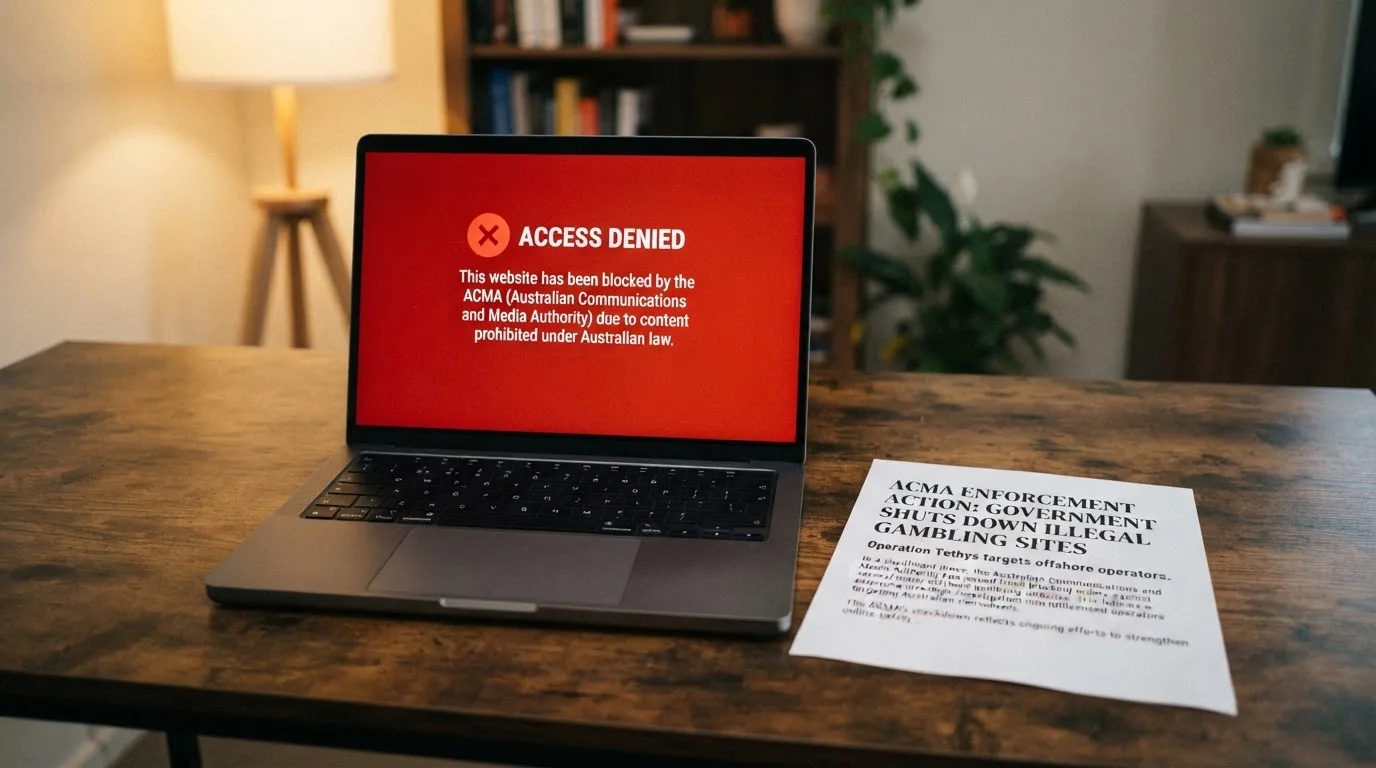
The ACMA — the Australian Communications and Media Authority — is the body that investigates, issues formal warnings, and directs Australian internet service providers to block illegal sites. As reported in June 2026, a total of 1,751 illegal gambling and affiliate marketing websites had been blocked since the first blocking request in November 2019, and more than 230 unlicensed gambling services had left the Australian market since enforcement was strengthened in 2017. In the round reported on 26 June 2026, the ACMA asked Australian internet service providers to block twelve further illegal gambling websites: 7Signs, ChromaBet, Donbet, Duospin, Freshbet, Slots Gem, Jacks Club, Lucky Start, Pointsbetz.com, Spinrise, Vinyl Casino and Wildsino.
H2 Gambling Capital’s 2025 report estimates that Australians lose about A$3.9 billion a year to illegal gambling sites, and that the share of gambling going through legal channels fell from 74% in 2021 to 64%. The legal channel is the racing, sport, lottery and keno wagering licensed in the Territory. The illegal channel is everything the table above sits inside. The arithmetic underneath that A$3.9 billion figure is a clear breakdown of the illegal channel, and the figure it produces is the consequence.
The arithmetic: what the block rate works out to
The numbers available are the running total of 1,751 blocked sites, the count of 230 unlicensed services that have left the market since 2017, and the date of the first blocking request, November 2019. The arithmetic between those numbers has to be stated as a band rather than a single figure, because the ACMA publishes the cumulative total and the date of first action rather than a per-year breakdown.
Between November 2019 and the June 2026 reporting date is roughly six and a half years. Across that period, the regulator directed the blocking of 1,751 sites, which works out to an average of around 270 sites blocked per year, or close to twenty-three per month. That is the block rate of a regulator that is acting continuously, not in occasional sweeps; the 12-site round reported in June 2026 is one of many, not an outlier. The 230 services that have left the market since 2017 — across six and a half years — works out to an average of around 35 per year, or roughly three per month. The two numbers are not measuring the same thing: a blocked site is still on the ACMA’s list, an exited service has stopped offering to Australians. The block rate is what an Australian reader sees when they try to load the site; the exit rate is what the regulator counts when a service decides the Australian market is no longer worth the cost of being blocked. Both numbers run on the same clock.
The block rate of around 270 per year, sustained, is the consequence an offshore operator faces by continuing to take Australian players. The exit rate of around 35 per year is the consequence an offshore operator faces by deciding not to. The figures are running averages, not a forecast for the year ahead — a single round of twelve blocks, or a single year of one-off enforcement, sits inside the same band — and the band is what the regulator has published, not what the regulator is on track to publish. The reader’s takeaway is not the per-year figure; it is the per-year figure sustained over six and a half years without a clear slowdown. That is what the block rate settles, and the consequence is that a brand on the ACMA’s warning list today is on a list that has been growing, on average, by close to five sites per week for the entire period.
What enforcement means for an Australian reader
Enforcement against an offshore casino is not the same as enforcement against an Australian-licensed bookmaker. The ACMA directs internet service providers to block the site at the network level, which is what the 1,751-block cumulative figure measures. The ACMA also issues formal warnings, which is what the table above records. The ACMA does not, on its own published record, prosecute individual Australian players; the Interactive Gambling Act 2001 targets the provider, not the customer. An Australian reader who has deposited at an offshore casino and is refused a withdrawal has no Australian complaints body to take the case to, no Australian regulator to escalate it through, and no guarantee the balance is recoverable when the site is blocked. BetStop, the National Self-Exclusion Register, has been live since August 2023 and binds only Australian-licensed wagering services — an offshore casino is not on it, and self-excluding from BetStop does not exclude a reader from the brands in the table.
Player protection a reader can reach is the National Gambling Helpline on 1800 858 858, free, available around the clock, with online chat at Gambling Help Online. The line is for anyone affected by their own or someone else’s gambling, and it is the one piece of Australian consumer protection that does apply to a reader of this page regardless of which site they end up on.
The 2026 reform sits beside all of this. The Interactive Gambling Amendment (Gambling Reform) Bill 2026 passed Parliament on 19 August 2026; its advertising and inducement measures commence 1 January 2027. On a 2026 page the reform is law with a start date, not yet in force. The consequence for the brands above is that the marketing language aimed at Australian readers will tighten in 2027, and the regulator’s enforcement frame will widen. Neither change makes the offshore sites legal in the meantime.
Tax sits alongside the prohibition. Gambling winnings of a recreational player are not assessable income under section 6-5 of the ITAA 1997, and losses are not deductible, unless the person is carrying on a business of gambling. The rule is the model, and a reader with a non-trivial gambling position should check with the ATO rather than rely on it.
What the prohibition does not change
The prohibition does not change the fact that a reader can still reach an offshore casino through a network path the ACMA has not blocked yet. The 1,751 cumulative figure is the count of sites that have been blocked, not the count of sites that are operating. New sites appear; some are added to the list within months; some are still reachable at the time of reading. The percentage the homepage advertises is unaffected by any of this. The acceptance of an Australian bank card is unaffected by any of this. The settlement speed of a withdrawal request is unaffected by any of this. What the prohibition does change is the recourse a reader has if the settlement does not happen. That is the consequence that sits under the rest of the page.
A note on the numbers the marketing pages quote
The percentages an offshore casino advertises on its homepage are quoted without a source a player can check. The 96%, 97% and 98% figures that appear across affiliate reviews of the brands in the table above are drawn from the operators’ own pages and from affiliate marketing pages that repeat them. They are not drawn from any independent measurement a player can audit. The percentages are not in the ACMA record, not in any Australian regulator’s published audit, and not in any public-facing testing report. They are the operator’s claim, and the operator’s claim is what the regulator’s enforcement action is partly a response to: the regulator has warned several of the brands above for the marketing aimed at Australian readers, and the marketing is the percentages.
A reader who wants to make a comparison on the percentages alone cannot do it on numbers that cannot be verified. The next-best comparison is on the warning record the table sets out, which is a public regulator’s published record, and on the consequences that follow from that record. The block rate the arithmetic above derives is one of those consequences; the per-brand warning date is another; the operator name the ACMA has named is a third. The percentage is not in the comparison.
Frequently asked questions
What does a casino’s advertised payout percentage actually measure?
It measures the share of every dollar wagered on a game that the game returns to players as winnings across a very long run of play — typically millions of bets. It is not a forecast of any single session and not a guarantee on any single spin.
Does a high return-to-player rate mean a player is more likely to win on any single spin?
No. The rate is a long-run average; variance on any given session is wide enough that a higher rate does not change the probability of the next spin landing a win. A 98% slot can run cold for an entire evening; a 96% slot can pay out early and often.
How is an online casino’s payout rate different from a single game’s house edge?
They are two sides of the same figure. The house edge is one minus the return-to-player: a 96% slot has a 4% house edge, a 98% slot has a 2% house edge. They describe the same long-run relationship from opposite sides and should not be mixed up when describing what an offer costs.
Can an advertised payout percentage be independently verified by a player?
Not directly. Independent testing houses audit the game math in a lab, not the operator’s settlement behaviour across real-money accounts. The figure on the page is the operator’s claim; the certificate that accompanies it is about the game, not the site, and no Australian regulator publishes per-brand payout audits a reader can check.
Does a higher payout percentage change how quickly a withdrawal is processed?
No. Withdrawal timing is set by the operator’s internal review, by the payment rail used, and by any anti-fraud or anti-money-laundering checks the operator runs. A higher advertised rate and a slower withdrawal can sit on the same site, and the two figures are decided by different parts of the operation. See also Low deposit online casino in Australia .
Why might a game’s real-world payout differ from its advertised long-run average?
Variance. Over millions of spins the actual payout converges on the advertised rate; over a session of a few hundred spins, it can sit anywhere on a wide range around that average. A reader’s session is on the short side of that range, which is why the advertised figure is not a forecast.