
Best Australian online pokies in 2026 — a reader’s map of a prohibited market
Someone typing the words “best Australian online pokies online” into a search bar is looking for a ranked list of safe places to play. The honest answer is that no such licensed list exists, because online pokies are prohibited outright under Australian law for any provider offering them to a person located in Australia. What does exist is a long record of regulator action against the offshore operators that ignore the rule, a working set of free and confidential help services, and a sharp distinction between the legal poker machines in pubs and clubs and the offshore sites that market themselves with the word “Australian” in their name.
This page maps that landscape for 29 October 2026, with operator data verified against the ACMA’s formal warning register.
Table of Contents
- The paytable in plain language — what an online pokie actually does
- The fundamental frame — why no ranked list is possible
- The prohibition — what the Interactive Gambling Act 2001 actually says
- The ACMA enforcement record — what blocking looks like in practice
- Responsible gambling — what help actually looks like in Australia
- Payments — what an Australian reader can actually use
- Bonuses and free spins — the marketing that frames the offshore pitch
- Mobile and apps — what a reader installing one should know
- Specific games and providers — the brand-side of the picture
- The landscape — brands the ACMA has acted against
- Tax — what a recreational punter needs to know
- The 2026 reform — advertising and inducement from January 2027
- What a reader comparing options should actually compare
- Closing the map
- Frequently asked questions
The paytable in plain language — what an online pokie actually does
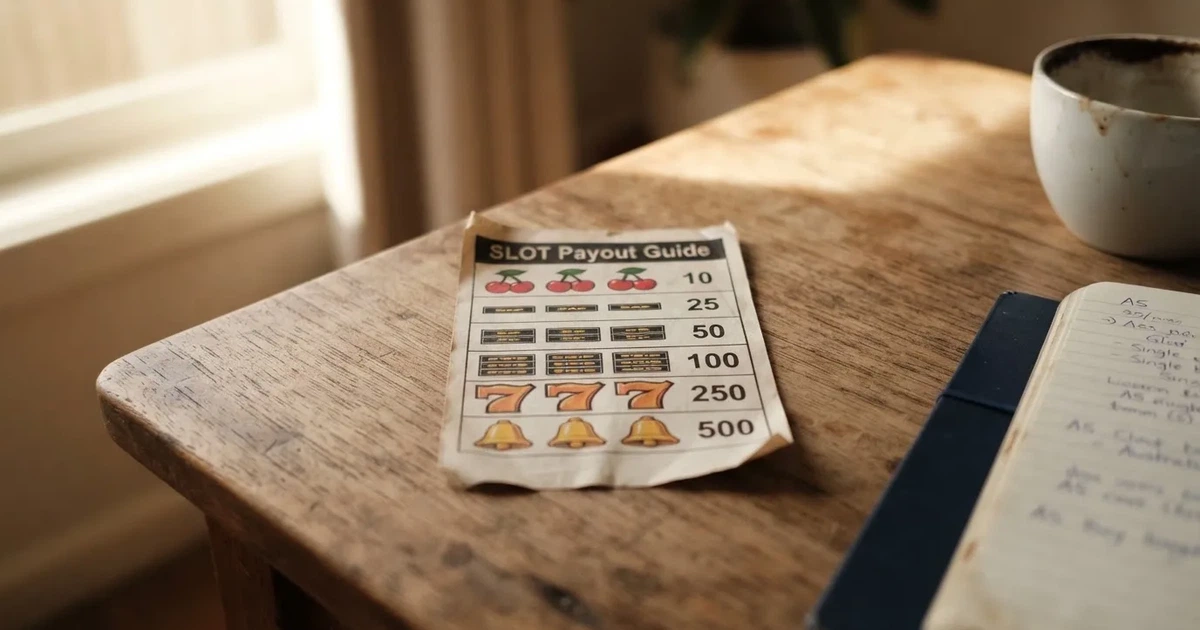
Before any discussion of which site is “best”, the building block of the product itself is worth understanding. A paytable is the reference chart a game prints to tell a player what each symbol is worth, how the win lines run and what bonus features trigger. The picture sits on a desk rather than a live screen because it functions as a reference, not a game.
A traditional three-reel machine shows one payline down the middle and a short list of symbols with the credit value of each combination — three cherries, three bars, three sevens. Modern five-reel video pokies run dozens of paylines, often with pays going both left-to-right and right-to-left, and stack wilds, scatters and free-spin triggers on top of the base game. The paytable also states the theoretical return to player — the percentage of all wagered money the game is designed to pay back over a very long run — and the variance, which is how lumpy the wins tend to come.
None of that machinery is licensed for Australian players online. The paytable a player sees on an offshore site is functioning in a jurisdiction that does not recognise Australian consumer law and is not bound by any of the minimum-return rules that apply to poker machines in Australian venues.
The fundamental frame — why no ranked list is possible
The whole idea of a ranked top-ten list rests on a comparison set that the regulator has explicitly forbidden. The Interactive Gambling Act 2001, tightened by the Interactive Gambling Amendment Act 2017, makes it an offence to provide online casino games or online pokies to a person physically in Australia, and no state or territory issues a licence for them. The search for the “best” site is, in this market, a search inside a category that does not legally exist.

What is licensable in Australia is wagering on races and sport placed before the event, lotteries and keno. The Northern Territory Racing and Wetter Commission regulates 52 of Australia’s online bookmakers — including Sportsbet, Bet365 and Ladbrokes — and does so for tax reasons from Darwin, where the commission has no full-time staff and meets once a month. Those are wagering licences, not casino licences, and a wagering licence does not extend a provider’s reach into online pokies.
So the page that follows is not a top ten. It is a working record of the brands the ACMA has chosen to act against, the enforcement tally the regulator has reported and the legal status a reader in Australia sits under if a balance is on a blocked site.
The prohibition — what the Interactive Gambling Act 2001 actually says
The IGA was passed in 2001 and tightened in 2017 after a review found offshore operators were scaling up their Australian marketing. The 2017 amendments made it explicit that providing online casino games — including online pokies — to someone in Australia is a contravention, and they gave the ACMA a sharper set of enforcement tools. The 2026 reform, the Interactive Gambling Amendment (Gambling Reform) Bill 2026, passed Parliament on 19 August 2026; its advertising and inducement measures commence on 1 January 2027, so they are law with a start date and not yet in force on a 2026 page.
Two consequences fall on a reader, not a provider. The first is that the individual player is not prosecuted — the IGA targets the operator — and the second is that an offshore site gives no Australian consumer protection, no complaints body and no recourse if a withdrawal is refused. The site can be blocked with a balance still sitting on it.
The legal land-based product — what a venue pokie actually is
Inside Australia, electronic gaming machines operate in every state and territory and each jurisdiction regulates them separately. The machines in pubs and clubs across New South Wales, Queensland, Victoria and Tasmania are licensed products with mandatory return-to-player floors, harm-minimisation requirements and venue-level monitoring. They are not the same product as an offshore online pokie, even when the offshore site borrows the word “pokies” in its branding.
The minimum return varies by jurisdiction: 85 per cent in New South Wales, the Northern Territory, Queensland and generally in Victoria, climbing to 87 per cent at Crown Melbourne, 87 per cent in the Australian Capital Territory and Tasmania, 87.5 per cent in South Australia and 90 per cent in Western Australia. Western Australia is the only mainland state that bans poker machines in pubs and clubs, a position in place since Crown Perth opened in 1985; Crown Perth’s own machine count has since grown from about 200 in 1985 to roughly 2,500, all approved by the state’s Gaming and Wagering Commission.
The legal floor matters because the offshore product has no floor at all. A site the ACMA has warned may print an RTP figure on its paytable, but the figure is self-reported and unenforceable in any Australian court.
| Jurisdiction | Minimum RTP |
|---|---|
| New South Wales | 85% |
| Northern Territory | 85% |
| Queensland | 85% |
| Victoria | 85% (87% at Crown Melbourne) |
| Australian Capital Territory | 87% |
| Tasmania | 87% |
| South Australia | 87.5% |
| Western Australia | 90% |
Tasmania’s pre-commitment reform
Tasmania planned nation-leading mandatory pre-commitment cards for its poker machines, with implementation of the reform delayed until late 2025. Pre-commitment means a player sets a dollar limit on a card before they sit down at a machine, and the machine enforces it. The Tasmanian Liquor and Gaming Commission, which took over oversight of the machines in November 2021 after the Federal Group’s monopoly ended, has been the regulator pushing the reform. The reform is a venue-side answer to a venue-side product — it has no bearing on offshore online pokies, which sit outside any Australian regulator’s reach.
The ACMA enforcement record — what blocking looks like in practice
The ACMA investigates, issues formal warnings and asks Australian internet service providers to block illegal sites. According to the ACMA as reported in June 2026, a total of 1,751 illegal gambling and affiliate marketing websites had been blocked since the first blocking request in November 2019, and more than 230 unlicensed gambling services had left the Australian market since enforcement was strengthened in 2017.
That is the headline figure. The arithmetic behind it is what gives a reader a sense of pace. From November 2019 to June 2026, the ACMA’s blocking requests covered 1,751 websites across roughly 79 months. The rate works out to an average band of about 22 blocked sites per month across the full period, though the monthly pace has moved sharply over time as the ACMA has moved from establishing the regime to running it at scale.
The June 2026 blocking round
In a round reported on 26 June 2026, the ACMA asked Australian internet service providers to block 12 more illegal gambling websites: 7Signs, ChromaBet, Donbet, Duospin, Freshbet, Slots Gem, Jacks Club, Lucky Start, Pointsbetz, Spinrise, Vinyl Casino and Wildsino. Twelve sites in one round is the kind of figure that explains why the running total keeps climbing the way it does.
The block is technical, not legal. An Australian player trying to reach a blocked site gets an error from their ISP, not a fine from the regulator. The offshore operator stays in business elsewhere. The point of the block is to remove the easiest route to the product, not to punish the player.
H2 Gambling Capital’s 2025 estimate of losses
H2 Gambling Capital’s 2025 report estimates that Australians lose about A$3.9 billion a year to illegal gambling sites, and that the share of gambling going through legal channels fell from 74 per cent in 2021 to 64 per cent. The estimate is a third-party modelling figure, not an ACMA audit, but it is the clearest public number for what the prohibition does not yet collect back into the legal market.
Responsible gambling — what help actually looks like in Australia
For any reader whose thinking about play is starting to feel compulsive or stressful, the help available is real and Australian. Gambling Help Online runs free, confidential counselling around the clock, with chat and email channels as well as phone. The National Gambling Helpline is 1800 858 858, free, 24 hours a day.
BetStop, the National Self-Exclusion Register, has been live since August 2023. It binds Australian-licensed online and phone wagering services — a player who registers is excluded across every participating licensed operator at once. An offshore casino is not connected to BetStop and is not required to honour an Australian self-exclusion registration. That gap is one of the cleanest reasons the ACMA keeps publishing warnings: the offshore product cannot plug into the harm-minimisation system Australian venues are plugged into.
What BetStop does and does not cover
For a reader registering on BetStop, the exclusion period chosen — from three months to a lifetime — applies across every Australian-licensed wagering operator that is part of the scheme. The exclusion does not follow the player to an offshore site, and the offshore site has no technical way to check the register. The register is a domestic tool for a domestic product.
Payments — what an Australian reader can actually use
For Australian-licensed online wagering, the legal deposit routes are debit card, bank transfer, PayID and Osko, and BPAY. Credit cards, credit-related products and digital currency are banned as payment for licensed online wagering since 11 June 2024, with penalties of up to A$247,500 for operators that accept them.
A site asking an Australian player for a credit card or a crypto deposit is therefore operating outside the Australian rules. That is a useful tell: it does not prove the site is illegal, but it confirms the site is not bound by the rules Australian licensees are bound by. The protection Australian consumer law gives a debit-card dispute does not exist for a crypto transfer into an offshore wallet.
PayID and Osko are real-time bank-to-bank transfers that move in seconds between participating Australian banks, which is why they show up in marketing for fast-withdrawal offshore sites. The payment rail is Australian; the operator on the other end is not.
Bonuses and free spins — the marketing that frames the offshore pitch
The offers an offshore pokie site uses to win a signup — deposit matches, free-spin bundles, “no deposit” credit — come from the same offshore operator that the ACMA has warned. None of them are issued by an Australian-licensed provider, because an Australian-licensed provider cannot legally offer online pokies at all.
The mechanics of a deposit-match bonus are universal across the offshore market: a percentage match on the first deposit, a wagering multiple that says how many times the bonus must be turned over before it can be withdrawn, a maximum cashout cap and a list of games that contribute different shares of the turnover. The wagering multiple is where the offer’s real cost hides, because the multiple is applied to the bonus amount, not the deposit, and the games that count toward clearing it often exclude the highest-variance pokies.
Free-spin bundles work the same way in principle: the spins are credited, the winnings are bonus funds, and the wagering multiple applies to those winnings. A “no deposit” free-spin offer is the most aggressive form of the same pattern, because it asks for nothing up front and binds the player with a wagering requirement before any of it can be withdrawn. None of these structures exist inside the Australian licensed product, because the products themselves do not exist.
Mobile and apps — what a reader installing one should know
A mobile-friendly pokie site is, technically, just a responsive web page that resizes for a phone screen. An “app” in this market is typically a web-app shortcut pinned to the home screen, because Apple’s App Store and Google’s Play Store both prohibit real-money gambling apps in jurisdictions where online casino play is not licensed — which includes Australia.
An Australian reader who finds a downloadable real-money casino app is looking at a product that has sidestepped the store policies, often through an APK install direct from the operator. That install carries whatever permissions the operator has asked for and whatever data flows the operator has built into it. The legal status of the product does not change with the install method.
Specific games and providers — the brand-side of the picture
The studios that build the games on these offshore sites — the providers whose names turn up in a paytable — operate as B2B suppliers to the offshore operators. They are licensed in their own jurisdictions, often Curaçao or Malta, and they sell the same games to many operators at once. The studio’s licence is not a substitute for the operator’s licence, and the ACMA’s enforcement action is against the operator offering the games to Australians, not against the studio that built them.
Baccarat and blackjack appear on these sites as live-dealer tables streamed from studios in Europe and Asia. Baccarat’s house edge is 1.06 per cent on the Banker bet, 1.24 per cent on the Player bet and 14.36 per cent on the Tie. Blackjack under liberal Las Vegas Strip rules carries a house edge of about 0.28 per cent with optimal play, climbing to about 0.43 per cent under Atlantic City rules. Those edges are independent of the offshore legal status of the site: they describe the mathematics of the game, which is the same in a licensed Melbourne casino as it is on an offshore stream. What differs is what sits around the edge — the consumer protection, the dispute resolution and the regulator behind the operator.
The landscape — brands the ACMA has acted against
The table below lists the eleven brands the ACMA has issued a formal warning over for offering prohibited online gambling services to Australians, in the order they appear in the ACMA’s published register. This is not a ranking — every brand in the list sits in the same legal position, which is the position the regulator has warned them out of.
| Brand | ACMA action and date | Operator named by the ACMA | Subject support |
|---|---|---|---|
| RocketPlay | Formal warning, March 2026 (earlier May 2022) | Pulsup Ltd (March 2026); Dama N.V. (May 2022) | — |
| Level Up Casino | Formal warning, May 2022 | Dama N.V. | listed by Bgaming as an operator carrying its titles |
| Woo Casino | Formal warning, March 2025 | Dama N.V. | — |
| Spirit Casino | Formal warning, May 2025 | Dama N.V. | — |
| National Casino | Formal warning, July 2025 | Consolutetish S.R.L. | listed in the Wikipedia Gambling in Australia entry as an offshore operator |
| Bizzo Casino | Formal warning, July 2025 (earlier 2022) | Consolutetish S.R.L. (July 2025); TechSolutions (CY) Group Limited / TechSolutions Group N.V. (2022) | — |
| Ignition Casino | Formal warning, July 2025 | Bamboo Media | — |
| Instant Casino | Formal warning, February 2025 | EOD Code SRL | — |
| Jackbit | Formal warning, April 2026 | Ryker B.V. | — |
| Casino Intense | Formal warning, April 2025 | Sterplay Holding Ltd | listed across ABC reporting, ACMA publications and Crown Melbourne’s baccarat tables page as an operator name appearing in coverage |
| Sky Crown | Formal warning, September 2022 | Hollycorn N.V. | — |
Each row carries the operator the ACMA named in its warning, not the licensee the site displays. The two are different legal persons: the ACMA names the company it served the warning on, while the site may display a Curaçao or other offshore licence held by a different corporate entity in the same group. The mismatch is one of the cleanest signals that the licence the player sees is not the licence the regulator has acted against.
What “no-data” means in the table
A dash in the subject-support column means the ACMA’s published record was the only material the research turned up that names this brand. The brand’s own site, its marketing and its affiliate pages were not used as sources for this page — the affiliate pages in particular tend to recycle promotional copy rather than verifiable facts. Where a row carries a “listed by” entry, the source named there is a directory, a Wikipedia entry or a media report that mentions the brand in passing; the entry does not constitute an endorsement and does not change the brand’s legal position.
The brands at the individual level
RocketPlay carries two ACMA warnings seven years apart — a May 2022 warning to Dama N.V. and a March 2026 warning to Pulsup Ltd. Two warnings on the same brand across different operating companies is a fair signal that the marketing has not slowed under either entity. The brand is one of the clearest examples of how the offshore industry rotates corporate shells while keeping the customer-facing name.
Level Up Casino sits under the May 2022 Dama N.V. warning. The Dama group has been the most consistently warned operator entity in the ACMA’s published register, with five brand-level warnings attributed to it — Level Up, Bambet, Dazard, Wild Tornado and Cobra Casinos in May 2022, plus the Woo and Spirit warnings in 2025. The cumulative picture is a corporate group the regulator has had to warn more than once.
Woo Casino was warned in March 2025 under Dama N.V. The warning sits more than two and a half years after the original Dama group warning and indicates the operator continued to market to Australians across the gap.
Spirit Casino carries the May 2025 Dama N.V. warning. It is the most recent Dama warning on the register, and the brand itself is a useful illustration of how a new name can appear on an old problem.
National Casino was warned in July 2025 under Consolutetish S.R.L., an entity that also carries the Bizzo Casino warning from the same month. The two warnings on the same operator entity, in the same month, on different brands, point to the same pattern: a single offshore group running multiple skins under one corporate roof.
Bizzo Casino carries two warnings seven months apart in formal terms but actually years apart in substance — the July 2025 Consolutetish warning and a 2022 warning to TechSolutions (CY) Group Limited and TechSolutions Group N.V. The 2022 warning was one of the larger early-round ACMA actions and the 2025 warning confirms the brand survived the change of operating entity.
Ignition Casino sits under the July 2025 Bamboo Media warning. The brand has been around since the mid-2010s and was one of the longer-established offshore products in the Australian market before the warning.
Instant Casino was warned in February 2025 under EOD Code SRL, making it one of the earlier 2025 actions. The brand’s name leans into the speed-and-convenience pitch the offshore market uses to recruit around the IGA prohibition.
Jackbit carries the April 2026 Ryker B.V. warning, alongside the CasinOK warning in the same month. Jackbit markets around crypto deposits — a payment method the IGA’s 2024 reform explicitly bans for Australian-licensed wagering, which means a Jackbit deposit is happening outside the Australian rules from the moment of payment.
Casino Intense sits under the April 2025 Sterplay Holding Ltd warning. The name carries a high-volatility pitch and a tight game catalogue, both of which are common patterns for offshore operators trying to differentiate on game feel rather than regulatory standing.
Sky Crown carries the September 2022 Hollycorn N.V. warning. Hollycorn N.V. was warned on the same day over a sister brand, Blue Leo. The warning is older than most on the register, but the brand is still being marketed to Australians — Hollycorn has not been named in a 2025 or 2026 round.
Reading the table as a whole
The table carries one operating entity named per row, but the entity that has attracted the most distinct brand-level warnings is Dama N.V., with five brands warned in 2022 and two more in 2025. Consolutetish S.R.L. has two brand-level warnings from the same July 2025 round. The pattern across the eleven brands is consistent: a small number of offshore groups run a larger number of customer-facing brands, and the ACMA’s enforcement works at the brand level as well as the entity level.
A reader looking at the table should not read across it for a “best of” — every entry sits in the same legal position, and the only signal worth reading is that the ACMA has named the brand on its published register of formal warnings.
Tax — what a recreational punter needs to know
Gambling winnings of a recreational player are not assessable income in Australia, under section 6-5 of the ITAA 1997. Losses are not deductible either, unless the person carries on a business of gambling. The rule is the same for an Australian venue and an offshore site, and the ATO’s published guidance treats the offshore product the same way as the legal one for tax purposes. Anyone whose gambling activity has crossed into business-of-gambling territory should check with a registered tax agent.
The 2026 reform — advertising and inducement from January 2027
The Interactive Gambling Amendment (Gambling Reform) Bill 2026 passed Parliament on 19 August 2026. Its advertising and inducement measures commence on 1 January 2027. The provisions are aimed at licensed wagering operators and at the marketing of prohibited products, with inducements — the deposit-match bonuses and free-spin offers that drive offshore signup — squarely in scope.
For a reader who sees inducement advertising on or after 1 January 2027, the legal position of the advertiser will have tightened. For a reader on a 2026 page, the law with the start date is law but not yet in force, and the offshore inducements the ACMA has been warning about since 2017 will continue to be the regulator’s main enforcement target.
What a reader comparing options should actually compare
Given the prohibition, the comparison a reader can actually make is between the legal venue product and the offshore product, not between offshore brands. On the venue side: a licensed pub or club with mandatory harm-minimisation, a regulator behind the operator and a dispute path through the state gaming authority. On the offshore side: a self-reported RTP, no Australian regulator, no enforceable dispute path and a payment method the licensed product is banned from accepting.
Inside that frame, the comparison is not close. The legal venue product gives a reader what the offshore product cannot: a regulator that will act on a complaint, a payout that does not depend on the offshore operator staying solvent and a self-exclusion tool that the offshore site has no way to query.
Closing the map
Eleven brands, one consistent legal position, and a regulator that has published 1,751 blocking requests since November 2019. The honest “best” in this market is the legal product that the prohibition leaves room for — a licensed pub or club machine under a state regulator, with BetStop and the National Gambling Helpline as the harm-minimisation layer around it. The offshore brands the ACMA has named are not ranked, not recommended and not legal for an Australian reader to play at; the table above is the working record of who the regulator has had to warn.
Frequently asked questions
Is “Australian pokies online” a licensed category recognised by any state regulator?
No. The Interactive Gambling Act 2001 prohibits online casino games, including online pokies, from being offered to anyone in Australia, and no state or territory issues a licence for them. The licensed Australian pokies product is the electronic gaming machine in a pub, club or casino, regulated state by state.
Is there a legal Australian online pokies app, as opposed to a mobile browser site?
No. Online pokies cannot be licensed for Australian players, so there is no legal app to install. What exists is a responsive mobile browser site from an offshore operator, sometimes disguised as a home-screen shortcut. The App Store and Play Store prohibit real-money gambling apps in jurisdictions where the product is not licensed.
What’s the difference between “Australian pokies online” and pokies in an Australian venue?
Venue pokies sit inside a state regulatory framework with mandatory minimum returns, harm-minimisation requirements, venue-level monitoring and a regulator behind every operator. Offshore online pokies sit in none of those. The minimum RTP on a venue pokie varies from 85 per cent to 90 per cent by jurisdiction; an offshore site self-reports the figure.
Do sign-up bonuses offered on “Australian pokies online” sites come from a local operator?
No. The site offering the bonus is offshore and outside Australian law. The wagering multiple that hides the bonus’s real cost is the operator’s own choice, the maximum cashout cap is the operator’s own choice, and there is no Australian regulator to appeal to if the bonus terms are not honoured.
Can a PayID-friendly “Australian online pokies” site still be operating from offshore?
Yes. PayID is an Australian payment rail that any operator — Australian-licensed or offshore — can integrate. An offshore site accepting PayID is still offshore, and the deposit does not carry the protections an Australian-licensed wagering operator is required to provide. A PayID transfer into an offshore wallet is faster than a bank transfer, but it is not safer.
Does the word “Australian” in a pokies site’s name indicate its actual licensing jurisdiction?
No. The word is marketing. The ACMA’s formal warnings repeatedly name Curaçao and other offshore entities as the actual operators of brands with “Australian” in their name, including in the Dama N.V., Hollycorn N.V. and Consolutetish S.R.L. cases on the table above. The licence the site displays and the regulator the ACMA has warned are different documents about the same brand.