
Best new online casino sites in Australia in 2026: what the regulator’s record shows, and what lawful play looks like
Current as of 29 October 2026, verified against the Australian Communications and Media Authority’s (ACMA) public register of formal warnings and blocking requests.

A “best new online casino sites” page aimed at Australian readers is, on first inspection, a contradiction. The Interactive Gambling Act 2001 (IGA) makes it an offence to provide online casino games, online pokies and in-play betting to a person physically in Australia; no state or territory issues a licence for it, and the ACMA has been chipping away at the offshore brands that try to reach Australian players anyway since the first blocking request in November 2019. Anyone in Australia who searches for a brand-new casino site is, almost by definition, looking at a product the local regulator considers prohibited.
That is not the end of the conversation, though — it is the start of one. This page treats the shortlist the reader actually wanted as a record of regulator action rather than a recommendation. Each brand in the table below has been formally warned by the ACMA for offering prohibited online casino services to Australians, and the table is ordered by the date of that warning. The framing matters because the more interesting question, after legality, is what an Australian reader is meant to do instead: licensed wagering on sport and racing, land-based venues, the pokies clubs, BetStop for self-exclusion, and a payments stack — debit cards, PayID, Osko, BPAY — that the law actually allows.
Table of Contents
- The Australian legal frame around online casino sites
- The ACMA’s enforcement record: 1,751 blocked sites and a long list of warnings
- The shortlist the regulator built: 11 brands the ACMA warned by name
- Payments in Australia: the lawful stack and the warning signs
- Bonuses, wagering, and what a brand-new site is actually selling
- Mobile and apps: what a brand-new site looks like on a phone
- Games, providers, and live tables: what the catalogue actually is
- Responsible play: what an Australian reader can actually use
- What an Australian reader should actually do
- What to read next, and what the page is not
- Frequently asked questions about new online casino sites in Australia
The Australian legal frame around online casino sites
The IGA, tightened by the Interactive Gambling Amendment Act 2017, makes providing online casino games or in-play betting to anyone in Australia a civil offence. The current scope is what the law says it is: lotteries, keno, and pre-event wagering on sport and racing are licensable; everything else, in practical terms, is not. The Northern Territory Racing and Wagering Commission (NTRWC) regulates the licensed online bookmakers — 52 of them, including Sportsbet, Bet365 and Ladbrokes — and the practical reason those books sit in Darwin is tax. The commission itself has no full-time staff, meets once a month, and is, in the words of one recent ABC report on a bill to reform it, “a de facto regulator”. That is the architecture behind every legitimate wagering product an Australian can use online.

The product an Australian reader types “best new online casino” hoping to find is the product the IGA names a “prohibited interactive gambling service”. That phrase is what the ACMA writes in its formal warnings, and it is the phrase that should be on a reader’s mind when a brand-new site asks for a deposit.
A useful way to think about the law is by who it bites. The IGA targets the provider, not the player. There is no prospect of prosecution for someone who opens an account with an offshore brand; the consequence is what that brand cannot do for the player when something goes wrong. An offshore site gives no Australian consumer protection, no Australian complaints body, and no Australian recourse when a withdrawal is refused. The site can be blocked overnight by the ACMA with the player’s balance still on it. Those are the trade-offs the marketing copy never names.
The 2026 reform sits on top of this. The Interactive Gambling Amendment (Gambling Reform) Bill 2026 passed Parliament on 19 August 2026; its advertising and inducement measures commence on 1 January 2027. It is law with a start date — not a measure in force on a page read in 2026 — and its reach into the offshore market is mostly the same reach the ACMA already has, sharpened by clearer inducement rules. Worth noting; not worth describing as if it had already bitten.
The ACMA’s enforcement record: 1,751 blocked sites and a long list of warnings
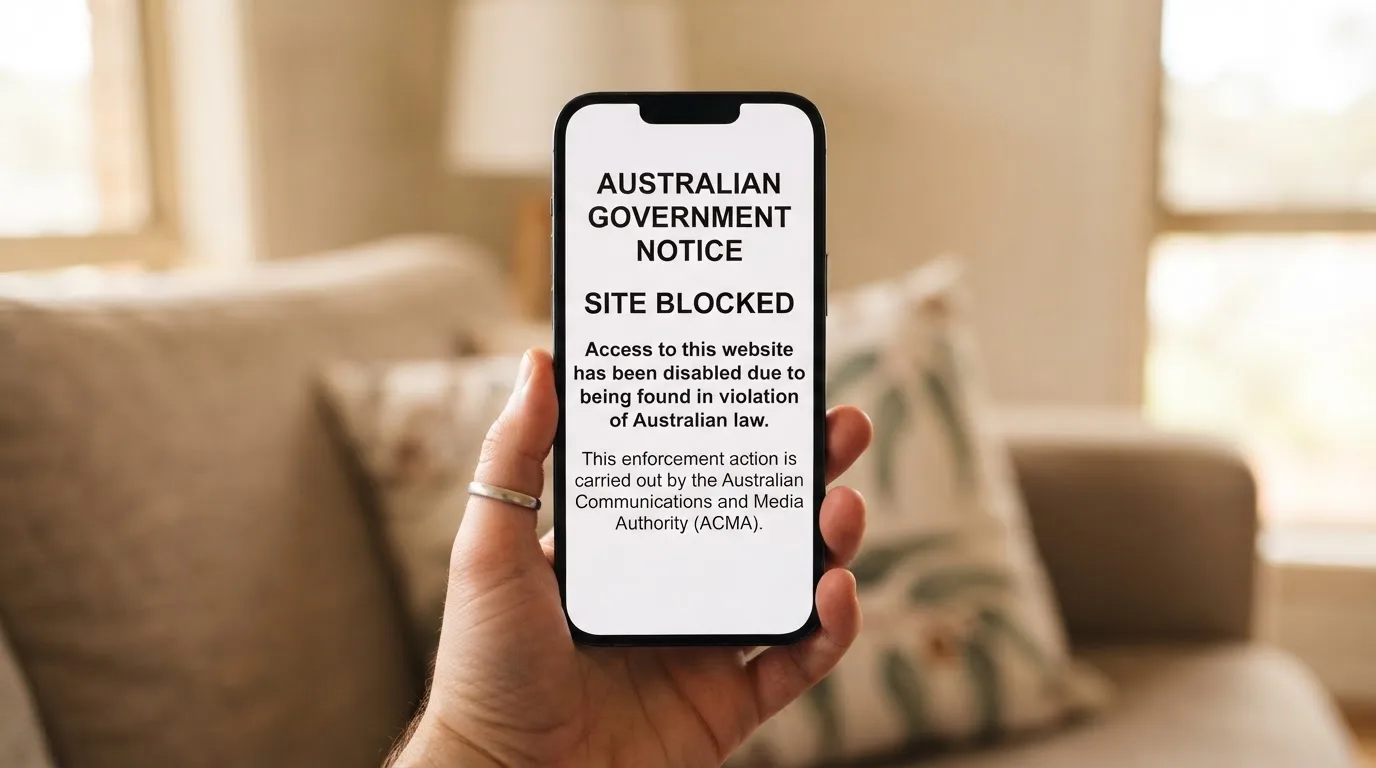
The ACMA’s enforcement has two registers worth knowing. The first is the blocking list: every round of formal blocking requests sent to Australian internet service providers since the first one in November 2019. As reported in June 2026, that list stands at 1,751 blocked gambling and affiliate marketing websites, with more than 230 unlicensed gambling services having left the Australian market since enforcement was strengthened in 2017. The second is the formal-warning register: published notices naming a brand and its operator, with the date and the section of the IGA invoked. The warning register is where the page’s table of brands is built from, and the blocking round reported on 26 June 2026 — which asked ISPs to block 7Signs, ChromaBet, Donbet, Duospin, Freshbet, Slots Gem, Jacks Club, Lucky Start, PointsBetz, Spinrise, Vinyl Casino and Wildsino — shows the current pace.
The losses the regulator is trying to claw back are large. H2 Gambling Capital’s 2025 estimate puts Australian losses to illegal gambling sites at around A$3.9 billion a year, with the share of gambling going through legal channels falling from 74% in 2021 to 64%. The fall is small in percentage terms and large in dollar terms, and it is the dollar figure that explains the volume of formal warnings.
Blocking rate over the life of the regime
The blocking record now covers roughly 81 months from the first blocking request in November 2019 to the June 2026 round. Spread across the running total of 1,751 blocked sites, that lands at a band of about 21 to 22 blocked sites per month on average over the life of the regime — a useful figure to keep in mind whenever a single round of twelve names feels like a small number. Two warnings make sense of the band. First, blocking rounds are reported in batches, so the underlying pace is uneven: a quiet month and a busy month look the same once averaged. Second, the early years of the regime were lighter — the law was only reinforced in 2017, and the first formal blocking request did not arrive until late 2019 — so the average pulls a slow start together with a more aggressive recent pace. The condition is what most readers will care about: a brand blocked this month is a brand blocked this month, regardless of what the running average looks like.
The shortlist the regulator built: 11 brands the ACMA warned by name
The table below is built from the ACMA’s published formal warnings. Each brand has been warned for offering online casino games to Australians in breach of the IGA. That is what the table is for — to record, in plain language, what the regulator has done, and to whom, and when. It is not a recommendation to play at any of these brands; it is the opposite, and the opposite is exactly the framing an Australian reader needs.
| Brand | ACMA action and date | Operator named by the ACMA | Subject support |
|---|---|---|---|
| RocketPlay | Formal warning, March 2026 (and earlier Dama N.V., May 2022) | Pulsup Ltd | Listings only — Gambling Insider |
| Level Up Casino | Formal warning, May 2022 | Dama N.V. | Listings only — Westpac |
| Woo Casino | Formal warning, March 2025 | Dama N.V. | — |
| Spirit Casino | Formal warning, May 2025 | Dama N.V. | — |
| National Casino | Formal warning, July 2025 | Consolutetish S.R.L. | Listings only — acma.gov.au, austrac.gov.au, betstop.gov.au |
| Bizzo Casino | Formal warning, July 2025 (and earlier TechSolutions, 2022) | Consolutetish S.R.L. | Listings only — Gambling Insider |
| Ignition Casino | Formal warning, July 2025 | Bamboo Media | — |
| Instant Casino | Formal warning, February 2025 | EOD Code SRL | Listings only — EcoPayz, PayID |
| Jackbit | Formal warning, April 2026 | Ryker B.V. | — |
| Casino Intense | Formal warning, April 2025 | Sterplay Holding Ltd | Listings only — austrac.gov.au, betstop.gov.au, Gamblinginsider.com |
| Sky Crown | Formal warning, September 2022 | Hollycorn N.V. | — |
The same operator turning up more than once is the page’s quiet throughline. Dama N.V. appears in the table four times — RocketPlay (May 2022), Level Up Casino (May 2022), Woo Casino (March 2025) and Spirit Casino (May 2025) — and Consolutetish S.R.L. appears twice, for National Casino and Bizzo Casino, in the same July 2025 round. Bizzo’s earlier 2022 warning went to a different operator, TechSolutions, which is the kind of detail that turns an offshore brand’s “new” launch into a less reassuring story than the homepage suggests: a brand can be re-skinned and re-launched under a new corporate name without changing the underlying product or the regulator’s view of it.
Subject support, the fourth column, is the column most readers will find unfamiliar. It records where the brand appears in non-promotional listings — regulator pages, payments directories, industry publications — without adding any endorsement from those listings. A dash in that column means the inputs carry no such listing at all. The reader should read the column as a footprint, not as a vote of confidence: a brand that appears only on affiliate marketing pages is a brand with no Australian footprint beyond the marketing.
RocketPlay — warned twice, by two operators
The most telling entry in the table is the one that records two warnings. RocketPlay was first warned as part of a May 2022 round that named Dama N.V. across six brands — Bambet, Dazard, Level Up, Rocketplay, Wild Tornado and Cobra Casinos — and then warned again, in March 2026, with Pulsup Ltd named as the operator of RocketPlay. Same product, two operators, four years apart. The RocketPlay entry carries listings in Gamblinginsider.com only, which is exactly the kind of footprint an offshore brand carries when its only public record is the marketing.
A brand that has been told twice is a brand the regulator has been unable to remove from the Australian market by warning alone. The 2026 step up is the same step the ACMA has used on every other repeat offender: a fresh formal warning with the new operator named, on the same legal grounds. The RocketPlay entry is the entry that best illustrates the gap between “new” and “untouched by the regulator”.
Level Up Casino — a 2022 warning, no fresh action since
Level Up Casino was named in the same May 2022 round that caught the original RocketPlay listing. There is no fresh formal warning on the ACMA register since then, which is interesting for two reasons. It does not mean Level Up has stopped offering its services to Australian players — the ACMA’s blocking list is the register for that, not the warnings register — and the brand still appears in Westpac.com.au listings, which is the payments-side footprint. A reader who sees Level Up advertised as “new” should treat “new” as a marketing word and the regulator’s silence on this brand since 2022 as something else.
Woo Casino and Spirit Casino — the same Dama N.V. footprint, two years apart
Woo Casino (March 2025) and Spirit Casino (May 2025) are the freshest Dama N.V. pair in the table, both caught in the same enforcement period that includes National Casino and Bizzo Casino. Both entries carry a dash in the subject-support column — the inputs carry no non-promotional listings at all, which is the emptiest footprint a brand can have. A reader is meant to notice that column’s emptiness. An offshore brand with no listing on a regulator page, no listing on a payments directory, and no listing on an industry trade page is a brand whose only public footprint is the marketing itself, and the marketing is the thing the regulator is warning about.
National Casino and Bizzo Casino — two brands, one operator, one round
National Casino and Bizzo Casino were caught in the same July 2025 round and both named Consolutetish S.R.L. as the operator. Bizzo had already been warned once, in 2022, when the operator was TechSolutions. The fresh warning is the ACMA’s way of saying the operator changed but the offering did not. National Casino’s listings are the most varied of the table — acma.gov.au, austrac.gov.au and betstop.gov.au — which is itself worth reading carefully: the first two are enforcement registers, the third is the self-exclusion register that the brand is not part of. A brand that appears in enforcement registers but not in the self-exclusion register it claims to honour is a brand that has chosen its footprint.
Ignition Casino — one warning, no other footprint
Ignition Casino was named alongside National Casino and Bizzo Casino in the July 2025 round, with Bamboo Media named as the operator. It is the second of the three July 2025 brands and the second to carry a dash in the subject-support column. Bamboo Media is not one of the operator names that recurs across the table, which is why a reader doing a side-by-side might assume the company is smaller or newer; that assumption is the kind of thing the ACMA register does not say.
Instant Casino — the February 2025 entry
Instant Casino was caught early in 2025 — February, with EOD Code SRL named as the operator — and is the first brand in the table by chronology that is not part of the May 2022 Dama N.V. cluster. The subject-support column lists Ecopayz.com and Payid.com.au, which is interesting: ecopayz was once a common deposit wallet at offshore brands, and PayID is an Australian instant-transfer system whose appearance in an offshore brand’s footprint is something the regulator considers worth flagging.
Jackbit — the most recent ACMA action in the table
Jackbit was caught in April 2026, with Ryker B.V. named as the operator. CasinOK, the second brand named in the same round, is not in the table because the table is built from the brands the ACMA’s published warning specifically named as offering prohibited services. Jackbit is the entry that makes the table feel current, and a dash in the subject-support column is again the most arresting detail: no listing on a regulator page, no listing on a payments directory, no listing on an industry trade page.
Casino Intense — the April 2025 warning
Casino Intense was caught in April 2025 with Sterplay Holding Ltd named as the operator, and is the third brand in the table by chronology to be caught between February 2025 and July 2025 — a window that, taken with the June 2026 blocking round, captures most of the regulator’s recent pace. Casino Intense’s listings — austrac.gov.au, betstop.gov.au, Gamblinginsider.com — are the same mix of regulator pages and trade publications that the National Casino entry carries. The footprint tells the reader roughly the same story.
Sky Crown — Hollycorn N.V., the September 2022 warning
Sky Crown is the oldest entry in the table by date of warning: September 2022, with Hollycorn N.V. named as the operator, and Blue Leo named alongside it as part of the same operator’s offering. The ACMA’s published PDF on the Hollycorn warning is the original source for the operator name. A dash in the subject-support column means the inputs carry no other footprint. Sky Crown is also the brand whose age in the table makes the “new” framing most obviously a stretch: a brand warned in 2022 is not new in 2026 in any sense a regulator would accept.
What the table does not show
The table does not show licences. No Australian jurisdiction issues an online casino licence, so a brand claiming one is either licensed somewhere else (Curaçao, Malta, Anjouan, the Isle of Man — names that surface in the offshore market and mean different things in each) or not licensed anywhere at all. The table does not show welcome bonuses, wagering requirements, withdrawal times, or anything else the affiliate marketing pages usually sell a reader on, because the only sources for those figures were the affiliate marketing pages themselves. A reader who wants to compare what an offshore brand actually offers will need to look elsewhere; this page does not.
Payments in Australia: the lawful stack and the warning signs
The Australian payments stack is the part of this story that is genuinely distinctive. An Australian reader using a licensed wagering service — a sports book, a racing book, a lottery — has a narrow and well-defined set of deposit options, and the same stack tells a reader an offshore site is operating outside Australian rules when the site asks for something else.
The lawful stack: debit card, PayID/Osko, BPAY
The lawful deposit routes for licensed Australian wagering are debit card, bank transfer, PayID/Osko, and BPAY. Credit cards and credit-related products have been banned as payment for licensed online wagering since 11 June 2024, with penalties up to A$247,500 for operators that breach the rule; the same restriction constrains credit-linked digital wallets such as Apple Pay. Digital currency is in the same category. Anything else — a credit card, a crypto deposit, a wallet not on the lawful list — is the warning sign that the site is not part of the Australian system at all.
PayID and Osko: instant, named, and very Australian
PayID is the addressing layer on top of the New Payments Platform (NPP), the real-time payments infrastructure that went live to the public on 13 February 2018 and is owned by New Payments Platform Australia Ltd, a non-profit whose 13 shareholders include the Reserve Bank of Australia and the major banks. With Osko on top of PayID, a transfer between participating banks arrives in under a minute, 24/7 including weekends, whether the transfer is addressed to a BSB and account number or to a PayID. Over 100 Australian financial institutions offer PayID-based instant transfers, and more than 25 million PayID identifiers were registered on the platform as of April 2025.
Two practical features of PayID matter for an Australian reader choosing a deposit route. The first is that paying to a PayID shows the name of the account holder before the transfer is sent. AP+, the platform operator, warns that being asked to transfer to a PayID on an illegal gambling site almost certainly means a scam site, which is the cleanest signal a reader is going to get that an offshore brand has not built the Australian payment layer into its product at all. The second is the ACCC-cleared consolidation behind it: in 2021 the ACCC authorised the merger of NPP Australia with BPAY and eftpos into a single company, Australian Payments Plus (AP+). The platform’s monthly outages are capped at no more than two minutes, which is the operational discipline a real-time system has to hold to.
BPAY: the bill-payment route that has been there since 1997
BPAY is a bill-payment service in online banking: the payer enters the Biller Code and the Customer Reference Number (CRN) printed on the bill. It has been around since 18 November 1997, is available in the online banking of over 140 Australian banks and financial institutions, and is offered by over 95,000 businesses. BPAY is run by Australian Payments Plus, the same operator as PayID and Osko, and is owned equally, via parent company Cardlink Services Limited, by Australia’s four major banks — ANZ, Commonwealth Bank, National Australia Bank and Westpac.
BPAY is not a deposit route an offshore casino would typically expose, because it requires the casino to bill through a registered Biller Code on the Australian system. The casinos that do expose it are the ones that have done some Australian integration work. Most have not.
Mobile wallets and credit cards
Apple Pay, Google Pay and Samsung Pay collectively accounted for around 45% of all card payments in Australia by number at the end of 2025. None of them is a free-standing payment method for an Australian wagering customer, because the underlying funding source still has to be a debit card — credit cards and credit-related products cannot be used for licensed wagering under the 2024 rule. The Reserve Bank of Australia’s July 2025 review proposes removing surcharges only on eftpos, Mastercard and Visa transactions, explicitly leaving American Express outside the scope of the proposed surcharge ban — a small detail, and one that explains why an Amex-funded transaction at an offshore site feels different from a debit-funded one at a licensed book.
AUSTRAC’s threshold-transaction-report rule — A$10,000 or more in physical cash — does not apply to ordinary electronic bank transfers. A reader sending an A$10,000 PayID to an offshore brand is not, on the AUSTRAC side, in the threshold-report territory. That is a small consolation, but it is one a reader should know.
Bank-side gambling blocks
Australian banks have spent the last two years building gambling-block tools at the card level. Westpac’s gambling block works at card level: it refuses authorisation of transactions registered under the merchant category code “Betting/Casino Gambling” on eligible personal credit and debit cards. ANZ’s gambling transaction block, activated in the ANZ app, also blocks Gambling Transactions made through a digital wallet such as Apple Pay on an eligible card — not just the physical card — and once it is on, removing it requires a 48-hour waiting period. The ANZ page warns that not all gambling transactions will be blocked and that some non-gambling transactions might be blocked in error. Commonwealth Bank offers the same kind of gambling lock in the CommBank app, with the same caveat.
These blocks are not enforcement of the IGA — they are a bank-side layer on top of it, and they are imperfect. They block at the merchant category code, which means a transaction routed through a non-standard MCC will not be blocked. They cover card payments, not bank transfers, so a PayID deposit is unaffected. They are, however, the most direct tool an Australian player has to keep an offshore brand’s marketing email from converting into a deposit, and they are the closest thing to a friction layer the current system offers.
Bonuses, wagering, and what a brand-new site is actually selling
A “welcome bonus” is the lever an offshore brand uses to convert a search into a deposit, and the lever has a fixed shape wherever it appears. There is a bonus amount, a wagering requirement (a multiple of the bonus or the bonus-plus-deposit that must be turned over before any winnings can be withdrawn), a game-weighting table (slots contribute 100%, table games often less), a maximum bet per spin while the bonus is active, an expiry window, and a list of games excluded from the wagering calculation altogether.
What changes between brands is the values on those levers, and what does not change is the underlying cost. A 100% match bonus with a 40x wagering requirement on the bonus alone is the same shape as a 200% match with a 50x wagering requirement on the bonus-plus-deposit; the dollars differ, the multiplier differs, and the dollar-effort required to clear the bonus differs, but every “free” bonus carries the same arithmetic underneath.
This page does not print bonus terms for any of the brands in the table above, for one reason: the only sources for those terms were affiliate marketing pages. Affiliate pages earn commission on the player they refer, which is the same reason a reader should treat any welcome-bonus figure published on an affiliate page as a marketing figure, not a contractual one. The bonus terms that bind a player are the ones in the brand’s own terms page, and they can — and often do — differ from what the affiliate page says. A reader who wants to know what a welcome bonus will actually cost should read the terms page at the brand itself, with the affiliate page closed.
For a reader who wants a quick way to think about an offshore bonus without doing the arithmetic: a 100% match up to A$500 with a 40x wagering multiple on the bonus alone means A$20,000 of qualifying turnover before any winnings are withdrawable, and a player going through that turnover on slots at the standard RTP loses about 4% to 6% of it to the house edge — a real cost sitting on top of any “free” deposit.
Mobile and apps: what a brand-new site looks like on a phone
The phone-screen experience at an offshore brand is mostly a smaller browser window on the desktop product. The exception is a downloadable app, and the exception is what an Australian reader should be most cautious about.
The first thing an Australian reader should know about a brand-new casino app is whether it is in the App Store or the Play Store at all. The Apple App Store and the Google Play Store both enforce policies on real-money gambling apps, and both reject apps that target markets where the product is prohibited. An app that targets Australians is, by definition, an app that has decided not to enter the Australian stores — which usually means it is delivered as an APK (Android) download or as a web-app shortcut, with no Australian store vetting behind it.
The second thing is the payments layer in the app. A licensed Australian wagering app takes PayID, Osko, BPAY or a debit card. An offshore brand-new casino app will, at best, take a debit card and a crypto deposit; at worst, it will ask for a credit card or a wire transfer. The payments layer is the layer that tells the reader which set of rules the brand is operating under.
The third thing is what the app does on a phone that has a bank-side gambling block enabled. A reader who has turned on the ANZ gambling block, or the Westpac block, or the CommBank lock, and finds the app’s card deposit declining, has just been shown the block working. That is the block’s job. An app that does not trigger the block — because it is routing through a non-standard MCC, or because it is asking for PayID — has skipped the block, and that is the case where the bank’s block is least useful.
Games, providers, and live tables: what the catalogue actually is
An offshore brand’s catalogue is, almost without exception, built from third-party studios: Pragmatic Play, Evolution for live tables, NetEnt, Play’n GO, BGaming, Nolimit City, Hacksaw Gaming, and a long tail of smaller studios. The catalogue is one of the easier things for a brand-new site to assemble, because the studios’ games are licensed in bulk and the integration work is largely commodity.
What the catalogue does not tell the reader is which games are actually available to Australians at the brand in question. Most studios geo-block Australian IPs at the game level, which means a brand-new site can list a 5,000-game catalogue and an Australian reader can land on a page that plays 800 of them, with the rest greyed out. The greyed-out games are the studios’ own decision, not the brand’s, and the brand will not advertise the greyed-out list.
For the live-casino side, the studios are fewer and the geo-blocks are louder. Evolution, Pragmatic Play Live, Ezugi, Vivo Gaming, Asia Gaming — these are the names that surface in a live lobby — and an Australian reader will see most of them as greyed-out thumbnails. A live table the reader can actually sit at, from Australia, is a smaller set than the brand’s lobby suggests.
The volatility and RTP question is the one that matters for what a slot actually costs to play, and the only honest answer is that the inputs do not name RTP figures for any specific title at any brand in the table. A reader who wants to know the RTP of a particular game should look it up at the studio — Pragmatic Play publishes RTP figures for its titles, NetEnt does the same — and should treat any RTP figure carried in an affiliate page as a marketing figure, not a contractual one.
Responsible play: what an Australian reader can actually use
The lawful side of the Australian system has tools the offshore side does not connect to. BetStop — the National Self-Exclusion Register, live since August 2023 — binds only Australian-licensed online and phone wagering services. An offshore casino is not connected to BetStop, which means an Australian reader who has registered with BetStop can still open an account at an offshore brand, deposit, and play, and the registration that is meant to stop them does not stop them.
This is the cleanest single sentence to keep in mind on the responsible-gaming side of this page: BetStop is the strongest tool the Australian system offers, and it does not reach the products the page’s title asks about.
The tools that do reach the offshore market are the bank-side gambling blocks described above — Westpac’s, ANZ’s, CommBank’s — and the support services that are independent of which product the player is using. The National Gambling Helpline is 1800 858 858 — free, 24/7 — with chat at Gambling Help Online. A reader who finds themselves using an offshore brand should treat the helpline as the right place to start, because the offshore brand itself offers no Australian complaints body and no Australian complaints process.
The minimum age for any gambling product in Australia is 18.
What an Australian reader should actually do
The practical answer to the question the page started with is short. If the reader is in Australia and wants to wager, the lawful options are licensed sports and racing books (Sportsbet, Bet365, Ladbrokes, and the rest of the NTRWC’s 52 licensees), licensed lotteries and keno, and the land-based venues. If the reader wants the pokies, the lawful option is a licensed club or casino.
If the reader has been using an offshore brand and wants to stop, the practical answer is the National Gambling Helpline (1800 858 858) and a bank-side gambling block at the major banks. BetStop will not reach the offshore brand, but the bank-side block will at least raise the friction on the next deposit.
If the reader is the friend or family member of someone using an offshore brand, the same helpline is the right starting point.
What to read next, and what the page is not
The page is a record of regulator action, not a buyer’s guide. It does not recommend a brand; it does not compare welcome bonuses; it does not name a brand-new casino site as a place to play. The brands in the table are the brands the ACMA has warned, and the order of the table is the order in which the ACMA warned them. The lawful path the page points to is licensed wagering, land-based venues, and the support services that are connected to the Australian system.
The two pieces of arithmetic the reader can carry out from the page — the blocking rate of roughly 21 to 22 sites a month over the life of the regime, and the A$3.9 billion a year H2 Gambling Capital puts on losses to illegal sites — are the figures that explain why the ACMA is going at the pace it is, and why a brand-new site reaching an Australian reader is, more often than not, one of the brands the regulator has already acted against.
Frequently asked questions about new online casino sites in Australia
How can someone tell how new an online casino site actually is?
The “new” word on a casino homepage is a marketing word. The more reliable signals are the operator name and the licence jurisdiction — both of which can be checked against the ACMA’s register of formal warnings. Eleven of the brands this page lists have been named in formal warnings, and several of them have been named under more than one operator over the years, which is the kind of detail that turns “new” into a less reassuring story.
Do brand-new casino sites carry more risk than established ones?
The risk an Australian reader is taking on at an offshore brand does not depend much on how new the site is; it depends on whether the brand is licensed in Australia (none of them are, for online casino games) and what consumer-protection route the player has when something goes wrong. The ACMA’s enforcement record shows that the same operator turns up under several brand names, which is the more useful risk signal than the launch date.
Is it legal for a newly launched online casino to accept Australian players?
No. The Interactive Gambling Act 2001 makes it an offence to provide online casino games to a person in Australia, and no state or territory issues a licence for it. The ACMA’s enforcement record — 1,751 blocked sites and more than 230 services having left the market since 2017 — is the practical shape of that prohibition.
What should someone check before trusting a casino site that only just launched?
The first check is the operator name against the ACMA’s register of formal warnings. The second is the licence jurisdiction, with the understanding that an offshore licence (Curaçao, Malta, Anjouan) is not the same as an Australian licence and does not give the player Australian consumer protection. The third is the payments layer: a brand that asks for a credit card or a crypto deposit is operating outside the Australian rules; a brand that exposes PayID, Osko or BPAY is at least routing through the Australian payments system, though the underlying offering may still be prohibited.
Do new casino sites typically offer a welcome bonus to attract players?
Yes, and the welcome bonus is the marketing lever an offshore brand uses to convert a search into a deposit. The wagering requirement, the maximum bet per spin while the bonus is active, the game-weighting table, and the excluded-games list are the levers that determine what the bonus actually costs. The affiliate marketing pages that carry the headline figure are not the terms that bind the player; the brand’s own terms page is.
Can a new mobile casino app be verified as genuine before downloading it?
The Apple App Store and Google Play Store both reject real-money gambling apps that target prohibited markets. A brand-new casino app delivered as an APK download or as a web-app shortcut has not been through either store’s review, and that is the clearest single signal that the app is targeting a market the Australian regulator considers prohibited. A reader who wants a vetted Australian wagering app should use a licensed sports or racing book from the NTRWC’s 52 licensees, delivered through the Australian stores.